Playable Books
Cecil Forsyth · section 9 of 60
No. 5. The Tambourine
Read and hear this section in the playable edition →
Er. Tambour de Basque; It. Tamburino; Ger. Baskische Trommel, Schellentrommel,
or Tambourin.?
The Tambourine is an instrument of universal distribution. It has practically remained unchanged for the past 2000 years. It consists of a small wooden hoop, on one side of which i is a parchment head which can be tightened or loosened by means of brass rods and nuts. The hoop is cut away at intervals to allow the insertion of smali tinkling metal plates. These plates, commonly called the jingles, hang loose in pairs and are held in position by a wire which passes through their centres.
There are three recognized ways of playing the Tambourine:
(1) By striking the "head" with the knuckles. This gives detached notes and simple rhythmical groups.
(2) By shaking the hoop. This practically gives a "roll" on the jingles.
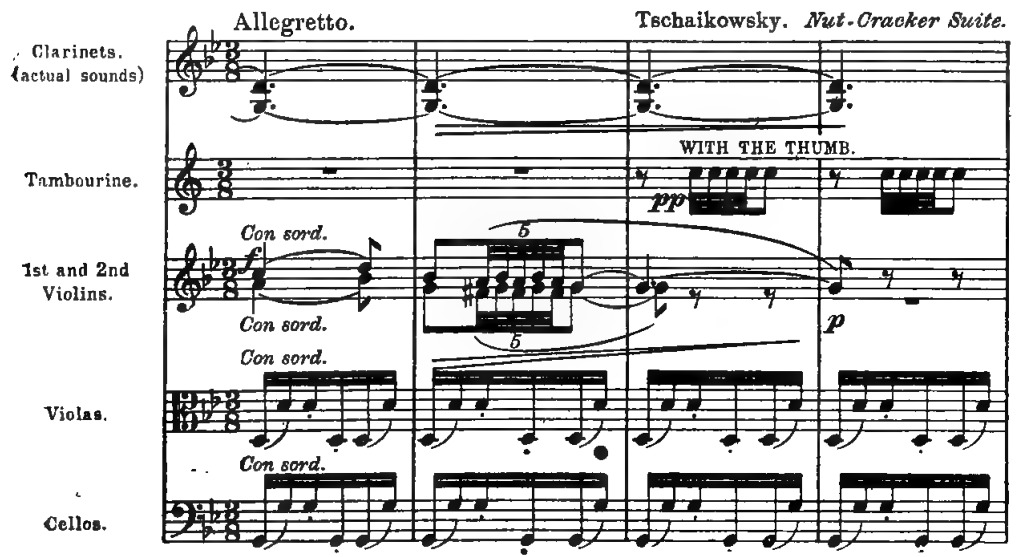
(3) By rubbing the thumb on the "head." This gives a partial tremolo made up chietly of the sound of the jingles.
1 Hence the old Scottish name for the instrument Swasche, Swesche, or Swische. « Item the tent October, 1576, gevin for an swasche...lilj li," from the Register of the Canongate. The Scots for Drummer was Swescher or Sweschman. For an early reference to the English "dromes and fyffes " see page 42 (foot-note).
2 There is some confusion in the German nomenclature, as Tambourin is used both for the Provençal Long-drum and for the Tambourine. 'The old English name for the Tam. bourine was 1 ymbyr (see toot-note, p. 41). In mediæval times it was sometimes furnished with a snare (Fr. timbre).
A fourth method may be mentioned, as it has been tried with success in the Theatre. It consists of tuning one of the Kettle-Drums to a drone-bass, placing the Tambourine on the Drum and playing on the Tambourine-head with the Kettle-Drum sticks. The resulting tone has something of the quality of a muffled Drum, but with a sort of "edge" added by the faint sound of the jingles.
The notation of the Tambourine is generally on a single line, or conventionally on a stave in the treble-clef
The sudden unexpected ff roll of the Tambourine is effective at moments of rhythmic excitement where a highly-coloured tone-scheme is called for. This is more particularly the case when the orchestra is playing in its upper register. The tone of the instrument, however, soon becomes tiresome. Its proper place is the Theatre.
The pp of the Tambourine Is less generally usetul. It may occasionally be employed with success in dance-rhythms, but it is as wel always to bring its notes into direct relationship with the rhythmical pattern of the music. When this is not done the instrument often has the misfortune of sounding like a copyist's mistake.
A good example of the Tambourine used in the real French style with rhythms of this sort
TaLi
pocof==p
poco f=p poco f cresc.
can be found in Berlioz's Carnaval Romain Overture. Another excellent example is to be seen on page 37 of the Full Score of Elgar's Cockaigne. The Tambourine has crotchets batutto colla mano and it is associated with the Bass-Drum, the pizzicato of Cellos and Basses and a tenuto for the 4th Horn.
t'he following short quotation is trom the Arab Dance of Ischal rowsky's Nut-Cracker Suite. It gives a neat illustration of the "thumb" method.
Example 5