 Playable Books
Cecil Forsyth · section 13 of 60
No. 9. The Castanets
Read and hear this section in the playable edition →Fr. Castagnettes; It. Castagnette; Ger. Kastagnetten.

There they were made not of brass but of chestnut (castaña). Under the name of Castañuelas they became the characteristic instruments of the spanish peasantry, and they have retained their popularity for • hundreds of years. So far, however, they have made little headway outside Spain.
Each pair of Castanets consists of two hollow pieces of hard wood, which can be clicked together by the fingers. The left hand usually plays a simplified rhythm on a larger pair—known as "macho," the male, while the right hand plays the full dance rhythm on a smaller pair—known as "hembra," the female. Several distinctions of variety are noted in Spain, but they are of no great importance.
The characteristic of the Castanet tigures is a simple quaver rhythm in triple time, in which the central quaver is split up either into semiquavers, into a semiquaver-triplet, or into demisemiquavers.
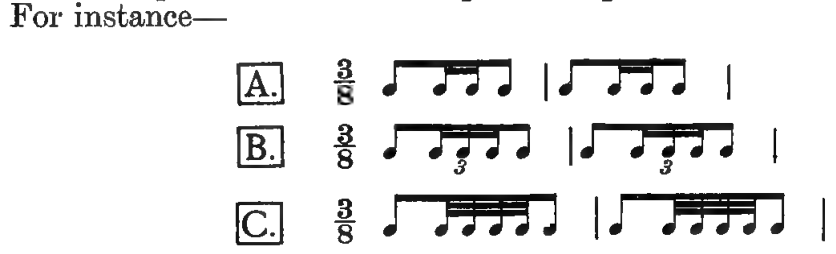
Other varieties of this formula are as follows:
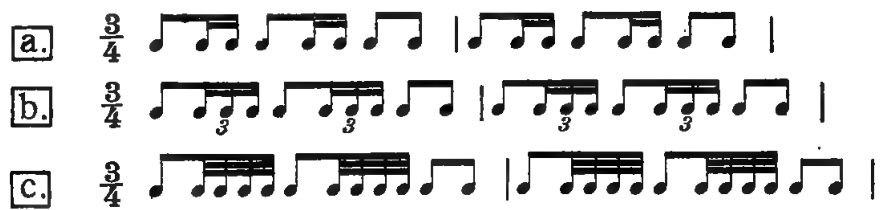
As a rule, the dancers or their companions keep the Castanetrhythms going throughout the whole dance. During the song, however, they are only used as an interpolation, four bars of Song and four bars of Castanets ad finem et nauseam.
Castanets are sometimes mounted, a pair at each end ot an ebony handle, for use in the orchestra and military bands. This is, however, a mere concession on the part of the South to the bloodlessness of the North.
In the Score of Samson et Dalila Saint Saëns prescribes the use of Castanets, both of wood and of iron.