 Playable Books
Cecil Forsyth · section 14 of 60
No. 10. The Rattle, the Wind-Machine, and the Anvil
Read and hear this section in the playable edition →The first two of these instruments are mentioned only because they have recently been used by Richard Strauss; the Rattle ("Knarre") in Till Eulenspiegel, and the Wind-Machine ("Windmaschine") in the 7th Variation of the Don Quixote set.
The Rattle is of the old Watchman's pattern, a wooden cogwheel which is revolved smartly against a hard flexible spring of wood or metal.
The Wind-Machine is not strictly a Percussion-Instrument at all. On the other hand, it is certainly not a Wind-Instrument, except in a facetious sense. However, it may be conveniently described here, and a few words will suffice for its description.
The sound-producing mechanism in the Wind-Machine is a sort of herel from which macho the stae bare is and o Tits side in e there is a covering of black silk. "bearing" supported by an open "cradle." It is then churned round with a handle, so that the silk comes into contact with a "face" of wood or cardboard
The instrument is used by Strauss to imitate the wind in the Episode of the Windmills, and the notation employed is a conventional C' in the bass-clef, thus,—
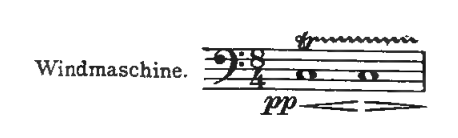
and the player is wisely directed to keep out of sight of the audience. The part is only ten bars long, of which nine are - These crescendos and diminuendos represent rather a raising and lowering of the pitch than an actual increase of force. In any case, the whistling eflect of the wind as it rises and talls is gained by a variation of the pace at which the handle is turned.
This imitation of the "felon winds" that blow "from off each beaked promonotory" may be itself imitated (pianissimo) in the seclusion of the home by means of two fingers and an umbrella.
Orchestral Anvils are really nothing but small steel bars made to imitate the sound of the real anvil as accurately as possible. They can be manufactured so as to produce either a definite musical note or an indefinite unmusical noise. A hard wooden or metal beater is used. Ihe Anvil has been written for by Verdi in Il Trovatore, by Berlioz in Benvenuto Cellini, by Gounod in Philémon et Baucis, and

Ine kherngold Anvils as they appear in the Full Score are eighteen in number. Wagner evidently intended them to be of three distinct sizes, threnin the treble def on a lange. They are written in nine
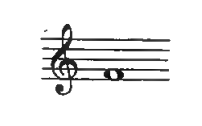
and six in the bass-clef on these notes :
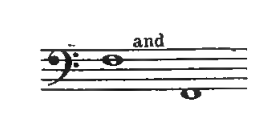
In practice the parts are almost invariably "boiled down." Few Theatres can afford eighteen blacksmiths.