 Playable Books
Cecil Forsyth · section 17 of 60
No. 13. The Glockenspiel'
Read and hear this section in the playable edition →

Er. Carillon (or Jeu de l'imbre); It. Campanetta.
toy hit ation on oh 2 cesa bachardost, Has bells were of the tiniest and lightest, and varied in compass according to the maker's discretion and the composer's requirements. Händel's set in Saul has a
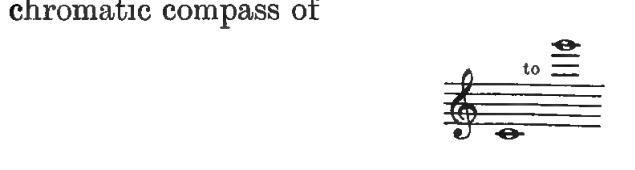
and he writes for them as "transposing instruments" at a fifth below their actual pitch.
Example 21

Mozart's set for Papageno's music in the Zauberflöte has a chromatic
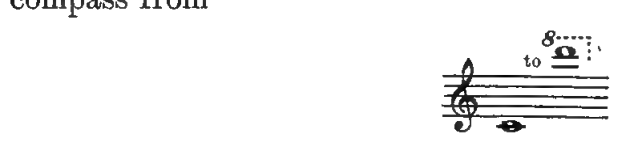
and he also writes for them as "transposing instruments," but at an octave below their true pitch.
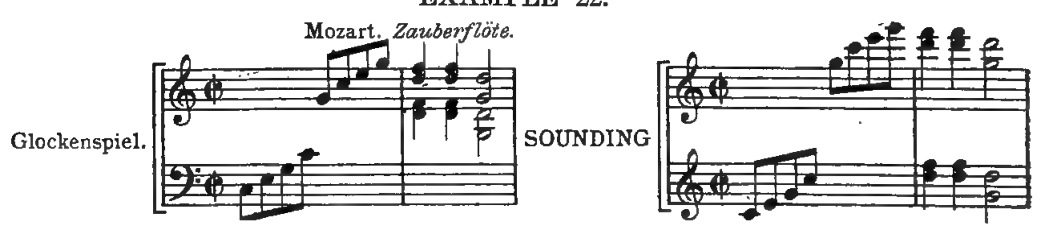
Alter dropping out of use for half a century, the Glockenspiel has now returned, but—like Bottom—"translated.' It is no longer a set
The correct English for Glockenspiel is "Chime-Bells.". This might well be Chimes of small bells are represented and described in England from the eleventh century onwards.
of little Bells, but a series of steel plates. Its keyboard is gone and,
instee to stayer us pat con or of locken it in his country are (1) An instrument of twenty-seven chromatic notes from
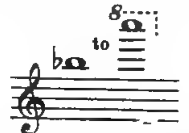
(2) An instrument of thirty-seven chromatic notes from
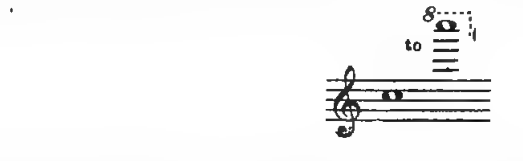
" In the best instruments the plates are mounted ladder-wise in two parallel rows on a horizontal surface. Of these two rows the plates making up the diatonic scale of C major from
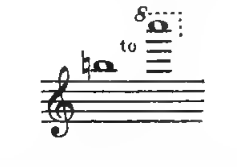
run in a direct line away from the player on his right-hand side, while the brate is an as are sy-tuned placia, bes on tor Which very greatly enhances the brilliance of the instrument.
The Glockenspiel-part is written in the treble-clef two octaves below its actual pitch. The following written arpeggio will, therefore, include the whole compass of the smaller instrument (No. 1) described

The student is recommended to keep within the compass of the smaller instrument, as the full three-octave Glockenspiel is not found everywhere.
There are, naturally, many varieties in the manutacture of the Glockenspiel. In the Tubuphone the plates are replaced by small tubes of metal. These are arranged exactly like a Planoforte-keyboard with the "black notes" oxidized. The scale is the usual chromatic series of twenty-seven notes.
A charming little Glockenspiel with a fairy-like tone is made of bell-metal plates titted with resonators. Perhaps the most successiul innovation of all is the application of huge watch-case or shell-shaped resonators to the small plates.' The latter are at present only made
1 Known as "Marimba Gongs."
in the diatonic scales of G major and Eb major, and in various harmonic sets in El. A chromatic set made to the standard Glockenspiel pattern
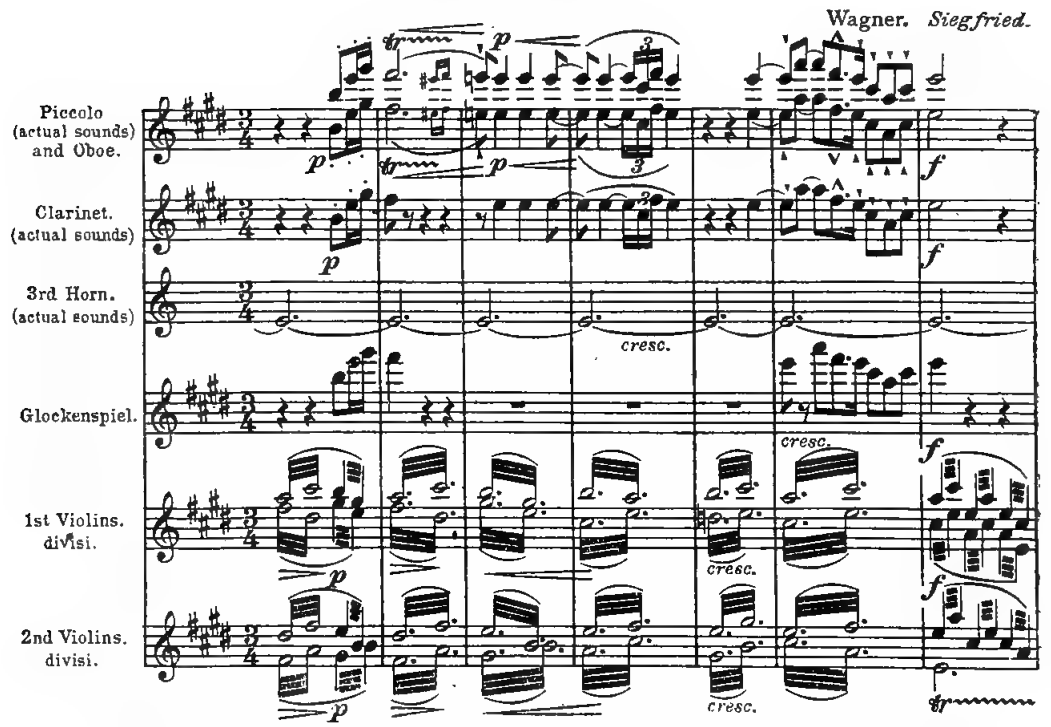
The tone of the Glockenspiel is bright and rather startling. Played, as it usually is in this country, without a keyboard, it is yet capable of a certain rapidity of movement. With a mechanical action it can, of course, be treated as a tiny Pianoforte. But the student should remember that owing to its resonance and extremely high pitch very rapid successions of notes tend to sound "jumbly." Its main use is to "brighten the edges" of a figure or fragment of melody In conjunetion with the upper octaves of the orchestra. Strictly speak. ing, one may say that it combines with nothing. And this is its virtue. When even in a tutti it is linked with Piccolo and Eo-Clarinet no turther doubling is needed to make the part prominent. The best examples of the Glockenspiel are to be found in the Finale of the Walküre, and in the Waldweben (Siegfried). The following quotation is from the latter work. It shows the Glockenspiel in a threemelodie combination with the Piccolo, Oboe and Clarinet. There is a soft "fingered-tremolo"' background for Violins in four parts. The part is written according to Wagner's usual method, only one octave below its actual pitch.
Example 23
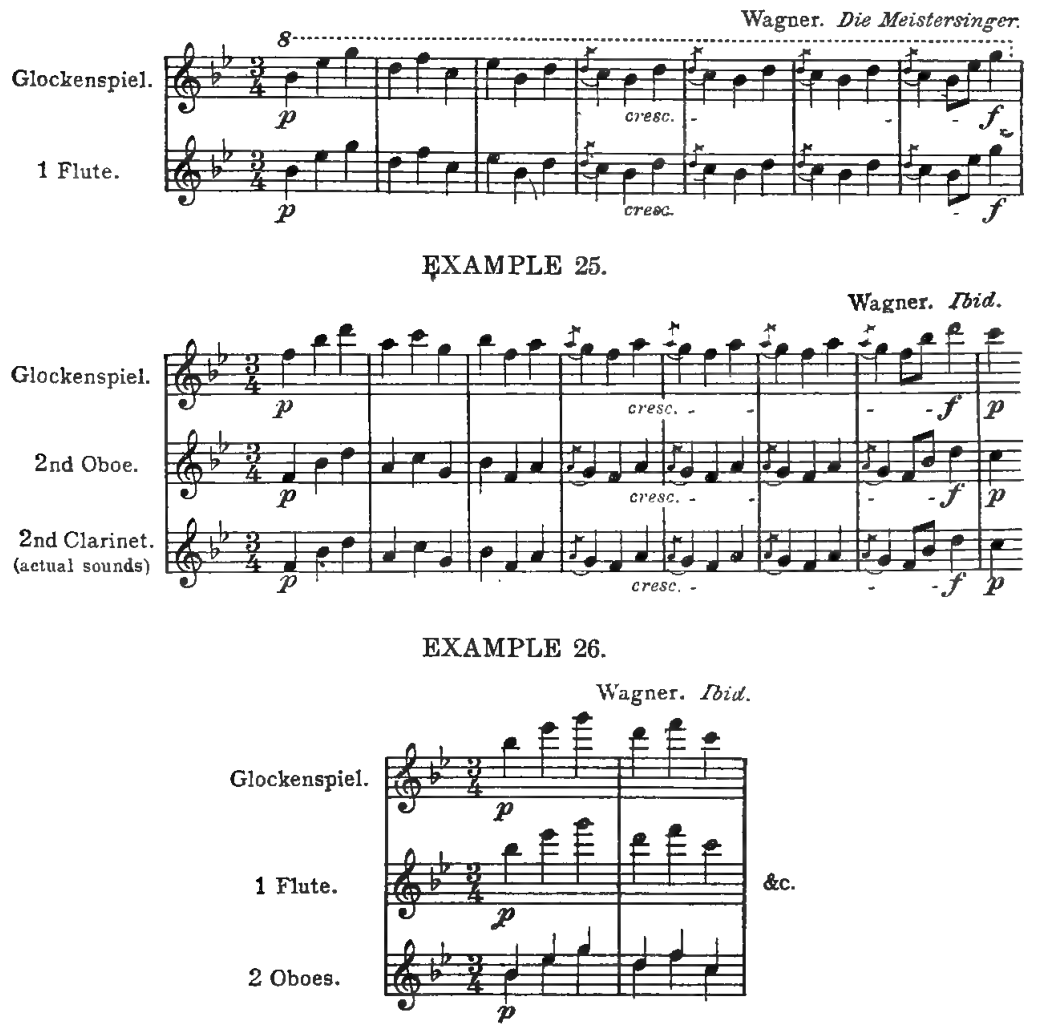
As the Glockenspiel is continually used in the manner shown above, that is to say, in octave-combinations with the Wood-Wind, it may be as well to draw the student's attention to an instructive passage in the
1 See page 356.
Meistersinger. It occurs in the Waltz-tune (Act III.). The same phrase is played three times by the Glockenspiel, but each time with a slightly different arrangement in the Wood-Wind. The accompani- Inent, omitted below, is practically the same in all three cases, four Horns tenuto with pizzicato Strings! The student should examine these three arrangements and then note the difference in performance, especially the difference produced by the high Flute-notes in No. 3.
Example 24
Note. A toy instrument, which at one time excited serious attention and speculation, was known as the Harmonica. Urginally it consisted either oi circular glass plates in a trough of water, or of drinking-glasses partially filled with water. The sound was produced by rubbing the glass with the tingers. The pitch varied according to the size of the glass plates or the amount of water in the drinking. glasses. This toy developed into the Reyed-Harmonica, an instrument in
1 In the first Example the Cellos and Basses are "arco," and there are two Bassoons holding notes. The quotations are from pages 471, 473, and 475 of the Full Score.
which a series of glass plates was struck by light hammers. A simplified Pianoforte-action controlled the hammers, and the compass was from
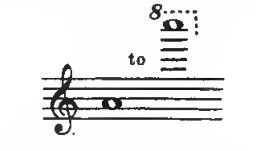
It was treated as a transposing instrument, and its part was writter an octave below the true pitch. Its tone seems to have been some thing like that of the Celesta, only more flutey.
No. 14 The Celesta.
This instrument was invented by Mustel, and is scientifically interesting as being the first instrument to which the principle of the resonator has been applied.
Some misapprehension seems to exist as to its exact mechanism. Gevaert 1 and Widor 2 make the statement that M. Mustel's Celesta is an arrangement of tuning-forks struck by hammers. This is quite incorrect.
The Celesta consists of a series of small steel bars or plates. These are set in vibration by hammers. And the hammers themselves are set in motion by a simplified Pianoforte-action controlled from an ordinary Pianoforte-keyboard. The peculiar beauty of the tone is partly due to the fact that under each vibrating steel bar is an accurately-tuned resonator of wood. Attached to the instrument is a pedal which materially enhances its sustaining power. The Celesta
Originally the instrument was made with a compass of five octaves. The bottom octave has now been abandoned, owing to its unsatis-
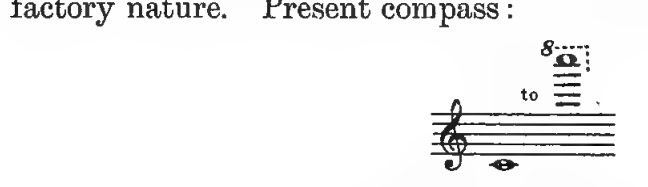
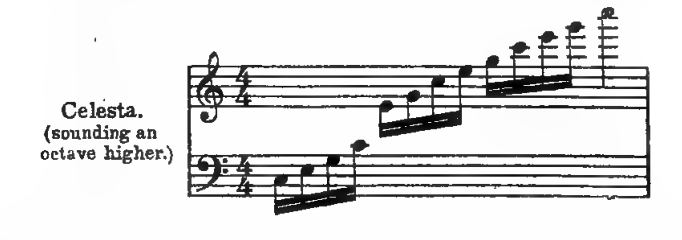
It is written for on two bracketed staves like the Pianoforte, but an octave below its actual pitch. The treble and bass-clefs are used at discretion. The following written arpeggio takes in its full compass:
1 A New Trentise on Instrumentation. Translated by E. F. E. Suddard, page 328. 2 The Technique of the Modern Orchestra. Translated by Edward Suddard, page 123.
It is almost unnecessary to say that the instrument is chromatic the about its entire in sume acca be ted in my desired be. pale to guy ten gad a pith a fair is rain. chord-work. It is delicious when picking out a fragment of melody with a light accompaniment of Wood-Wind or Strings. When treated thus, however, the melody-notes must not be too long, as the instrument lacks the ordinary orchestral sostenuto. The light, the fanciful, and the graceful are best suited to the character of the instrument. In the theatre it is less effective than in the concert-room.
An example of the use of the Celesta is to be found below under the heading, "Bass-Clarinet." 1 In the Nut-Cracker Suite, from which it is quoted, Ischaikowsky writes the part at its actual pitch. This is done merely because the Pianotorte is indicated in the Score as a substitute.