 Playable Books
Cecil Forsyth · section 16 of 60
No. 12. Bells
Read and hear this section in the playable edition →

Fr. Cloches; It. Campane (or Campanelle); Ger. Glocken.
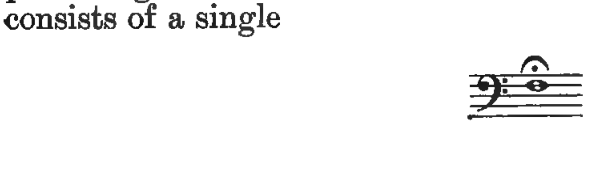
There is no need to describe this instrument in detail, but one may say at the outset that the church-steeple variety is never employed in the orchestra. Such a bell, even it it is to produce a note no lower than middle C,
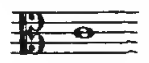
would have to be over twenty tons in weight. This makes it an impossibility in the Concert-room and in the Theatre. The largest theatrical bells in actual use are said to be those at the Paris Opera House. They were cast at Meyerbeer's suggestion to ring the Bartholomew's toesin in Les Huguenots. Their pitch is
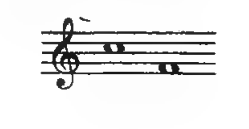
and Meyerbeer writes their part an octave lower. To the ear, of course, they give the usual bell-illusion of being one or two octaves lower than their real pitch.
Apart from their weight, there are serious obstacles in the way of using real large bells in the orchestra. The ditficulty, however, is that the large bell of proper shape and substance is the only one which really "sounds like a bell." " Unlike any other instrument, it has two distinct notes, the tup-note, which is governed by the disposition and quality of the metal, and gives the actual pitch, and the hum-note, which depends principally on the shape of the casting, and gives a note to get rid of the weight and yet preserve the quality. Untortunately, up to the present leave us with a very obvious answer to the question, "When is a bell not a bell?"
The first substitute is the Saucer-shaped Bell cast in bronze. This type of bell is fairly satisfactory in the Theatre, where it can be mounted permanently in a massive wooden frame. For concert work, however, it is still tar too heavy to have any practical value. When properly struck, it gives a good solid note, but one must remember that it never descends to the deep leger-line bass-notes which composers generally amuse themselves by writing. As we have already mentioned, there is always an illusion in these matters. A composer who writes
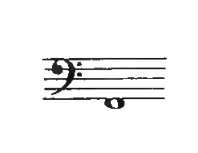
will, undoubtedly, get something much nearer
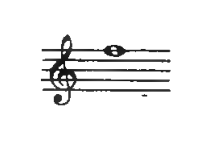
and be quite satisfied that he hears a deep note. The illusion is, of course, caused by the muddled series ot notes which make up the humnote. The ear of the musician dissects these as the higher harmonics of an ordinary musical instrument. He then naturally imagines the deep fundamental note which alone could produce them in a musical instrument.
The second substitute is the Tubular Bell. These instruments are made in sets, all of one diameter—either 1 inch, 1f inch, 1} inch, or 2 inches-but of varying length. They are light in weight, and therefore easy to transport. For concert purposes they are usually hung from a wooden bar, supported at each end by a sort of inverted V, thus 1. The stand folds up and holds the tubes in position for travelling. A damper is attached to the frame and worked by means

A set of these bells generally consists of a major scale of eight tubes, or a chromatic octave of thirteen. In either case, the tubes are selected from some part of this compass—
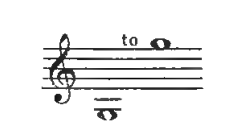
Below the bottom G three semitones are still possible, the Gb, F, and El, but these are of doubtful quality. The best tubes are the middlesized. An Eb scale of bells,
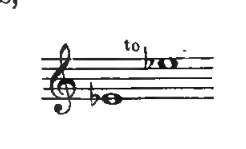
is a favourite, especially with Military Bands.
Considerable difficulty is experienced in eliminating the hum-notes at the top and bottom of the extreme compass. The makers' object is merely to produce a purely musical sound whose overtones shall have a close analogy to those of any ordinary musical instrument. The awkward point really is, that the more the hum-note is eliminated, that is to say, the more the bell is brought into conformity with our common ideas of musical pitch, the less the Tube sounds like a bell. The dilemma is one from which the composer, at any rate, cannot escape. For heavy cast-bells, however caretully used, always disturb, and in their turn are disturbed by the harmonic scheme of the orchestra. They "sound like bells," it is true, but the piteh-precision of the orchestra is directly opposed to their integral characteristics. The resultant combined sound quality is generally somewhat uncomfortable. Indeed, in the Theatre the best effect is often to be got by the discreet use of a heavy bell whose tap-note is absolutely removed from the orchestral harmony.
Composers, however, regularly prescribe deep bell-notes whose definite pitch is associated with the harmony of their music. Various attempts have theretore been made to suggest their eftect without actually employing heavy bells.
The most elaborate of these attempts is probably the Bell-Machine devised by Mottl for the Parsifal,—
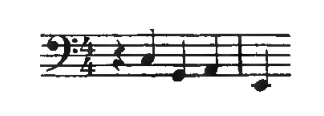
The appearance of this Machine is somewhat startling. It is as if an amateur carpenter had been trying to convert a billiard-table into a grand pianotorte, and in the course of his experiments had left the works outside. There is a deep sounding-board over which are strung heavy pianoforte wires, six for each note required. In each of these sets of six three are tuned to the octave above. The strings are set in vibration by a broad flapper or hammer loosely covered with cotton wool.
How little this sounds like a bell may be judged by the fact that at Bayreuth it was found necessary to employ at the same time four Gongs or Tam-tars, tuned to the pitch of the four notes. Even with this addition, the notes lacked the "ictus" (the tap) and the general buzz (the hum) of the real bells. A Bass-Tuba was therefore requisitioned and made to play

while a continual roll was performed on a fifth lam-tam. This instrument has apparently now been abandoned at Bayreuth in favour of a set of Tubes.
A single deep pianotorte-wire strung in a long wooden case is sometimes used for imitating a bell. Indeed, the musical sum-totals of a heavy bell and of a freely-vibrating pianoforte wire are much alike, except in the point of actual force. In this connection we may mention Satonott's recipe for the Parsifal bells. It needs only a grand piano behind the scenes and this music,—

No one seems to have suggested trying the class of Bells technically called "clockmaker's gongs." In view of their portability, they might be worth a trial. These "gongs" are lengths of coiled steel In large clocks they are struck by leather-headed beaters.

Bell-makers say that in opposition to the ordinary Bells which require space, and especially water, for their full effect, these "gongs" À "gong" of this sort, 9 or 10 teet in length, can be coiled so as to slip into the overcoat pocket. When enclosed in a light glass frame, and struck with a leather-headed beater it will produce a beautifully sonorous and solemn
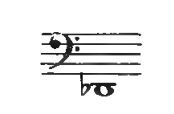
For orchestral purposes, these "gongs" could be developed from the coy-state in which they are at present. A special frame--a cube with one side removed—would have to be designed and mounted on a sound-board.
Mr. Frederick Corder has suggested an ingenious method for reproducing the actual harmonic effect of a bell in the orchestra. It
forte and sostenuto, played by four Horns and three Trombones in unison. Below it a Cello sounds the BI a diminished fifth lower molto vibrato; while above it two Flutes hold the chord
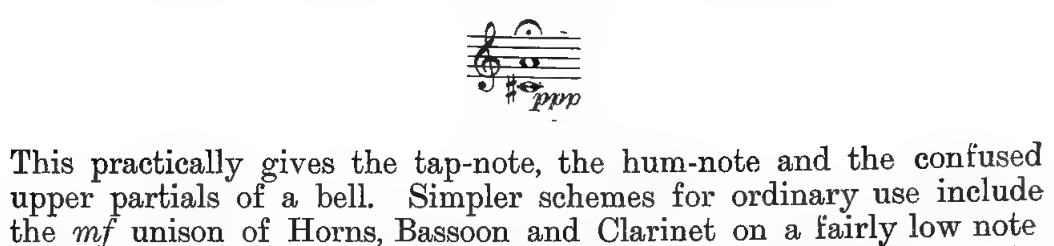
with the addition of a Cello pizzicato and a soft-stick-roll on the Cymbal, while a Harp or Glockenspiel sets the note free in the octave above. The addition of pop Brass as a background, with Flutes above, materially helps the illusion. This sort of recipe is, of course, useless, unless the music itself suggests a Carillon-pattern.
Of Bells in musical literature there are not many examples. are naively used by Bach in his Cantata for Contralto Voice, Schlage doch, gewünschte Stunde. Their pitch notes are B4 and El. The notation of the Campanella in this Cantata is as follows:
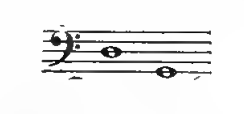
The actual octave intended by Bach is, of course, quite uncertain, nor is it clear why, in writing for the Bells as "transposing instruments in E," he should not have used the obvious notation of G, C. Query, is it merely a mistake of bass- for treble-clef ?
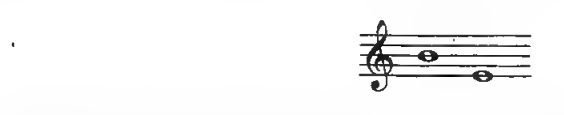
Sullivan employed a set of Bells in the Golden Legend,—
Example 15
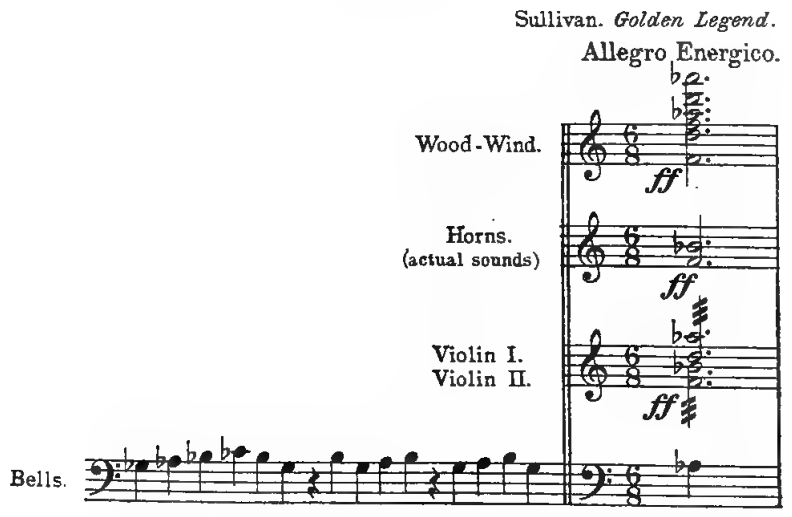
while Stanford has made effective use of a reiterated
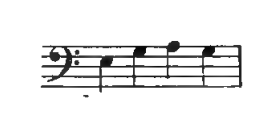
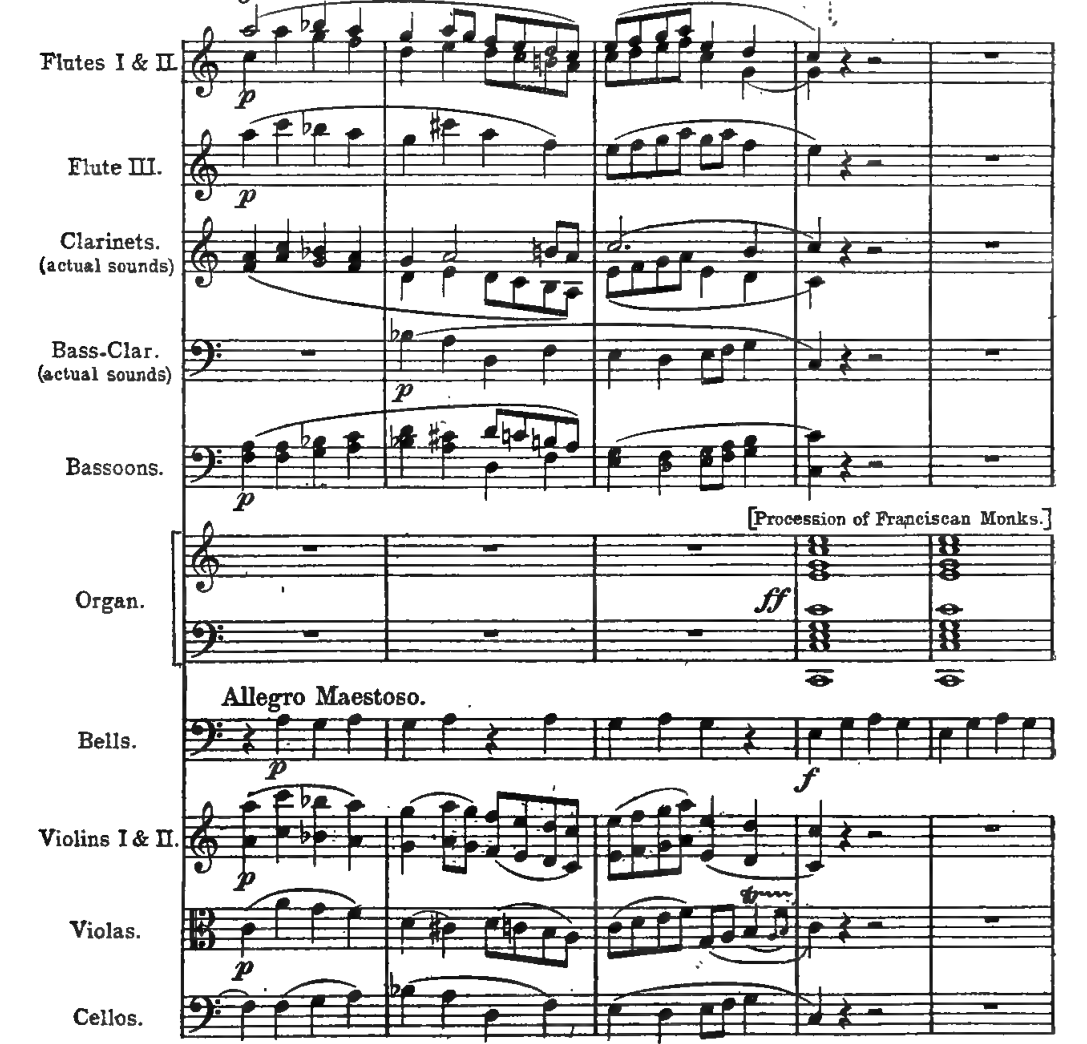
in the 3rd Act (the Church Scene) of his opera, Much Ado about Nothing.
Example 16
Stanford. Much Ado about Nothing.
"ictug" often the composer contents himself with suggesting the alone of the bell. Ihis effect, especially when it represents only the striking of a clock-bell, can Such is the midnight-chime at the opening of Saint-Sans's 'Danse Macabre, twelve little "tieks" on the Harp, which an unhappy Harpist has been known to extend to the unlucky number thirt een. The accompaniment is a single Horn "D, simo chord for Ist and 2nd Violins and Violas. The composer adds the stage-direction that if there is no Harp the "D" must be struck twelve times on a Bell or Tam-tam, "but pianissimo, and not forte, as marked for the Harp."
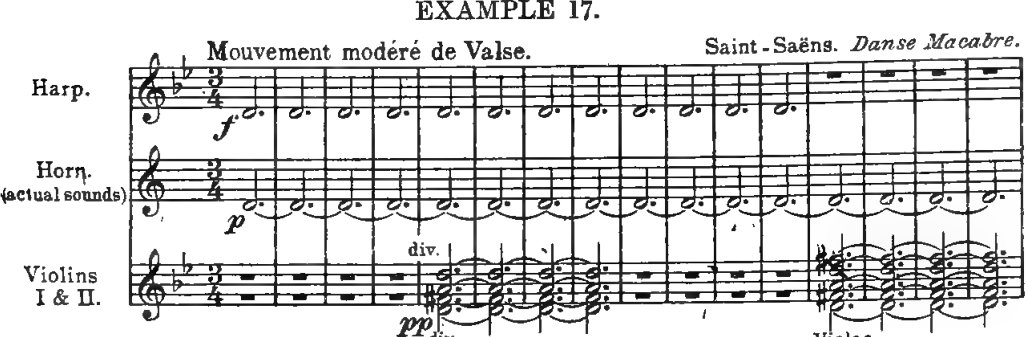
Saint-Saëns. Danse iMacabre.
div. Violas.
The evening and morning "Seven ơ'clock's" in Strauss's Sinfonia merely seven little p taps on the Glockenspiel Domestica are the second "Seven o'clock"— quoted below—there is only a miniature accompaniment of three Violins and a Viola, all muted. Here is the passage:
Example 18
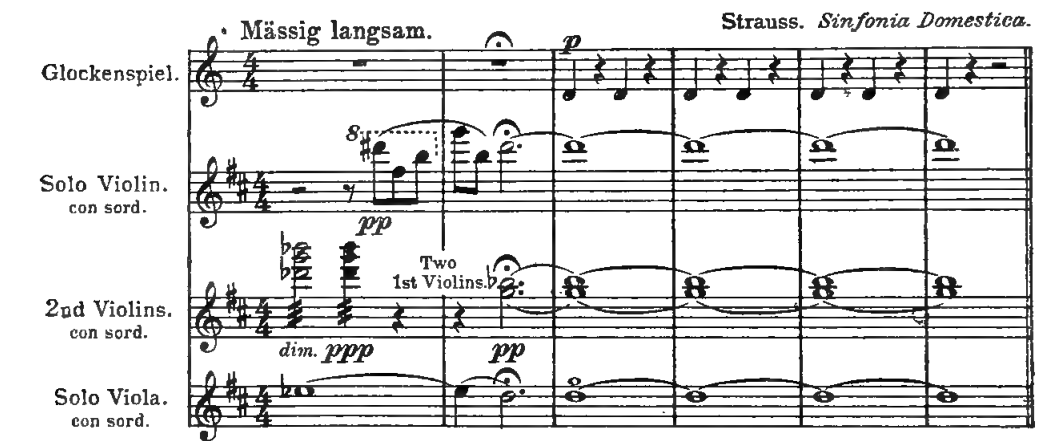
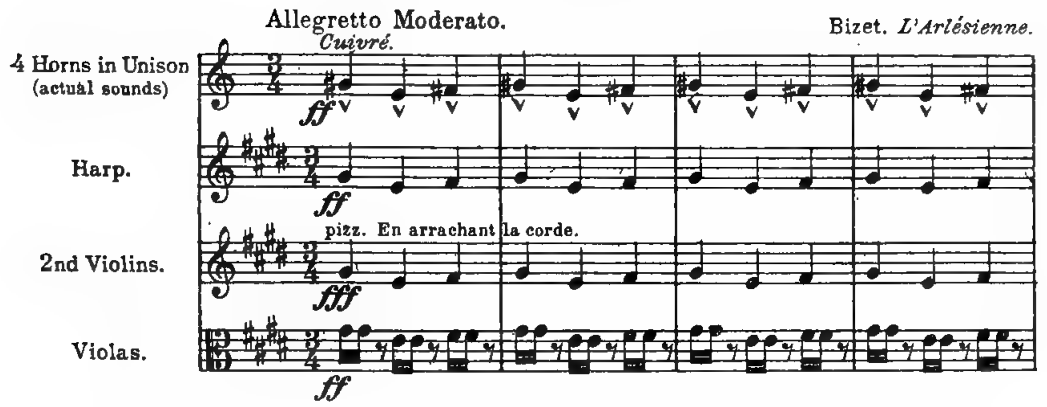
It need scarcely be said that bell-like sounds in the orchestra often depend for their effect on the associative ideas called up by the music. Instruments, perhaps sounding very little like a bell, repeat a passage which might well be executed by a peal of bells. The memory of the audience does the rest. Such is the Carillon movement in Bizet's Ist Suite, I'Arlésienne. It is founded on the continual bell-like reiteration of the three notes, G♯, E, F♯. The orchestration —four Horns "cuivré" 1 with the pizzicato of Harp and Violins, and the energetic repeated notes of the Violas-helps the idea. But the main effect is gained by the iteration, not by the sound-imitation. We can see the truth of this by trying to imagine what our answer would be if we were to hear only the first crotchet of these four bars and were then asked, "What does this represent?"
1 See pages 113, 129.
Example 19
Another instance of this association of ideas may be seen in Saint- Saëns's song, La Cloche. The composer uses a Horn to repeat an Ar in the last half of several consecutive bars. Now, a Horn sounds very little like a Bell, but the iteration of the note is just such an iteration as one might expect from a single Bell. The words of the song lead the audience to expect a Bell. So that when it actually comes the sound of the Horn is quite satisfactory as a reminder.
On the other hand, Wallace's little cracked bells in Villon depend for their success chiefly on their direct sound-imitation. The Triangle,
Example 20
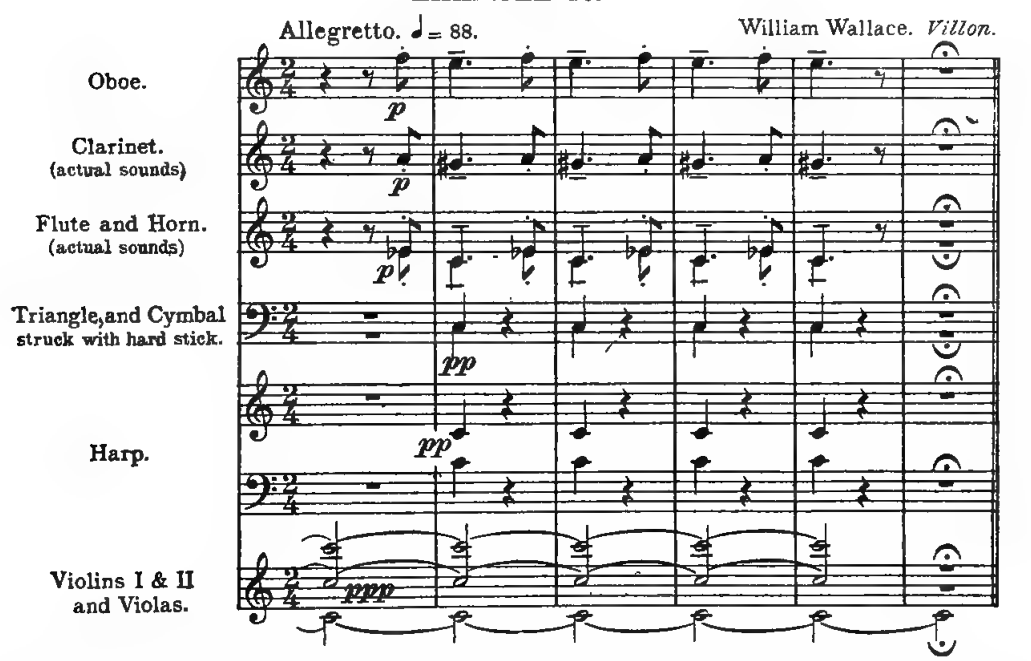
Cymbal, and Harp give the "ictus," while the false-relation between the Oboe and the unison of Flute and Horn reproduces the confused upper partials. The held three-octave C in the Strings supplies exactly the right orchestral background. This clever piece of scoring deserves detailed examination, the more so because it relies for its vivid effect on a sort of mental jugglery. There are the two sets of notes, the eight at the top of the score and the four in the middle. The mind, accepting them both as sound-imitations, is forced to hover between the two. The artistic deception is only cleared up on a paper analysis.