 Playable Books
Cecil Forsyth · section 19 of 60
No. 16. The Xylophone.1
Read and hear this section in the playable edition →
Er. Xylophon (popularly, laguebois) ar. Dilafone; Ger: Xylophon, Strokedel,
This is an instrument of some antiquity. Till recently it consisted of thirty-six little slabs of hard wood--walnut, rosewood, or boxach one of which had a slightly rounded or domed upper surtace These wooden bars were isolated on long thin bundles of straw and arranged ladder-wise in four interlaced rows. The two beaters were generally spoon-shaped and were cut from willow-wood. In this form
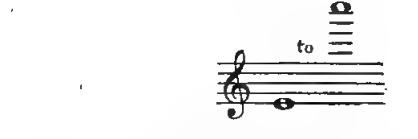
It was, however, awkwardly large, and it had this further imperfection
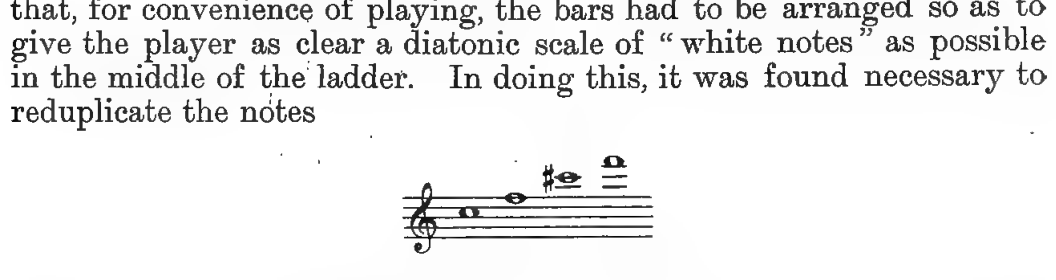
In order to counterbalance this convenience, and also perhaps to prevent too great a degree of pride on the part of the player, the top Bo was omitted altogether.
Nowadays this cumbersome contrivance has given place to a standard pattern of 27 notes arranged in two rows precisely like the 27-bar English Glockenspiel? Its compass, however, is an octare below that of the latter instrument, namely
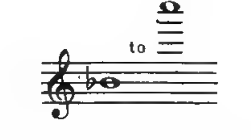
This pattern, which omits the ineffective portion of the compass, is ertectly satistactory for every orchestral purpose. It must, however,
e noted that continental Xylophones are still made on the old large 'pattern. Foreign instrumentation books all give the compass of the
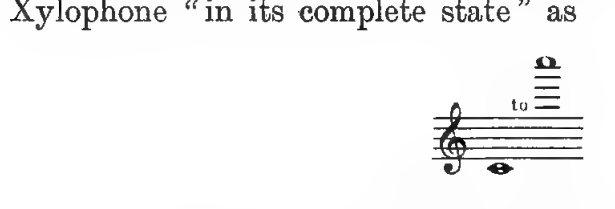
& See page 61. 1 From the Greek xulon = wood and phone = voic .
In the best English instruments the bars are made of hard rosewood. They are held loosely on their guides by screws, and have a complete set of resonators accurately tuned to their respective notes. beaters are light, and are made either of willow, spoon-shaped, or with a rather large globular head of boxwood.
To know what the Xylophone can do one must have heard a good player. Arpeggios, scale-passages, repeated notes, successions of thirds and sixths, and brilliant glissandos are all executed with accuracy and with a lightning-like rapidity. In fact, the technique is very much on the same plane as that of the Hungarian Urmbalom.
The Xylophone part is written on one stave in the treble-clef. The best way is to write the part at its true pitch. But, as usages vary in this particular, it is wise to say that you are doing so in your Score. Xylophone players know that its hard dry clatter is most etfective between the rough limits of
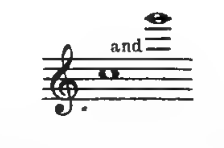
and therefore generally use their discretion as to octave. Saint-Saëns's well-known
Example 27
Saint-Saëns. Danse Macabre.

in the Danse Macabre is always put up an octave in periormance Mahler has introduced the Xylophone into Symphonic music. In' the Ist Movement of his 6th Symphony there is a part for the instrument with elective repeated notes of this sort:
Example 28

Holbrooke and Grainger have both written for it: the former in Queen Mab, the latter in his scotch strathspey and Reel.