 Playable Books
Cecil Forsyth · section 20 of 60
Brass instruments
Read and hear this section in the playable edition →Preliminary
BEFORE we begin to study the technical development of the modern Brass Instruments, we must devote a few pages to the early instrumental types from which they sprang. It need scarcely be said that neither the Horn nor the Trumpet began its existence in the comparatively perfect state in which it is usually first presented to the musical student. The beautiful seventeenth century Hunting- Horns and the orchestral Trumpets and Hand-Horns of the eighteenth century had a past. They were not sudden unexpected inventions, like the motor-car or the aeroplane. It is perhaps unnecessary to detail this past, but a bare outline of its prominent features will help the student to a better understanding of the various instruments as they appear in modern orchestral history. We shall therefore sketch this outline down to the days of the Hunting-Horn and the Natural Trumpet. From that point onwards we shall take up the subject with greater precision and combine its history with an account of the physical conditions which are common to all the orchestral Brass.
The original type of all the instruments which we are now discussing was undoubtedly an animal's horn or tusk, to the smaller end of which a cup-shaped mouthpiece was fixed. A simple instrument of this sort has been and still is in almost universal use. We must note that trom its very nature it is roughly conical in form. It must, however, be remembered that long before the Christian era some metal or other had been substituted for the actual horn or ivory of the original instrument. The model was easily imitated either by a casting in bronze or by means of a thin beaten ribbon of metal wound on a "core." So long as the instrument remained the actual horn of an animal, there was no possibility of musical development. But, with the first manufactured instrument, came the certainty of development. In length, proportions, and smoothness of bore, the player could be studied and variety could be obtained. Thus we find the ancient Romans in the centuries immediately preceding our era with a varied assortment of what we should call "Military Brass." 3
1 The "Olifant-Horn" carved from an elephant's tusk was a recognized mediæval instrument of music.
2 The Cornu, Lituus, Buccina, and Tuba.
In mediaeval times, the big metal Horn and its model, the Cow- Horn, existed side by side, very similar in shape, and both played with cup-mouthpieces. These were the instruments which were used by Huntsmen, Foresters, and Watchmen. They were often big handsome instruments, and were regularly employed by the mediæval Gilds and Corporations to sound the note of assembly.! However, as the manufactured instrument increased in size, it decreased in handi- It became unmanageable for the Huntsman. This was a serious difficulty in days when layman and even priest had almost no outdoor recreation but the chase.
The difficulty was solved by winding the tube into a complete circle. The Horn was then passed under the player's right arm and the bell projected over his left shoulder. It was, in fact, carried just like a modern "Helicon" or "Circular Bass." One cannot put a date to this improvement, but a guess may be founded on the fact that a Horn-player and his instrument are carved thus on a fourteenth century choir-stall in Worcester Cathedral? It is interesting to note, however, that the English, with their innate conservatism, always preferred the short metal Horn made roughly to the model of the actual animal's horn. This is the Horn that figures in our ballads, folk-lore, and legendary tales as the "bugle." On the Continent the longer form was preterred. In France the Cor de Chasse was introduced occasionally in the early part of the eighteenth century to accompany hunting-scenes in Ballets and Operas. It was then, so to speak, re-introduced to England as an orchestral instrument of foreign origin. And "French Horn" it remains with us to this day.
We shall return to the Horn in a moment. But meanwhile we have to consider two other instruments, the Trumpet and the Trombone. Early in the middle ages there existed two cylindrical brass instruments, the Claro (or Clarion) and the Buysine. From the eleventh to the fourteenth century 3 these two instruments remained as welldetined types clearly contrasted with each other. The Claro was the ancestor of the Trumpet, the Buysine of the Trombone.
The Claro was originally a short straight tube of brass, with a cup-mouthpiece at one end and a bell at the other. As with the Horn, however, an increase of length was demanded for purposes ot outdoor effectiveness. With an instrument so constantly used in camp and on the field of battle this necessitated an alteration of shape. And this alteration had to be directed towards greater portability and ease of management. In a word, somewhere towards the end of the thirteenth century the instrument began to be folded up. The folding, however,
" Many still exist, and some are even now in use. The Canterbury, Dover, Folke stone, Ripon, and Ipswich Horns are all well known. There are many others. earliest English reference to the Horn as a musical instrument appears to be in a Psalter in the Cottonian Library at the British Museum. The MS. is interlined with Anglo-Saxon, and its date is about 825. "Singao in fruman mondes horne."
" A reproduction of this carving may be seen on page 185 of Rev. F. W. Galpin's Old English Instruments of Music.
3 " De ilke orible bosyne him went to pe yeare: "com to pine dome.'" Dan Michel's Ayenbite of Inwyt (Remorse of Conscience), 1340.
was not in the slightest like that of the modern Trumpet. It was a farge Sa phenland, stact, if tested int will take the rinst ration of the Alto Saxophone (No. 3), page 167, and will bring the curve of the bell over so as to form an upside-down letter U, he will get a rough architectural plan of the early mediaeva. Clarion.
A Trumpet of this sort without "stays" was of course liable to continual damage. Accordingly, early in the fifteenth century we find the two curves of the instrument brought together in two planes for mutual support. They were not fixed-merely placed together, and then bound with an ornamental cord. This Trumpet had, however, more or less of our modern shape. At this period the word "Clarion" was more particularly applied to the folded instrument. "Trumpet" was reserved for the old straight instrument.' In the last stage of its evolution the folds of the military Trumpet were fastened to each other so as to form practically one rigid whole.
The Buysine was, like the Claro, a straight tube of brass with a cupmouthpiece at one end and a bell at the other. Unlike the Claro, however, it was of great length. We are in complete ignorance as to the manner in which the slide-mechanism was first applied to the Buysine. This is the more surprising when we consider the mechanical complexity of the change and the simple musical perfection of the result. All we know is that the slide was in actual use during the fourteenth century. To the instrument so altered the name Sackbut? was applied. In Germany, however, the old name was never dropped. The word Posaune, formerly Buzaun, is merely a collateral form of Buysine.
The Sackbut in its tully developed form was practically a Irombone. Indeed it is quite sate to say that a photograph of a sixteenth century Bass-Sackbut,' if included among the Trombones in a modern instrument-maker's catalogue, would scarcely excite the curiosity of even a professional player. It must, however, be added that some difference of opinion exists as to whether the slide mechanism was normally so arranged as to allow of the seven modern "Irombonepositions." *
Before taking up the more detailed study of the Brass Instruments as they were in the seventeenth and eighteenth centuries, the student must be intormed that the earlest device for increasing the scales of the cup-mouthpiece instruments did not depend on any of our modern methods. These methods, which will all be explained presently, are "crooks," " slides," and "valves." The first attempt was merely an
1" When, however, the long straight instrument was entirely discarded, the word Trumpet was used indiseriminately for the Clarion and the Field Trumpet, though in the agual historance oin thie they wend the lat, the sounding wite iver. lle lore, Old English Instruments of Music, page 204. The Thurner Horn was merely a folded Trumpet.
2 The Spanish word from which Sackbut is derived is used of a pump. It is evidently descriptive of the player's action..
* They were made in several sizes from treble downwards. 4 See pp. 83, 134, 139, 140.
analogy trom the wooden reed-pipes. In all these instruments the soitness of the materla made the lateral boring oi holes in the pipe easy and practicable. The idea was transferred to the cup-mouthpiece instruments, and it is worth noting that the invention was originally English and was in use as early as the tenth century. None of these "cup-mouthpiece instruments with lateral holes" has survived to the present day, but at one time they played an important part in the history of music.
The most respectable instrument of this family in point of antiquity and length of service was the old Cornett, known' also as the Zinke, Cornetto, and Cornet à bouquin. This instrument was originally made of horn, bone, or ivory, in three sizes. It afterwards developed into an instrument of wood covered with leather. 'It had six fingerholes in front and a thumb-hole behind, like that of the Recorders? Its usual office was to play the upper part or parts in the Sackbut-or Trombone-harmony. As the Sackbuts generally took the lower part or parts, no pressing need was felt for a Bass-Cornett. Towards the end of the sixteenth century, however, a French priest 3 invented the Serpent.* This instrument was of wood, pierced laterally with holes. It employed a big cup-mouthpiece, and was the true bass of the Cornett or Zinke family. The Serpent had to give way to the Bass- Horn ° and the Russian Bassoon, and these, in their turn, to the Ophicleide. They were all cup-mouthpiece instruments with laterally bored holes. The only other instrument which employed this principle was the Keyed Bugle, an early nineteenth century invention, which for a few years enjoyed great popularity. Its existence was cut short by the advent of the valve system and the superiority of the modern Military Cornet.
The student is advised to note carefully the peculiarities of the instrumental group just described. It comprises instruments made of brass (such as the Ophicleide) and of other materials (such as the Cornett and Serpent). But they all have a common method of toneproduction and of scale-variation. Not only are all the instruments in this group individually obsolete, but the technical method of varying the length of the air-column by means of laterally pierced holes is now unused by any cup-mouthpiece instrument. We shall have occasion to refer to this group once or twice in a later portion of the book. But as no instrument of this type figures in any Score later than Gluck, it will be unnecessary to deal with its general history any more fully."
1 Of course no connection with the modern valved-Cornet. 2 See page 181.
3 Guillaume, Canon of Auxerre.
• Described more fully on page 286. It is supposed to be identical with the Lysarden, an instrument which occasionally fgures in old English inventories.
5 No connection whatever with the "Horn" in its ordinary musical sense.
" It is confined to what we now call the " Wood-Wind."
7 The technical details of one of these instruments—the Keyed-Bugle-are given with some fulness on pp. 112-4. •Shorter articles are devoted to the other instruments. See Index sub "Bass-Horn," "Cornett," 'Ophicleide," "Russian Bassoon," and " Serpent."
The appearance of the ancient Cornett and the obsolete Keyed- Bugle can be gathered from the illustrations on Plate II. The former instrument seems innocuous and primitive to the last degree. must not, however, despise it for that reason. It played a considerable
in the sayabolaye to baline the trombones. y had a much shorter and less distinguished career. In tone-colour it came midway between the Horns and the Trumpets. Gevaert laments its disuse and regrets that it is not employed regularly to play the parts It is, he says, "the very instrument required to take up the part ot the ola Cornetto, and to serve as a soprano to the Trombones The two bass-instruments which correspond to the Cornett and the Keyed-Bugle, namely the Serpent and the Ophicleide, are illustrated later. See Plate VII., p. 174, and Plate X1., p. 287.
We must now resume our study of the Brass Instruments at the place where they became of importance in serious organized music, and the first point to establish is the physical tact which underles all their various technical methods.
The student is probably aware of the following facts:
(1) That if he takes a length of metal tubing with a mouthpiece at one end, he can, by stretching, his lips across the mouthpiece and blowing, cause the air-column inside the tube to vibrate:
(2) That by varying the pressure of his breath and lips—the latter technically called the embouchure-he can compel the air-column to vibrate in various ways, perhaps as a whole, in halves, in quarters, and so on, but
(3) That he cannot compel the air-column to vibrate in any fractions of the whole which he may desire, only in certain unalterable fixed fractions.
(4) That he cannot, by taking a longer or shorter tube, alter these fixed fractional vibrations: that is to say, that he cannot alter the lengths of the air-waves relative to each other, but
(5) That, in a longer (or shorter) tube, the whole of the air-waves, retaining their relative lengths to each other, become longer (or shorter)
Combining these five scientitic tacts into musical terms, we may say
(1) That from an open metal tube we can produce • a series of musical notes whose pitch relative to each other is always the same.
(2) That the longer the tube the lower will be the pitch of the series; and consequently that the shorter the tube the higher will be the pitch of the series.
This series of notes is commonly known as The Harmonic Series. It is of fundamental importance in the technique of all Brass Instruments, because, on them, no notes except members of this Harmonic Series can be produced from any given length of tube. The length of tube may be and is varied mechanically. But, given any length, the player is bound down to this one group of notes.
The intervals of this Harmonic Series are, for a length of tube which would give Cas its fundamental note,
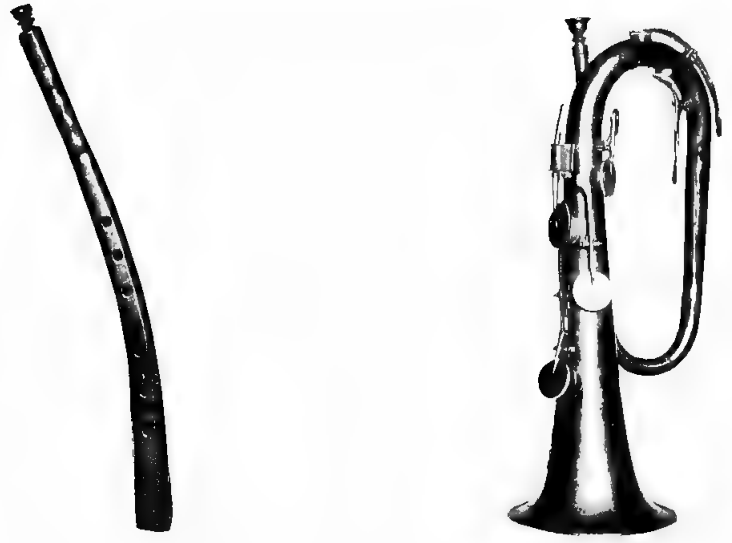
FI:. 2.—KuykD-BuGLE, tade by
FIc. I. -CoRNETr.
Charles Pace & Sun.
Facing p. 72.
By kind pormission of Messrs. Boosey & Co.

Of these notes Nos. 7, 11, 13, 14 are, according to our present ideas, out of tune. But this is not all. For, of the three original types of orchestral Brass Instrument, the two most important the Trumpet and the Horn—could not produce either No. I of the Series, or, for any practical purpose, Nos. 17, 18, 19, 20, 21.
We may boil the matter down into a sentence by saying that a player on the old Hunting Horn or the Military I'rumpet bad a reThe toire of 11 healthy and 4 decrepit notes only. Here is the list. good notes are printed in semibreves and the bad in crotchet-heads:

A player on one of these "natural" instruments was like a man continually hopping up and down a ladder, some of whose rungs were so shaky as to be a danger to lite and limb. At the bottom they were far apart and badly spaced, while at the top they were set so close together that he had great difficulty in getting his teet on them at all.
A Brass Instrument of the type which has just been described seems strangely impertect to the musician of to-day. We must not, however, forget that it is the instrument which served, at any rate for out-door purposes, from pre-Christian times down to about the early
day of th reeveator a moment to the question of the intervals which our early Brass-player had at his command. The student who appreciates the fact that the player was always perched on some one rung or other of a musical ladder may be inclined to ask this question,— Supposing this musical-workman's ladder were placed half-way up the front-door steps and he wished to get at some part of the wall which he could not reach from any one of his rungs, what did he do? The answer is simple. The "make" of the ladder could not be altered. But its position could. It could be placed one, two, three, or more steps lower down or higher up according to what was wanted. Only there was a limit both ways. It was not much good placing the foot of the ladder out in the road because of the passing traffic, and, if it were put too far up the steps, the workman was liable to break his neck while he was painting the attic window.
Now, in musical terms, the shifting of the ladder-that is of the whole Harmonic Series—was the plan adopted when people began to attempt the improvement of the Brass-Wind. And it was this improve-
They herate applied footie tum The freen tentivel and un" cesar y 618. appears in 1618 Trombones, and later still to the Horns.
ment which brought the Horn and Trumpet indoors. Hitherto they had been outdoor instruments, very good for sounding the death of a stag or for "duty-calls" in camps and barracks. But they were too rudimentary to be oi any serious use in organizea music. The Horn, now that it had at any rate a possibility of development, was unwound trom its player's body and coiled to a size convenient for handling. Its "bell" no longer pointed over his head or under his arm, but lay, where it was most wanted, next to his right hand
A mechanism was found by means of which the Trumpet- or Hornplayer was no longer confined to his one series of notes. The pitch of this series had always depended-as it still depends-solely on the length of his tube. Hitherto this length was unalterable. It the tube were of such and such a length he could only produce, let us say, the "C" Series of notes: if it was so much longer he could produce the Thine to how, theve his the
This was the first great revolution in Brass instruments, and its results were fairly satisfactory to everyone down to about the year
The The technique of this revolution was remarkably • simple. composer having made up his mind what special series he wished, directed the player to put his instrument into that key. The player, on his part, supplied himself with a complete set of neatly coiled brass tubes, called "crooks," 1 which he could insert into the main length of his tubing. All these crooks differed in length. No two were the same, and each "crook," therefore, when fixed to the instrument, represented a different key.
' Thus, if the composer wished to have the "F" Series of sounds, he marked the Horn-part in his Full Score, " Horn in F.". The player then took his " F crook inches long and fixed it to his Hoece It istrue that he could now do so dare 4 bad notes, be with his bo cone Hannone Sow sounded a perfect fifth lower.
But notice here two small points: (1) The blowing with the new crook was not quite the same. The "embouchure," that is to say, the pressure of the lip, varied according to the length of the crook. For a very long (ve. low-pitched) crook the embouchure was very loose: to a very short (v.e. high-pitched) crook it was very tight. And this difference became so great between the extremely high and the extremely low crooks that it was almost impossible to jump from one to the other. Furthermore, on the very low crooks the bottom notes of the series demanded a lip looser than any human being could accustom himself to. These low notes, therefore, were unplayable. Similarly the very high crooks called for such a preternaturally tight lip that their top-notes were out of the question.
1 Called by the Germans Bogen, short for Krummbogen.
(2) As in the case of the Kettle-Drum, neither composers nor players wanted to see the actual notes which they were sounding. Composers theretore went on writing only the series which was produced trom the direction at the beginning of the Score, Horn in Or goon in by the fundamental note "C." The actual sounds
and so on. The composer wrote, for instance, the notes C-E-G. It he olaced the words "Horn in Eb" at the beginning of the part thej sounded "Eb-G-Bb." If he wrote " Horn in F" they sounded " F-A-C. In fact, the written notes C-E-G, etc., were no longer pitch-notes at all, but only directions to the player to "blow Harmonies Nos. 4, 5 and 6." The instrument had, in short, become what is known as a Transposing Instrument, and the musical hieroglyphic
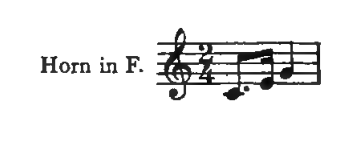
had come to represent the sounds
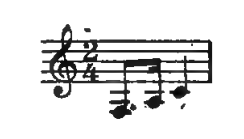
This is a type of what was and still is the ordinary notation for all Transposing Instruments. But in the case of the bottom notes of the Horn there was another convention. This convention, which has persisted to our day, consisted in writing them in the bass-clef, but an octave too low. There is not a word to be said for this foolish custom. The only reason tor adopting the bass-clet at all should be the avoidance of leger-lines. tion which oaly adds a complication ay about a protended simplifies- However, the student must be trepared to find is all old and in some modern scores sach notes as

In order tojascertain the actual sounds he must tirst put these notes up an octave to rectity the conventional transposition, and then down a perfect fourth to get the crook-transposition. By doing this he will see that the real sounds are
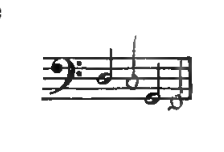
Furthermore, he should notice that, if the first example just given is written in the bass-clef without the alteration of an octave, it does away with the two leger-lines altogether. In his own practice the
1 See pages 414-5.
student is advised, on the score of logic, that if he uses the bass-clef at all—it is rarely needed—to use it at its proper pitch. If he wants, let
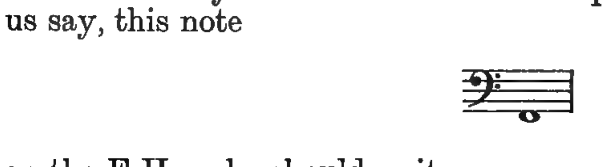
on the F Horn he should write
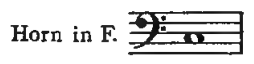
not
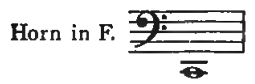
A clef ceases to have any logic at all when its pitch is disregarded
We must now return to the question of the Horn-mechanism as employed by the classical masters. We have already sufficiently explained how the invention of crooks gave the player the opportunity

using. But, in addition to that, another change was made in the tive orchestras as an experiment, and was still played with a out-door tone-quality. Îts "bell," however, as has been already said, now lay close to the players right hand. In the course of some experiments made with the object of subduing the instrument's coarse tone it was found ' that the insertion—or the partial insertion-of the hand in the bell not only stifled the tone, but lowered its pitch anyching trom a traction of a semitone to a whole tone
From this discovery came a new series of notes, totally distinc trom, but still dependent on, the old Harmonie Series. These notes were called "hand notes" or "stopped notes," as opposed to the "open notes " of the Harmonic Series. For instance, where the Horn-player was before only able to produce such open notes as

1By Hempel, a Dresden Horn-player, about 1754. He it was who brought out the Inventionshorn, an instrument in which the crooks were inserted into the body of the instrument, and not merely added near the mouthpiece. This instrument was also the first put a gir opening divered the wind sram to tan at un at to i ene to have the U-shaped slides which acted as compensators.

and an additional mechanism gave a lowered pitch on both instruments. complete mechanism was, in fact, four Horns in one.
he could now take these, as stopped notes, to sound
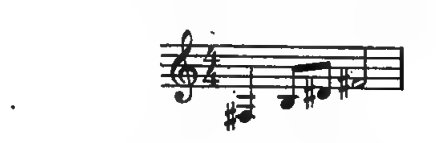
The Horn had now become partially chromatic. But the student must remember
(1) 'That the new stopped notes were of a quality so muffled and so different from the open notes that they practically sounded as if played on a different instrument.
(2) That they could, therefore, only be used advantageously (a) to humour the notes of the Harmonic Series which were already slightly out ot tune; (0) as passing notes, where they were only audible for the fraction of a second between two good open notes; (c) as "special-effect" notes, where a dull and muted tone-quality was wanted.
(3) That, though these notes were fairly accessible on the Horn, they were absolutely out of the question on the Trumpet. That instrument projected straight out in front of the player. tore, not be inserted in the bell, and only the old Harmonic Series of notes could be sounded. The system of crooks, however, was applied to the Trumpet much as it was to the Horn. Fewer crooks were in general use on the Trumpet, and its favourite crooks were not those most congenial to the Horn. Otherwise the system worked in much the same manner on both instruments.
From a consideration of paragraphs (1) and (2) the student will be able to appreciate the reasons why the use of the stopped notes never became part of the ordinary orchestral routine of the classical masters. Even in Beethoven's music they are the exception, not the rule. need only glance through a few volumes of his Scores to see that except where the Horn is brought prominently forward as a Solo instrument-and therefore must go outside the narrow range of its Harmonic Series—it still sticks to its accustomed C's, G's, and so on. In a word, the stopped notes and the open notes differed so markedly in tone-colour that they could only rarely be brought into action together. Meanwhile the fundamental character of the instrument remained unchanged, and the composer relied prily hi on thad this editure demo useful cries open totes. into any key by means of the crooks.
The actual number of crooks used in Beethoven's day for the Trumpets and Horns combined was fifteen. In the following complete list a note is placed atter each crook to show the actual sound which would be produced by that particular instrument when playing the written note,-
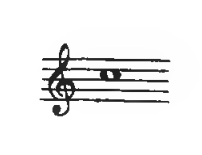
Horn
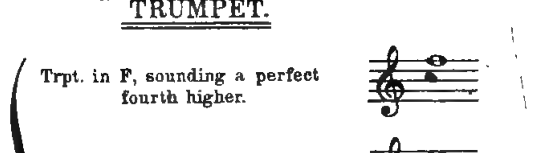
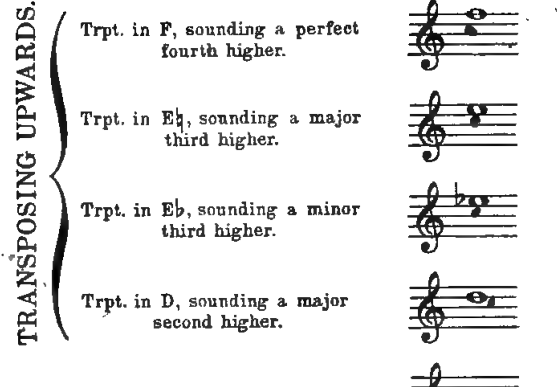
Trpt. in Eg, sounding a major
Trpt. in Eb, sounding a minor
Trpt. in C, sounding as written
Trpt. in B4, sounding a minor second lower
Trpt. in Bb, sounding a major second lower.
Trpt. in A, sounding a minor third lower.
Transposing downwards

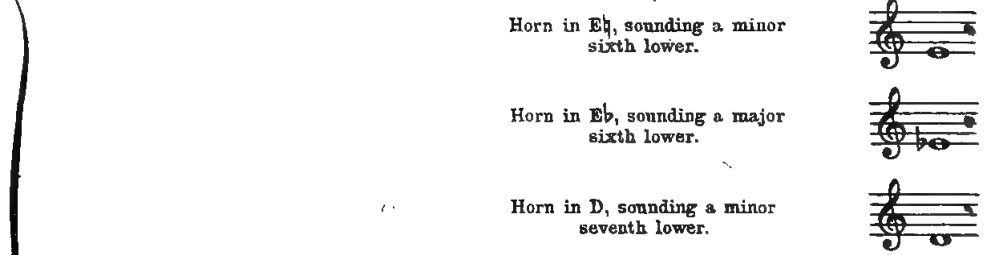
Horn in C Fave lowerading an
Horn in Bh Basa Laending a major
Several other Horn crooks-the C-alto, the Bi-alto, the Ab-alto, the Db, the Bi-basso and the A-basso-existed as workshop curiosities only. The Gb (FF) crook appears to have been used once only,-by Haydn in his farewell symphony. Un the Trumpet no Do crook was used nor any higher than F.
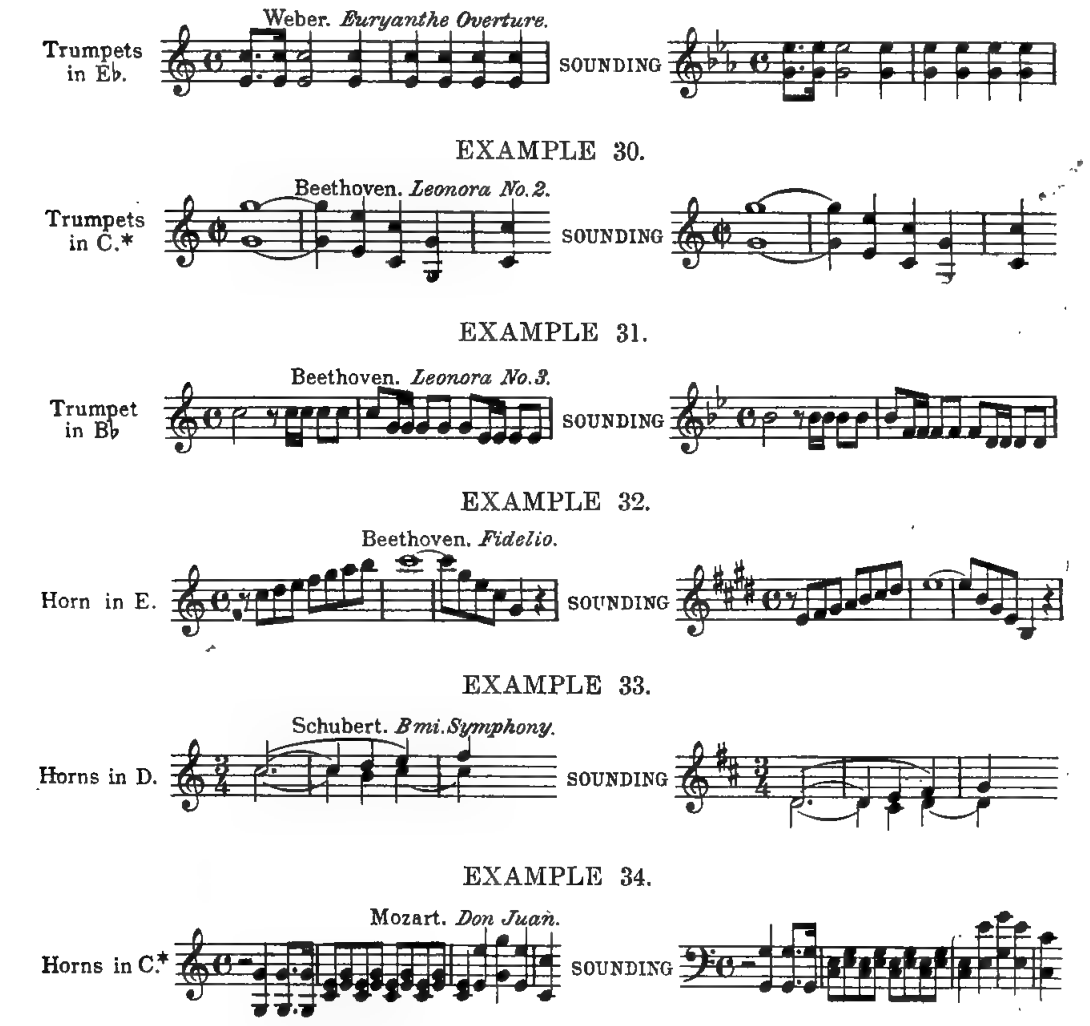
In order to make the transpositions of these crooks perfectly clear, six short passages are subjoined. In each case the written môtes are given on the leit-hand side of the page and the actual sounds on the right.
Example 29
Before proceeding further with the history of the Trumpet and Hooked moblem, ille solutioffer inchare shedent he following "crooked" his ingenuity.
Symphony by Haydn sometimes called No. 24 There is in Messrs. Breitkopf and Härtel's edition now progressing it is

It was evidently written tor two Horn-players of specially brilliant attainments, for (1) the part is marked "Corni obbligati," (2) in ar early set of parts at the British Museum the first Horn has the follow-
*Horn in C"always means "Horn in C-basso" i.e. "Horn transposing down On the other hand, "Trumpet in C" an ootave. The high C crook was never used. means 'Trumpet sounding the written notes in the same octave"
ing passage in the second movement accompanied only by muted strings:
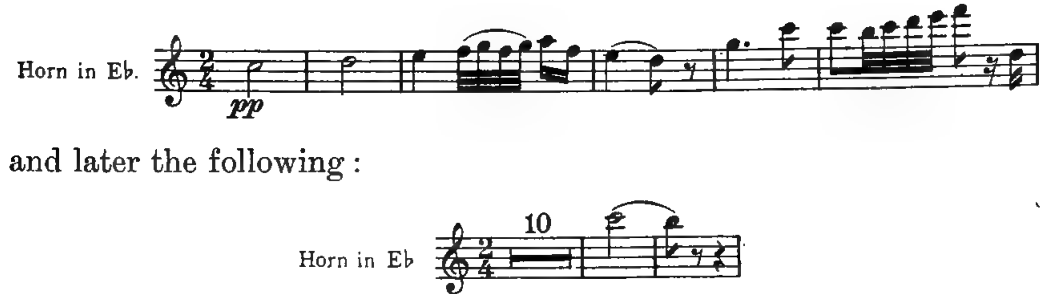
The former passage is altered in one of the published full scores so as to bring its highest notes down an octave. "Meanwhile the second Horn has to play such passages as this:

"The tirst Hor Thas he fo ports are marked "Corni Now, in the "Minuet and Trio," obbligati in Bb."

the third bar of which is simplified in some editions by the omission of the 2nd and 3rd notes of each triplet. The second Horn, however, in the same movement, has the following :

The bass-clef note occurs several times, and in each case the clef is carefully written in and afterwards contradicted. In one edition, however, the bass-clef is omitted each time, leaving a note which does not exist on the hand horn.
Query. Is the crook Bo-alto or Bo-basso?
We may now return to our Trumpet and Horn at the stage where we left them. It was the type of Trumpet and Horn which sufficed for Bach, Händel, Haydn, Mozart, Beethoven, Weber, and Mendelssohn, a type imperfect and limited in scope, but which-especially in the case of the Horn-called for the highest artistry on the part of the prayer, ana gave the composer a series of notes restricted, indeed, in number, but of a purer quality than any to which we are accustomed at the present day.
There is a general disposition to regard the classical masters as always labouring, and consciously labouring, under a terrible handicap in the matter of their orchestral Brass. This is, however, quite wrong. We are regarding the matter far to much from our own musically developed point of view. In the first place, up to Beethoven's day music seldom strayed through chromatic chords, and almost never made permanent excursions "far away from home." The Horns and Trumpets in the key of the piece met every emergency. When, in Beethoven's time, the music of a movement began to go further afield, it was possible to write one pair of Horns in the key of the piece and the other pair in the key of the principal modulation. Or, again, a special crook could be used for a special harmonic effect. (Andante in Ab of the 5th Symphony, Horns and Trumpets in C. Scherzo in # ot the ith symphony, Horns and Trumpets in D.) crook could even be made for an isolated phruse-Eroica Symphony, where the first Horn in Es takes the F-crook for

Then, again, we must not overlook the fact that the special "harmonic" type of melody was, and is, fundamental to one class of emotional effect. The substitution of a chromatic for a harmonic compass in a Brass Instrument does not affect the psychology of its true appeal in the slightest.
Still, even in Beethoven's later life, there were signs that composers were calling for a more even and a more extended Brass-technique. It was felt as a disadvantage! that the orchestral Brass could take very little melodic part in the orchestra unless the tunes were of what we may call the "boy's brigade" type. In the p and the mp, where nothing but a quiet sostenuto was called for, the Brass Instruments were admirable. But when it came to the f and the It, they could only blare away at unimportant notes and increase the noise. In fact, their usual business was to "take part in a conventional tutti," and, as their notes were often quite subordinate or even opposed to the musical matter in hand, the result was that the real melos in the orchestra was lost in a dismal swamp.
Then, again, any harmonic or melodie progression that made a feature of a bad Brass note was impossible. It either had to be dismissed from the composer's thoughts entirely, or else, whatever the dynamic exigencies of the case, played without the Brass. Under these conditions the composer's difficulties were often great, and the resultant Brass parts unbelievably dull. Here is an example of these difficulties. In Beethoven's Overture to Ardello the key-signature is E, and the four Horns are in E. The Trumpets, however, not being oble to play to pad nots have road or tea is that for the rest of the work their part consists of practically one
1 Mendelssohn is said to have expressed his belief that the valve-system would be perfected and applied to the Horns.
note only, the only one in their series which will fit the key, viz. the note 4, which they reiterate more than 150 times.
But, besides the composer, the player had to be considered. We must not think of the substitution of one crook for another as a mere mechanical alteration which did not affect him. A Violinist might tune his H-string down to Eo, and it would make no difference to his fingering. The slackened string, however, would make a considerable difference to his bow-arm if it were lowered to a major ninth below its proper tension. Now, what the bow-arm is to the Violinist, the embouchure is to the Brass-player. There is a difference, however, all in favour of the Violinist. To him his string is an external thing. a pinch it can be made to vibrate 'somehow, and the fingering cannot But for a Horn-player, let us say, the vibrating medium is his own lips and breath. le is continually engaged in the delicate tas. i picking out individual and very slightly ditterentiated notes tron the group of Harmonies that surrounds them. This needs great nicety of physical adjustment. It is, therefore, of the utmost importance that he should have a standard of lip-tension which he may correlate with the sounds which he is playing. Under the system of a multitude of crooks no such thing was possible. The note
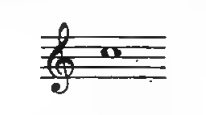
might mean the production of the sound
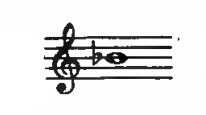
thieh ro comparatively high lip-tension on a crook 16 inches long, or
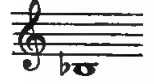
with a low lip-tension on a crook 125 inches long.!
All this pointed in the direction of a second revolution in the Brass department.
In 1815 two Prussians—Stölzel and Blümel-impelled perhaps by emulation of their fellow-countrymen who were engaged on a similar errand near Brussels, set out to rescue the Brass from its threatened danger and to fortify it in a position of orchestral safety.
' Crooks in Bp-alto and Bb-basso. We must also remember that, in extended works to played containy star, in opera sil ones alerton of to engi sam. cylindrical tubing into a warm conical instrument. irksome to the last degree. Instead of playing right through a performance on an instrument of one size, he had to make a change every five minutes The following is he list of crooks in their proper order as prescribed by Mozart for the performance o his Opera, Don Giovanni: D, F, Eb, D, •G, F, A, Bb, Eb, D, G, Bb, F, C, F, Eb, G, C, G, A, F, C, Eb, G, Bb, C, Eb, Eh, F, D, F, By, F, G, D.
We must explain how this was accomplished. The student will have observed that, of the three types of modern orchestral Brass, only two-the Horn and the Trumpet-have been mentioned so far. The third type-the Trombone-gave the cue which led to the second revolution in the Brass department. The Trombone was then what it is now, as far as its mechanism goes. It was not, however, the mechanism of the instrument, that is to say the slide, which was taken as a model by the early experimenters with the "hand-horn" and "natural-trumpet," but the compass-extension provided by that mechanism. Ihis compass-extension has remained to the present day the fixed type of compass-extension for all three-valve Brass Instruments.
We must then glance for a moment at the mechanism of the Tenor Trombone in Bo--the chief member of the Trombone family-and see what its compass-extension was. The instrument consists mainly of a "bell-joint" and of two parallel cylindrical tubes over which a third U-shaped tube is drawn. The latter tube—-the "slide"-moves up and down the two fixed "legs" of the instrument and, in doing so, alters the length of the vibrating air-column, that is to say, the pitch of its Harmonic Series. In the "Ist position," when the slide is held close up so that the air-column is at its shortest, the player can produce the usual Harmonic Series from the fundamental note Bb:
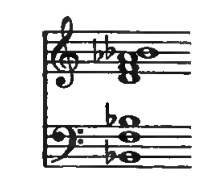
In addition, he can draw the slide down by increasingly large steps, and so can produce six other Harmonic Series from six other fundamental notes. The whole set of seven fundamental notes or positions

and on each of these notes the player can build a Harmonic Series similar to that which was set out above.!
In other words, the slide-mechanism gives the player not only a chromatic compass of two octaves upwards from the first fundamental note Bo, but also a compass-extension downwards of a diminished fifth. The instrument is built in Bb and the compass-extension is
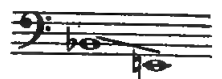
The student should fix this extension in his mind, as it gives the downward compass-extension of practically all modern Brass Instruments. Now, with the Horn and Trumpet there was no idea of substituting
" See pages 134-5 for the "pedal-notes" of the instrument.
a slide mechanism for the crooks. There was, however, an idea, which is now an accomplished fact, of substituting some other mechanism which would give these instruments a purely chromatic compass and incidentally extend that compass downwards a diminished fifth.
The idea, as it gradually took shape, was to adopt a tube of standard length and then to substitute for the crooks additional lengths of tubing welded into the body of the instrument. These additional lengths were to be controlled by a sort of mechanical stop-cocks or valves which would switch the air-current on and off at the discretion of the player.
At first glance this may seem to be a very simple problem, and the student may wonder how it is that only now, after a hundred years of experiment, is the solution at all satistactory. it is not, however, quite as easy as it looks. In the first place, one scarcely needs to point out that the problem could not be solved by the naive method of merely placing a dozen crooks and a dozen controlling valves on the instrument. Experiments in this direction were actually made in those early days. Some went so far as to weld together a whole bunch of Horns, bells and all. This type of experiment, in which the underlying idea was to keep the various lengths of tubing associated with each fundamental note absolutely independent, has been resumed in our own day and carried to some suceess.! hundred years ago, however, it was beyond the reach of any European manufacturer. The complications that resulted in practice were sufficient to put it quite out of the question. The only feasible plan appeared to be this—to weld into the instrument a series of tubelengths controlled by three valves; to use tube-lengths of such a size that their air-columns, when joined successively and separately to the main air-column, would lower the pitch by a b tone, I tone, and 1% tones; and finally, to provide a system of intercommunication between the tube-lengths, so that any combination of them might be thrown into the main air-column.
All this may seem to be only an elementary matter, but there was an inherent difficulty connected with the intercommunication of the valves. Let us state it in broadest outline. Suppose you have 10-foot tube to produce a given fundamental note and its Harmonic Series. Suppose, again, that you introduce an additional 1 foot of tube which can be switched on by your -tone valve, so as to produce the fundamental note and Harmonic Series of one semitone below the

1½ tone valves? Are they to bear the correct relative lengths to your original 10-foot tube or to your combined 10 + 1-foot tube? Whichever you choose, you will get an out-of-tune fundamental note and Harmonic Series for the one which you do not choose. In other words, the problem is to secure truth of intonation when your valves (or pistons) are used in combination.
This is really the one great difficulty which has engaged the
' See the description of the Modern Independent-Cylinder Trombone on pages 143-6.
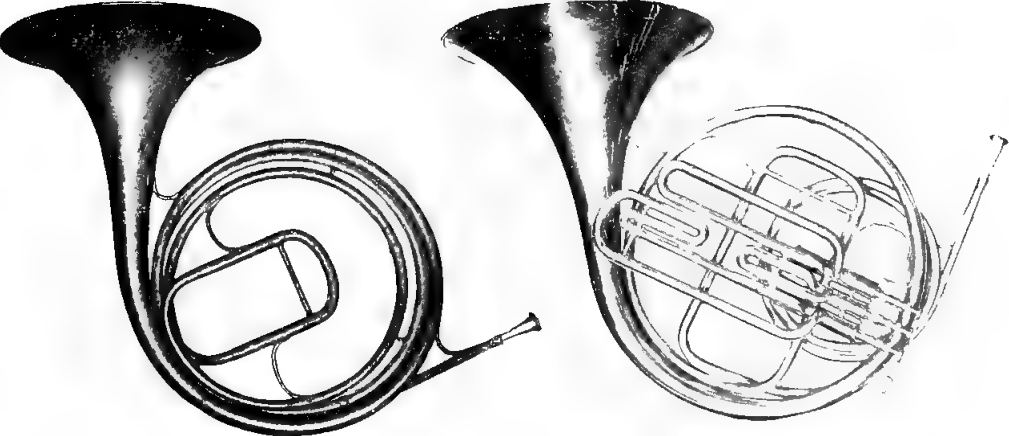
FI. 3.-MODERN ORCHBSTRAI VALVE-HoRN.
Facing p. 85.
By kind permission of Messis. Buosey & Co.
attention of manufacturers since the valve system became an artistic possibility. It is impossible even to hint at the many attempts which have been made to solve it. It is sutticient to say that there are now many systems of what are called "compensating pistons," that is to say, of pistons which mechanically correct the error in piston

gives a separate length of tube to each descending fundamental; the Besson Registre, Transpositeur, and Enharmonic systems; and the Rudall-Carte-Klussmann system, which gives the Horn a conical bore throughout the additional lengths as well as through the original body of the tubing. Any of these systems can be and are applied to the Horn and Trumpet of to-day. Nor do they forbid us still to use the old crooks. However, the integral part oi the Horn- and Trumpet-mechanisms of to-day is not the crook, but the series of additional brass tubes controlled by three valves, of which the 1st, 2nd, and 3rd are invariably so arranged that when used separately they lower the pitch of the instrument 1 tone, tone, and 13 tones. The Ist valve is the whole-tone valve, the 2nd is the half-tone, and the third is the tone-and-a-half.?
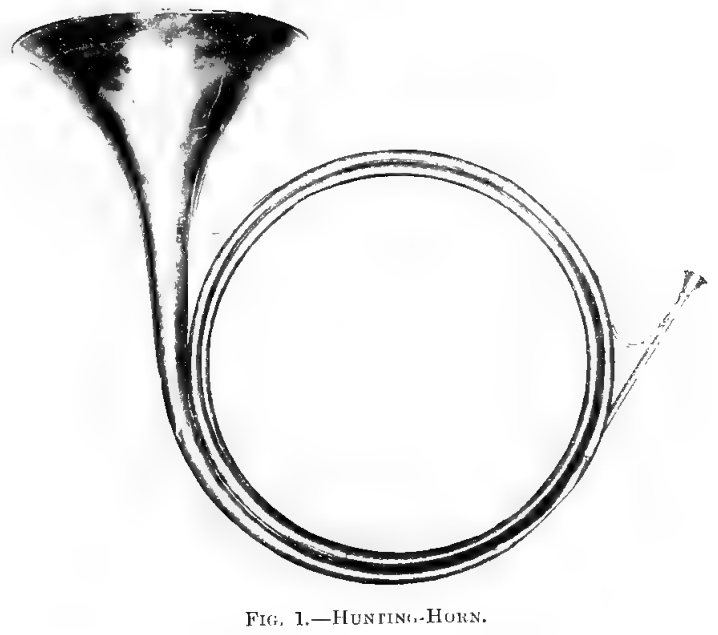
The three stages in the evolution of the Horn after it became a coiled-instrument are illustrated on Plate III. Fig. 1 is an old French Hunting Horn (cor de chasse) by François lerinet. It is, of course, capable of producing only a single Harmonic Series. Fig. 2 is a Hand-Horn of the type common in the last halt of the 18th and the first half of the 19th centuries. The special instrument here photographed was made by Distin tor Hugène Leon Vivier, the celebrated Horn-player, He seems to have preferred playing on a Horn-in-E, and that is the key in which this instrument is built. The only mechanism attaco die is played aid This ere intor mechanism attached This is the instrument on which he performed before Louis Philippe at the Château d'Eu. Fig. 3 is a modern orchestral Horn crooked in F and furnished with three Automatic Compensating Valves. This instrument is by Messrs. Boosey & Co. In all three illustrations the student will have no difficulty in noting the tunnel-shaped mouthpieces.
The modern valve-Trumpets and valve-Horns will be more par-
1 This system is not applied to what are called the "whole-tube" instruments (see below, page 86). It is probably the nearest theoretical approach to the old "crook " system.
• Widor states that in France instrument-makers are producing a Horn in which one piston is so modified as to raise the pitch a whole tone. In doing this they are compeller to sacrifice one note of the compass altogether:
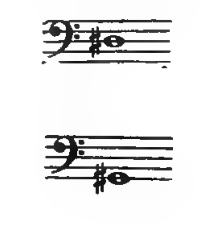
which sounds on the F-Horn :
ticularly described under their respective headings. Meanwhile we must notice an important diseovery which was made during the perfecting of the valve-system. If the student will refer back to page 73 he will see it stated there that neither the Horns nor the Trumpets could produce the Ist note of the Harmonic Series A Horn, therefore, giving the s-it. Half its length was practically useless. This was a well understood fact. However, during the course of the experiments in the application of valves to conical-bore instruments (such as the Horn) it was found that if the calibre of the tube was sufficiently enlarged in proportion to its length, and if a cup-shaped mouthpiece was substituted for one of tunnelshape, the instrument could be relied on to give its tundamental note in all normal circumstances.
The knowledge of this simple fact opened a new era The Valve- Brass became divisible, according to the German classification, intr "half-tube" and " whole-tube" instruments: that is to say, into instruments of comparatively narrow bore, in which the fundamental note. was unobtainable, and instruments of wide bore, in which the fundamental note was obtainable.
This is the true distinction between the Saxhorn?-Flügelhorn- Trumpet-Horn group and the Tuba group. In the former the lowest open note which the player can produce is the 2nd note of the Harmonic Series. Downwards from that he can do, by means of his three valves, exactly what the Trombone-player can do by means of his seven positions, namely shift his fundamental note semitone by semitone till he arrives at a note which is a diminished fifth below his original fundamental note. And there he stops.
As an example, the lowest open note of the Cornet is its 2nd Harmonic 3
The additional notes obtained by means of the three valves are

On the other hand, with the true Tuba, whether it is called a
But for apt oral cal pulayers ituld andacually mant ouch this nee, even on the I crook. A mere grunt. The sound on the F-crook
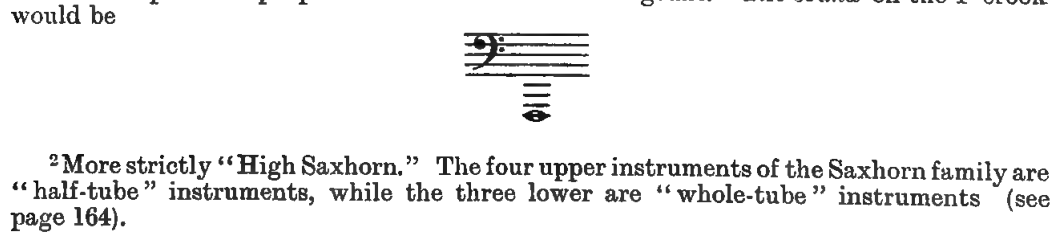
3 Of course, if the Cornet is crooked in Bb this open note and the other six semitones will all sound one tone lower; if it is crooked in A they will all sound If tones lower.
"Euphonium," an "Eb Bass," or a "BBb Bass," the player can drop from the second Harmonic, whatever it may be, plump down to his fundamental note. It is a mere matter of external furniture as to whether he can fill in the semitones between these two notes. If he has only three valves he can proceed chromatically down through a dimin- If, on the other hand, he is provided with a 4th valve, lowering the pitch 21, tones, he is able to fill in these five semitones and so make a complete chromatie descent to his fundamental note. Always provided he has the "lip" to do it.
For instance, the "Eb Bass" — a four-valve military instrument— can begin from the 2nd note of its Harmonic Series

and proceed downwards by means of its three valves through the follow-

Without a 4th valve the player would have to stop there. All he could do would be to take off all his valves and jump to his deep
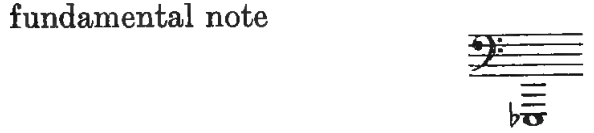
However, by means of his 4th valve he can fill in these intervening

He then takes off all four valves and, with a clear bore, produces the deep fundamental given above.
For the sake of completeness a list of valves and valve-combinations is subjoined. This list shows the alterations in pitch which they effect in any valved Brass Instrument. It is complete as far as the ordinary three-valve system goes. The four-, and even five-valve systems can easily be worked out on the same pattern.
lowers the pitch ½ tone, 1-semitone-valve
I tone, 2-semitones-valve
3-semitones-valve (or 2-semitones-valve
15 tones,
+ 1-semitone-valve in combination) 3-semitones-valve + 1-semitone-valve in
2 tones,
combination 3-semitones-valve † 2-semitones-valve
2% tones,
in combination 3-semitones-valve + 2-semitones-valve
+ 1-semitone-valve in combination 3 tones.
A few words must now be said with regard to the nomenclature of this nineteenth-century invention, the valved whole-tube Brass tamily. This is a matter of some little difficulty. For, untortunately, as it gradually became known that a new species of chromatic Brass Instrument was available, and as the growing military system oł Europe developed an increased demand for military bands, competitive instrument-makers all over the Continent began a vast manutacture of valved instruments, which were only partially warned off our shores by our musical Undesirable Aliens Act, the difference of pitch.
Simple instruments that should have been standardized under a single name received a dozen different titles in as many countries. Sometimes the name was adopted or modified from that of an earlier instrument: sometimes a purely "fancy"—and often foolish—name was invented: sometimes the instrument was christened after its godfather, the manutacturer. Even such simple words as alto, tenor, and bass were applied with various meanings in various countries.
Hence comes great confusion for the mind of the orchestral student. He knows that when he writes a fiddle part it will be played on a fiddle in Rome, in Dresden, or in London; but he learns with dismay that the instrument which he familiarly calls a "Tuba" is not so called even in the military bands of his own country, and that his "Tuba" part, if it ever travels outside his own study, may possibly be played on a felittone, a bombardon, a♯licorno Basso, or a Contrabass-saxhorn.
In order to throw some light on these dismal obscurities, one may remind the student (1) that though it was Richard Wagner who first installed "the Tuba" in the orchestra, neither his first idea nor its technical expression has ever found general acceptance; (2) that the development of these whole-tube instruments has everywhere been chietly a development for multary purposes, and that therefore, wherever deep "Tuba" parts have to be played, the instruments requisitioned are the perfected military instruments either slightly modified in pitch? or quite unaltered.
wil had descedopt d in tantellite pay ril behi the sudant Instruments as they actually exist and are used to-day in our concertrooms and theatres. These are otten not quite the same instruments as those that existed yesterday, nor the same as those in use abroad. They correspond, however, in a general way to both these groups, and the differences can easily be made plain in the course of each description.
The following simple arrangement of the Brass-Wind is based solely on mechanical differences of method in altering the length of the vibrating air-column. Whatever these mechanical differences, all the instruments named depend for their tone-production only on the
1 See foot-note to page 163, and page 165.
2 That is to say, built in a key near to that of the military pattern, but more convenient tor orchestral music that does not cling to the flat keys. Of course, besides hat, there has to be a second modification in England, owing to the fact that we are still notes of the Harmonic Series given above. The names of Obsolete Instruments are given in square brackets after each group.
(1) Tubes in which the length of the air-column is fixed; tubes, theretore, which can only produce one Harmonic Series at a time: the Natural Horn, the Natural Trumpet, and the Military Bugle. these the first is practically disused and the second is only used for "duty" purposes in cavalry regiments. [Obsolete: the whole series of ancient military instruments such as the Roman Buccina, Lituus, Cornu, and luba."]
(2) Tubes in which the length of the air-column is varied by means of holes pierced in the side? [Obsolete in this country: the Bass- Horn, the Russian Bassoon, the Keyed-Bugle, and its bass the

Trumpets, Valve Horns, Cornets, and, rarely used, the tour upper Saxhorns. (Used in military bands either here or abroad: Valve Trombones, Flügelhorns, Ienor-Cors.) (B) Whole-tube instruments, used regularly in our military bands: the Bo Euphonium, the Eb Brass- Buss, the BBb Brass-Bass. The last two instruments are also called by the generie name of Bombardons. All these three whole-tube instruments figure in a modified form in concert and operatic performances. The Bb Euphonium and the BBb Brass-Bass appear only rarely as Tenor-Tuba and Contrabass-Tuba. The Eb Brass-Bass is used constantly in the orchestra. It is as a rule built in the key of Ft and furnished with four valves. This is the usual instrument on which ordinary orchestral "Tuba" parts are played, in fact the instrument known to civilian composers as the Bass-Tuba.
(4) Tubes in which the length of the air-column is varied by means of slides: the Tenor and Bass Trombones, and, rarely used, the Contrabass Trombone. [Obsolete: the Alto Trombone, the Sackbut.]
Of the above four groups, the Horns (natural, valve, and tenor) and the "Wagner Tubas" as originally designed are all played with funnel-shaped mouthpieces.
All other Brass-Wind instruments are played with cup-shaped Exception, the Bugle, a hybrid which plays with a mixed cup-and-funnel mouthpiece.