 Playable Books
Cecil Forsyth · section 27 of 60
No. 23. The Bass (or G) Trombone
Read and hear this section in the playable edition →Fr. Trombone basse; It. Trombone basso; Ger. Bassposaune.
In this country the Bass-Trombone, both for orchestral and military purposes, is always built in G. Its seven positions have, theretore, for their seven fundamentals, the notes
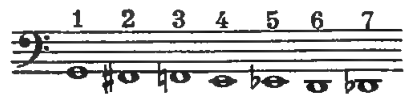
This leaves a gap of two semitones between the bottom note of the Bass-Trombone and the first pedal-note (the low Bo) of the Tenor- Trombone. On the continent the Bass Trombone has always been built in F, one tone below our standard instrument. Built thus, its
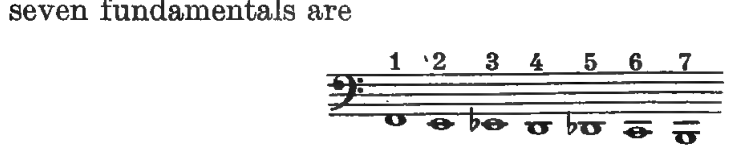
and it has always been the practice from Mozart and Beethoven's time till the present day to write down to the low C. Passages where this note occurs have usually to be altered or transposed by our players. This is a disadvantage. On the other hand, our G-instrument-already, perhaps, the most tiring instrument to play in the orchestra—is much more manageable than the continental F-Trombone. This somewhat counterbalances its required to "cry out from the depths." In Germany a Trombone of even greater length, the military Bass-Trombone in Eb, two whole tones lower than our G-instrument, used to be made. It is now apparently disused, at any rate for orchestral purposes.
The difficulty with regard to the build of the instrument is a rather serious one. If regard is paid solely to its repertoire, it must be in F. On the other hand, I, it ease of tone-production and flexibility in performance are more studied, G is the better key. The difficulty has been partially solved by the introduction of a mechanism so designed as to give the player the treedom ot the smaller instrument together with the possibility of descending below the low C when required. This mechanism consists of an extra length of tubing in the bell-joint, so arranged that it can be switched on or off at will. When the extra length is out of action, the instrument is an ordinary Bass Trombone in G. When, however, the extra length is switched on, the instrument is automatically transposed down a perfect fourth, and becomes & Bass Trombone in D with & descending chromatic compass
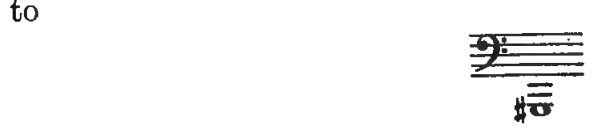
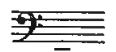
1 And occasionally to its bottom note, the low B4 that is to say, a perfect fourth below the lowest seventh-position note on the natural instrument in G. The simple mechanism is operated by means of a left-hand thumb-ring. A very slight movement of the thumb throws the extra tubing into or out of action.! The tone of the Trombone seems to be unimpaired, and the player not only has the capacity of performing such passages as the one printed below (see Ex. 176), but also the important technical advantage of a new series of the higher Harmonies taken from fundamentals of a low pitch." The compass of the G-Trombone is from the low Cu or Do (fundamental seventh position) upwards to
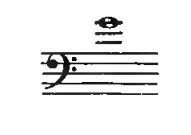
Neither the pedal notes below low CF nor any notes above the high G are of any practical use in the orchestra.
The Bass-Trombone is written in the bass-clef as a non-transposing instrument. As has been mentioned above, it generally shares a stave with the Bass-Tuba, and is written on the upper part of the stave.3 This is, however, mere matter of convenience, and may be disregarded It either of the instruments has an important and independent part
All that was said with regard to the technique of the Tenor- Trombone applies equally to the G-instrument, when allowance is made tor the difference of pitch. Shakes are scarcely ever written tor the Bass-Trombone. Such as exist may be found by transposing the Tenor-Trombone list down a minor third.
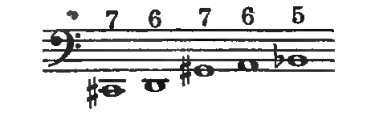
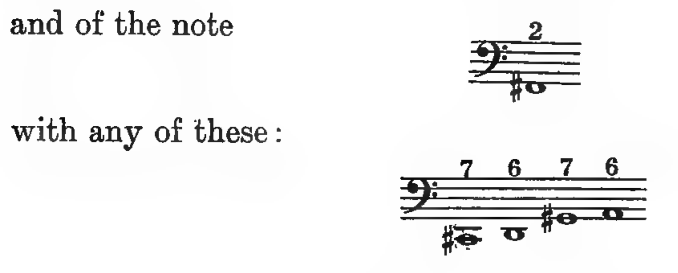
The caution with regard to awkward changes of position is even more necessary in the case of the larger instrument. In fact this point is so important that it will be as well to repeat the warning in its correct transposition. In its new form, and strietly with regard to the Trombone-in-G, it is as follows:
Avoid quick interchanges of the note

with any of the following:
1 This instrument is used in Sir Henry J. Wood's orchestra by Mr. Gutteridge. « This is practically the German Tenorbassposaune with the Daumenventil as intender for use in Die Walküre.
3 In Otello Verdi omits the Tuba and uses a Bass-Trombone as well as three Tenors.
* It need scarcely be mentioned that the slide is not controlled directly by the player' hand, but by a wooden handle fixed to the brass "stay" at the upper end of the slide Without such a handle the lowest positions could not be reached at all
• The corresponding difficulties on the continental F-Trombone can be easily found by merely transposing the whole series of notes down a whole-tone.
The tone of the Bass-Trombone, when it is not overplayed, is powerful and majestic in the extreme. It is, however, much less capable of execution than the Bb-instrument. The width of its position-changes is greater and its enormous air-column is, especially in the lower positions, less ready to speak. The long continuance of a f in the bottom register is most exhausting to the player. Deep held notes, when marked f, are quite out of the question. Even alter two or three beats oi moderate time their volume becomes noticeably Un the other hand, the p and the pp of the middle notes are easy to play and delightful to listen to.
This is a question of lungs, and, as it affects both Tenor- and Bass- Trombone players, it may be as well to give the rough serviceable limits within which these instruments should be confined both in the piano and in the forte:
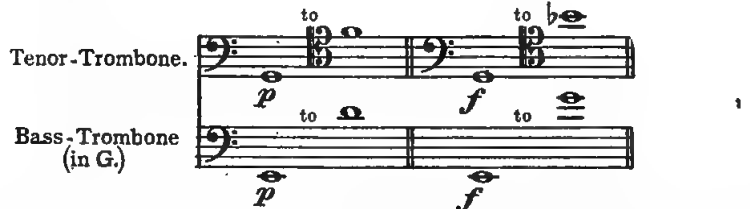
In the piano of each instrument add the three lower semitones for special melodie or harmonie reasons.