 Playable Books
Cecil Forsyth · section 28 of 60
No. 24. The Double-Bass-Trombone
Read and hear this section in the playable edition →Er. Trombone Contre-basse; It. Irombone Contra-basso; Ger. Kontrabassposaune.
This instrument was employed by Wagner in the Ring with the very sensible object of freeing himself from the continual necessity of associating the Tuba with the Trombones.?
1 This has been recognized for centuries. Indeed in une of the earliest references to the Sackbut-the ancestor of the modern Trombone-its use is advocated not for musical but for medical purposes. "The entrayles, which be underneth the myddrette, exercised by blowyng, eyther by constraint, or playeng on shaulmes, or sackbottes, or other lyke instrumentes, which do require moch wynde." Flyot's Castel of Helthe, a Tudor system-of-medicine published in 1533. It is hardly necessary to comment either on the practical character of this advice or on the heroic nature of an age which could accept the Bags-Trombone as a medical prescription.
2 Vincent d'Indy has used the instrument with the same object. In his second Symphony it replaces the Tuba.
As designed by him it was pitched in Bb, an octave below the Tenor Trombone. Its series of fundamentals would therefore be
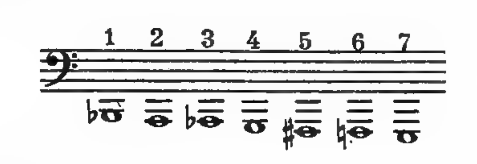
and he actually calls on the player to produce the deepest of these notes. Upwards it can rise about as far as its 10th Harmonic
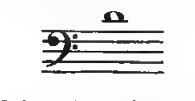
but ot course its general objective is depth, not height. In England the Double-Bass-Trombone has been built in C. In doing this the special purpose of the instrument, the performance of such parts as these
Example 78

seems to have been overlooked.
Wagner writes the Double-Bass-Trombone in the bass-clef at its true pitch.
With regard to the Double-Bass-Trombone, it may be questioned whether in its manufacture the limits of human lungs and lips have not been overstepped. The difficulties of adequate tone-production, to execution, are terrific. If there were really new
it has been found that any possible extension of the Brass-compass downwards must be looked for not from instruments of the Trombone family but from the wide-bore Tubas.
Before passing on to some more general considerations with regard to the use of the Trombones in the orchestra a few words may be spared for the Valve-Trombones?
At first sight it would appear that no instrument was less in need of an added mechanism than the Trombone. Its natural habit-of-body is simplicity and perfection itself. Its only technical fault—if fault it be—is a complete inability to play legato.
However, the continual modern call is for suppleness and ease of execution, both in diatonic and chromatic music. In this respect a certain stiffness and want of adaptability has been a continua.
1 Two Tenor-Trombones, omitted in the above quotation, play in unison an octave above the Double-Bass-Trombone.
2 Fr. Trombones à pistons; It. Trombonz a cilndri or Trombonz Ventili; Ger. Ventilposaunen.
handicap to the instrument. In order to remedy this and to solve some of the difficulties of compass-extension, several valve system. nave been applied to the Trombone.
Of these the ordinary system of added tube-lengths under the The instrucontrol of 3 or 4 valves may be put aside as not suitable. ment so constructed is really quite different from and interior to the ordinary slide-Trombone.
However, another system has been seen of recent years in the Queen's Hall orchestra,' and, as this system gives the greatest theoretical approach to the old crook-mechanism of the Horn, it will now be briefly described.
The system in question is known as the Seven-Cylinder Inde- Pendent act action, i is de modica din of to ordinay sim all bider valve-systems in that the cylinders (or pistons) are used, not to throw in an extra length of tube for each lower fundamental, but to take one off for each higher. It is a system of cutting off, not of addition. Piston-combination is, therefore, altogether avoided. That is the essence of the system. The Six-Cylinder action answers well enough in ordinary circumstances. When, however, a seventh cylinder is added there are, as we shall see, certain disadvantages.
The modification which was mentioned above, that is to say, the addition of the seventh cylinder, is specially designed for use on the Trombone in order to extend its range downwards without robbing it of its upper register. The first six cylinders and the open cylinderless position control the normal compass of the instrument. The seventh is used for purposes of downward compass-extension. The player is thus presented with an instrument on which he can perform any Irombone-part likely to be put betore him. in practice a com plete length of tube for each of the seven Trombone-positions is provided. This involves a departure from the ordinary cutting off system of the Six-Cylinder Independent action; and, in order to make clear the nature of this departure, we shall describe the Six-Cylinder System in a single paragraph and then the precise application of the seventh cylinder.
The Six-Cylinder Independent system was applied by Sax to various Brass Instruments of the "half-tube" family. Its action is normally as follows. The cylinderless position gives the greatest length of tube, three whole-tones below the primary length of tube in which the instrument is built. The action of cylinders Nos. 6, 5, 4, 3, 2, 1, is to cut off in the order named an additional length of tube corresponding to a rise of a semitone in pitch. In other words, the series diminishes in length from 6 to 1, and consequently ascends in pitch. The range of the whole instrument is therefore downwards from No. I cylinder (the shortest or primary length of the tube)
1 Under Sir Henry J. Wood, to whom I an much indebted for the greater part of the above information.
2 The "Independent" system was due, in the first instance, to Adolphe Sax. The instruments described above were specially built by Messrs. Lebrun of Brussels.
through Nos. 2, 3, 4, 5, 6, to the cylinderless position (the greatest length). We thus get the ordinary downward compass-extension of a diminished fifth, and incidentally a complete chromatic compass throughout the instrument.
The Trombone to which this system has been applied is the ordinary Tenor Trombone built in Bo.
Seven cylinders, however, are provided, and their operation is as follows:
When all the cylinders are "off" the player is actually playing on à Bb Tenor-Trombone in the seventh position. His fundamental note is
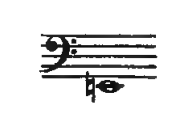
and he can only blow the Harmonic Series corresponding to that note.
Now the first six cylinders act in one particular way and the ith cylinder acts in precisely the opposite way.
Each of the first six cylinders cuts off a portion of the tube. No. 1 cylinder cuts off the greatest amount; No. 2 cuts off a slightly smaller, and so on, as far as and including No. 6. This has already been explained.
In musical language, by putting down cylinders No. 1, 2, 3, 4, 5, 6 in succession, the player obtains the fundamentals of the first six Trombone-positions.
tain the setakes of west froline pand, as we saw above,
This gives him the complete Tenor-Trombone compass from low E upwards.
But observe, the 7th cylinder is so far unused. Its action is quite distinct from that of the other six. By depressing it a new length of tube is added to the main-line of the instrument, with which we have hitherto dealt, and the whole instrument is shifted down a perfect fourth.
In other words, with the 7th cylinder down the Trombone is now equal to a Bass-Trombone-in-F. The two last semitones below the ordinary Bass-Trombone compass (viz. C4 and BA) can be produced.
gap before the first pedal-note (Bo) is thus bridged and the difficulties of playing parts written for the Trombone-in-F' vanish. In fact, the seven-cylinder instrument is a Tenor-Trombone and a Bass-Trombone in one. It is only necessary tor each player to cultivate his embouchure in the particular type of Trombone part (Ist, 2nd or 3rd) which he is accustomed to play:
The principal disadvantage of this instrument is its unwieldiness. This is a failing of the whole Independent-Cylinder System. extra lengths of tube are heavy, bulky and awkward. In a military band on the march they would be impossible. Un the other hand, in the orchestra this is of less importance. One can easily aceustom oneself to the unusual sight of three Irombone players apparently tucking sets of brass bagpipes under their arms. It is also to be noted that the special unwieldiness of the seven-cylinder Trombone is principally due, not to the Independent System itself, but to the necessarily great extra tube-length required by the 7th cylinder. In other words, it is due to the tact that the instrument is really a Tenor- and Bass-Trombone in one.
stomation. On an ism is etected with the path is ditties. to come by. This is no more than we might expect. So long as the player is employing only cylinders 1 to 6 and the open cylinderless position no special difficulties arise. The trouble begins when he switches on his seventh cylinder. For, of course, though that gives him a Bass-Trombone-in-F, it only gives him one position on that instrument. To secure the advantages of the other positions he should be able to use his six other cylinders in combination with the seventh. This he actually may be compelled to do, though it is completely against the whole theory and practice of the Independent System. come all the practical difficulties of intonation and the necessity of a continual resort to the tuning-slides. In short, the player has to pay the penalty of trying to play two instruments at once.
In tone these Trombones are massive and sonorous. Less biting and seemingly less brilliant than the modern small-bore Tenor, but much more flexible, much better adapted for chromatic work, for cantabile, and for unobtrusive part playing. Their apparent want of brilliance is possibly due to the fact that the players, not yet wholly used to the new technique, prefer the slide-instruments for their bravura passages.
It is worth noting that the exact correspondence between the old positions and the new cylinders is greatly in favour of the instrucan pass without serious ment. The Bo-Tenor-Trombone player difficulty from his slide- to his cylinder-instrument. Where he has been used to read his notes as in one of these positions,—
he can now read them as on one of these cylinders,—
Each position, except the lowest, corresponds in number precisely with the number of the cylinder necessary for producing the same Harmonic Series.
It will be interesting to watch whether these instruments establish and maintain their position in our orchestras or whether the slide mechanism, so often threatened throughout its long lite, Will retuse to "stand and deliver" to the cylinder as it refused before to the crook.
Before leaving this topic it may be mentioned that some of our best Trombone-players-men who have been used to the slide-instrument, all their lives—are sensible of the necessity for some slight adjustments and alterations in its "make-up." A combination instrument, in which the slide is the main mechanism and a valve or valves are used in supplement, may possibly turn out to be the instrument of the future.
Considering the antiquity and settled technique of the Trombones, the student may be surprised that it is not possible to quote a long series of brilliant passages designed for them. The fact is that they are essentially "group-instruments," that is to say, instruments which make their effeets harmonically and their differences of effect by differences of register, of spacing, and of contrasted piano and forte.
This general statement was first made by Berlioz. Strauss, however, quotes a particular example from the Meistersinger to prove it untrue. But the passage in question-two themes rhythmically contrasted and played simultaneously by the two first Trombones in unison and the third Trombone alone-does not affect Berlioz's general remark that "a single Trombone in an orchestra seems always more or less out of place. The instrument needs harmony..., though Wagner's passages may be, as Strauss says, "typical models of the polyphonic style applied to the Brass."
The Harmonic method was, as we have seen, the style of Bach and of his period. It was also the method of Gluck in Orfeo, Alceste, and Iphigenze en Lauride. It was also mainly the method of Mozart in his Brass accompaniment to 0 Isis and Osiris (Lauberflöte), and in the statue and supper scenes of Don Giovanni. It was also the method of Beethoven in such works as the U minor and Choral Symphonies. And the general method in their sanity was the use of simple rhythms and held notes in three-part harmony with carefully thought-out expression marks pand f, -and=.
Here is a brilliant effect in the last three bars of Dvořák's Carneval Overture. The Trombones, in close harmony French-fashion, suddenly "come through" with a flaming chord of A major. Nothing could be simpler on paper: nothing could be more effective in sound.
Example 79
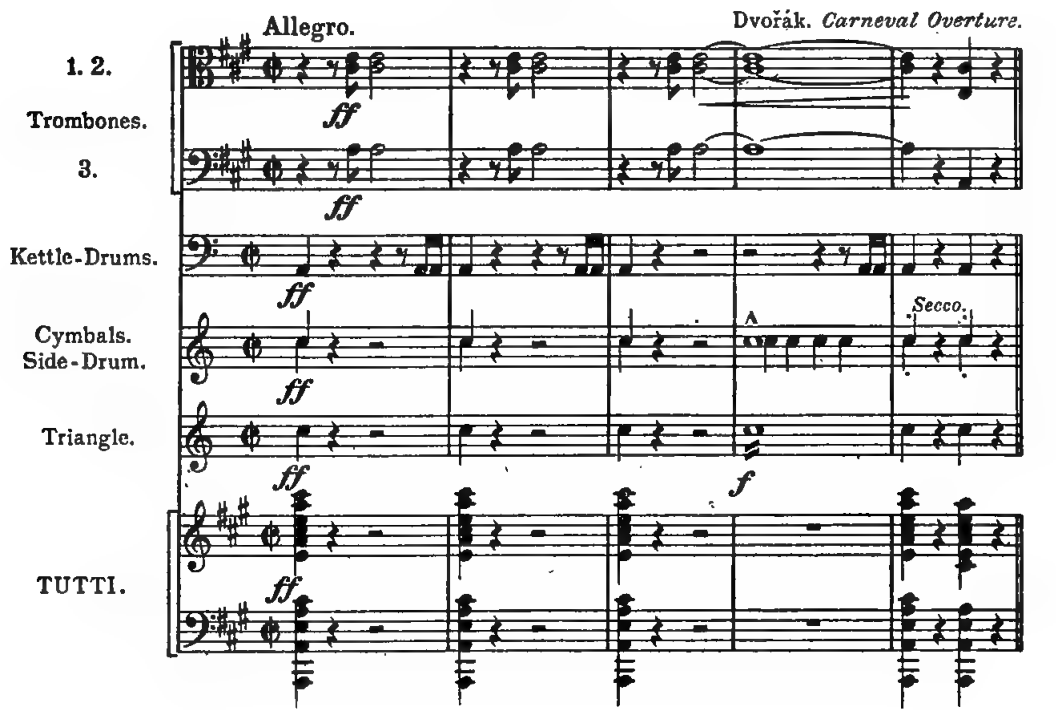
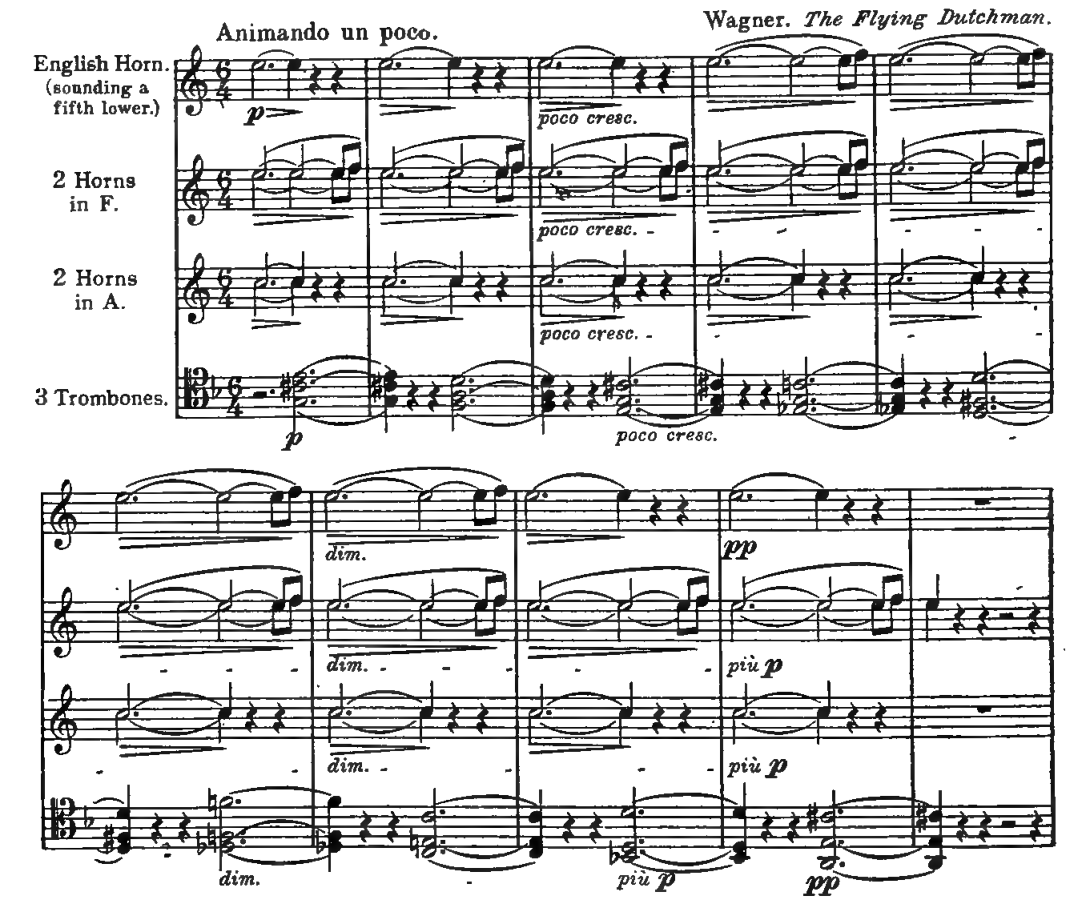
Compare the dynamic range of the three Trombones in this example -that is to say, their actual amount of sound—with the scarcely audible pianissimo which they produce at the end of the Pathetic Symphony (Ist movement, see Ex. 91). Or, again, compare the effect of Tschaikowsky's pianissimo close harmony with that of the ideallyspaced last chord of this passage from Wagner's Flying Dutchman
Overture:
Example 80
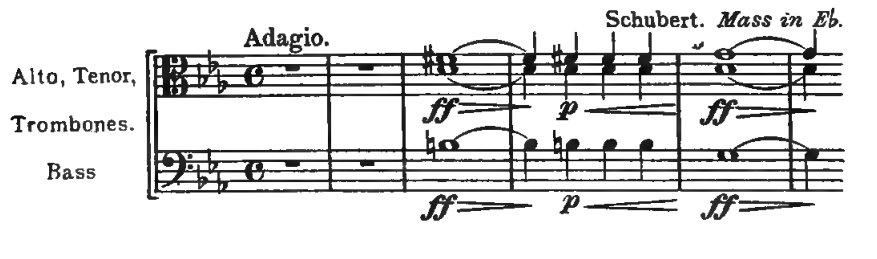
In this connection the student should examine the score of Schubert's Mass in Eb. It contains a good deal of vocal accompaniment in the old-fashioned German way, and of Trombone part-writing with Horns and Wood-Wind. In particular there is a surprisingly modern stroke at the opening of the Sanctus. The key of the movement is Eb. The Chorus repeats the word Sanctus on the ascending notes G, By, and D, harmonized by chords of Eb major, B minor and G minor: The Trombones enter on the second—the B minor-chord thus:
Example 81
It must be confessed that when not using the Trombones in harmony one runs certain risks. Against Wagner's brilliant " solo" use of the Trombones in the Tannhäuser Overture and the Prelude to Act III. of Lohengrin, and against Schubert's wonderful solo-passage for three Trombones in unison (C major Symphony), one must set the dreadful Tuba Mirum of Mozart. Only the first three bars appear to have been written by one who understood the instrument.
Example 82
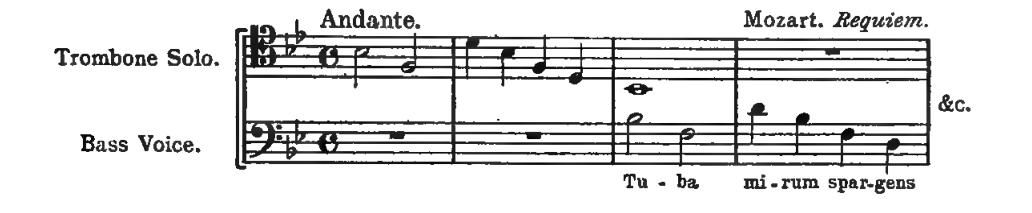
Tu - ba mi - rum spar-gens
The rest might better be described as Tuba dirum spargens sonum. Here is a sample:
Example 83
Mozart. Requiem.
Bass Voice.
Co-get om - nes
thro- - num
Then, again, on the "contra" side, there is the abominable circusy effect in the Freischütz Overture
Example 84
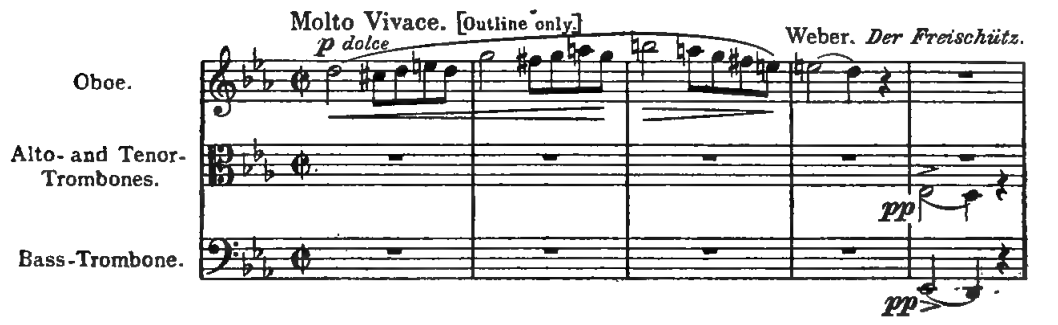
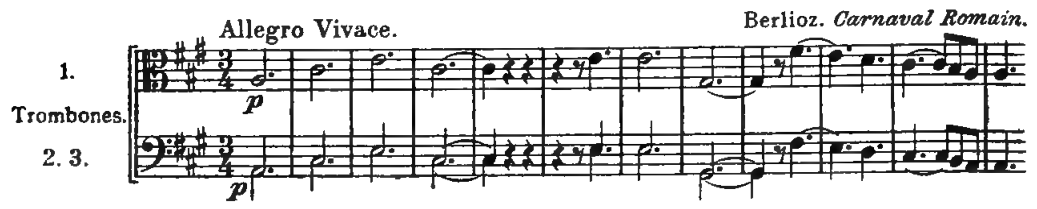
In connection with the last example we may note that the piano octaves of two Trombones always need caution in treatment. The sound of the instrument is naturally so full of a certain threatening purpose that the slightest variation from the serious, the majestic anc che pompous becomes vulgarized almost to the lever of a persona insult. Compare the determined semitonic rise of the Iromboneoctaves' in Don Giovanni where the Commendatore repeats his words,
1 Full Soore Peters's Edition, pp. 347 and 348. The Trombone-parts in this Finale are said to have been added by Süssmayer, Mozart's pupil.
"Tu m'invitasti a cena," with this sort of thing from Berlioz's Carnaval Romain.
Example 85
Halévy, who had a great deal more to answer for than we usually think in this country, was probably the first to write unaccompanied octaves # tor the Trombones. In the 4th Act of Lu Jurve there is a little eight-note passage which and partly to the boldness of its modulation, was looked on in its day (1835) as a surprising stroke, if not of genius, at any rate of theatrical vigour.
Example 86
Halevy. La Juive
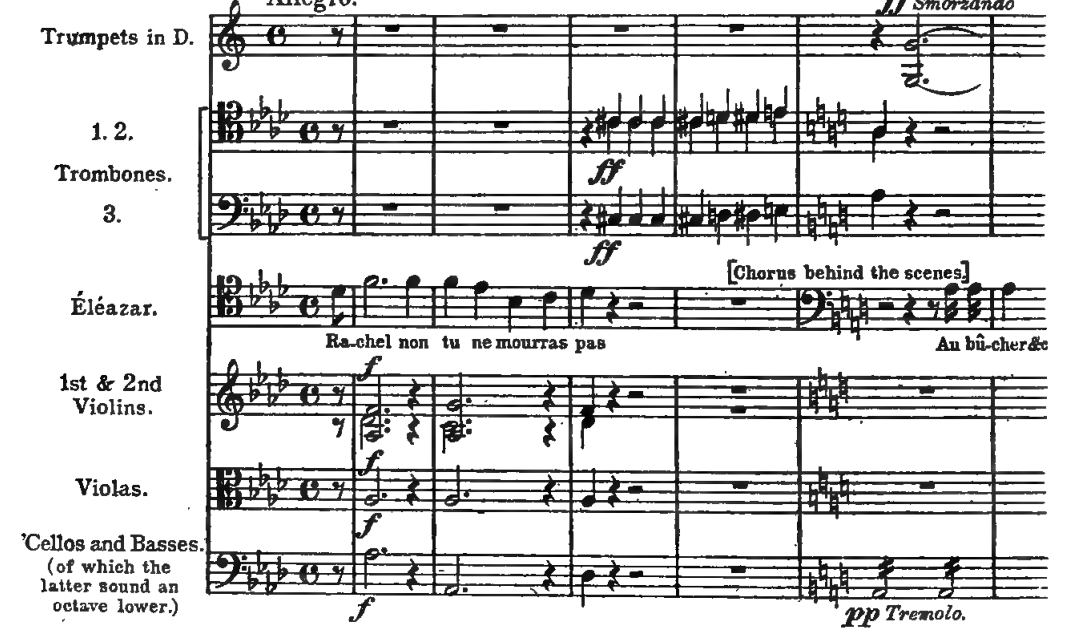
Rachel non tu ne mowtas pas
Stale as this seems to us nowadays, we must remember it as the immediate parent of Wagner's Brass-octaves in Rienzi (1842),
Example 87

1 In unison with the Bass-Trombone there is also an Ophicleide. The latter part is always played nowadays on a Bass-Tuba.
and probably as the original germ of many musically dissimilar passages in his later works.
hes randie in irone of unison, or in octaves. A good example, however, of the last named may be found below (see Example 94)
In his Commentares and Adartions to Berlioz's Urchestration Strauss points the moral of Berlioz's remark that the effect of reintoreing the Double-Basses with the Trombone is bad. He says, "In big tuttis one often finds important bass themes allotted to the trio of Trombones, reinforced also by Bassoons, Cellos, and Double- Basses. Such 'doubling' is perfectly useless.... If one has no Double Bapas one Should rather let them rest dusing the marcatas of the Trombones unless one has the specific intention of softening the brilliance of these latter instruments."