 Playable Books
Cecil Forsyth · section 53 of 60
No. 49. The Cello
Read and hear this section in the playable edition →

Fr. Violoncelle; It. Violoncello; Ger: Tioloncell.
The Cello is in pitch an octave below the Viola. Its four strings, of which the lower two are "covered," are tuned
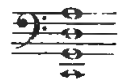
Its fittings are very much the same as those of the Violin and Viola with the addition of a long metal "peg" 'or "rest," so arranged at the lower extremity that it can be slid through a hole into or out from the body of the instrument. In the latter case it is used by the performer as a firm support when playing: in either position it is held tight by a metal screw-head.
Theoretically the Cello shares with the Viola the disadvantage of being too small for its pitch, but this disadvantage, as we have already seen, is counterbalanced by the great height of its ribs and bridge. This difference in construction is only made possible by the player's use of the sitting position bit this no ta position use of the sitting-position. the bass-side of the instrument upwards and not, as in the Violin and Viola, from the treble-side downwards.
The result of these differences in construction is an instrument which is acoustically nearly as perfect as the Violin, and much more
remarks that the four semitones,

1 There is a further mistake in Berlioz's quotation. The note immediately preceding the three bars printed above is given by hinı as

It should be an octave higher.
would be as abbreviations of Trombone and Clarinelto.
when played on the 3rd string are "bad notes... their tone is rough, harsh, incongruous, and uncertain; this is equally true of all Violoncellos used for orchestral purposes, whoever may be the maker." This seems rather too sweeping unless indeed the French orchestral cellist uses a type of instrument to which we are unaceustomed in this country.
Diatonic Left-hand technique.
This is quite different from the Violin-technique. The vibratinglength of string in the Cello is nearly double that of the Violin-string. Therefore, when playing in the lower positions near the nut, the cellist can stretch at most a tone trom Ist tinger to zna, and a semitone trom 2nd to 3rd, and from 3rd to 4th. Thus he is forced to adopt a fingering not quite so regular as that of the violinist. It may be formulated as follows:
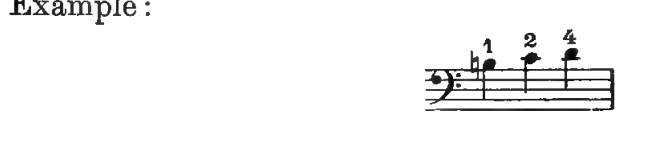
Three ascending notes, each of which is a whole tone from its neighbour, are fingered 1, 2, 4. Example:
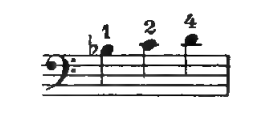
Three ascending notes, of which the first two are divided by a semitone and the last two by a whole tone, are fingered 1, 2, 4.
Three ascending notes, of which the first two are divided by a whole tone and the last two by a semitone, are fingered 1, 3, 4. Example:
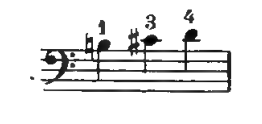
As will be seen, this involves a certain amount of irregularity. In the first example the 2nd finger stretches the whole tone, from Bo to C, while, in the last example, it is the 3rd finger which stretches the whole tone. This, however, is by no means a source of weakness to the cellist.
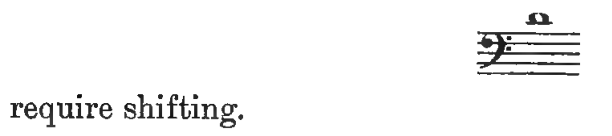
The student will easily perceive that, as the fingers can stretch no more than a fourth above the open strings, the only diatonic scales practicable without shitting are those in which the open strings are employed That is to say, in any other keys than Bo major, F major, C major, G major and minor, and D major and minor, shitting must be used. Furthermore, all scales and passages that rise above

The student may be inclined to ask whether this endless moving of the left hand does not infer a cumbersome and angular technique little adapted to elaborate passage-work. The answer to this is a plain "No." The best methods of taking the shifts have long ago been pertected and standardized, and capable players employ them in a way that quite evades observation. Also it must not be forgotten that, after a cellist has assumed any position, he has much better technical command in that position than the violinist has in his

only five semitones: with the violinist the ratio is four fingers to at least six semitones. The important limitation with regard to this part of the Cello-technique is that at any given moment the cellist has command of a compass of only a major third.
Skips of a fourth can, of course, be used when necessary in passagewriting, but the student should earnestly endeavour to avoid:
(1) Phrases-even slow cantabile phrases—which are continually skipping a fourth to-and-fro.
(2) Elaborate figures whose component parts are clearly founded on the interval of a fourth.
No. 2 is the more important point, and the point on which the beginner is more likely to go astray. Quick middle-register passages which a second- or even a seventy-second-rate tiddler can play with ease, whatever his position, by merely stretching out his little finger to take the pertect fourth, may present a quite unnecessary degree of difficulty, or at any rate of awkwardness, to the cellist. A tiny group of rapid notes may involve two quick shifts up and down during its performance.
No. 1 is not so important, but even here it is surprising how few | good Violin-melodies make good Cello-tunes, whatever the cunning with which they are transposed either in pitch or key.
In both cases—Nos. 1 and 2—the point to keep in mind is the position of the player's hand at the beginning of the note-group. This is really a simple matter, and any thought expended in the improvement of phrases and their adaptation to the needs of the instrument will be well repaid in a more finished performance.
The technique as described above is employed as far as the high A one octave above the first open string. Above that the string-length between the various intervals is so much shortened that the cellist is able to use the ordinary Violin finger technique.
In the highest register the thumb is withdrawn from its usual position on the bass-side of the neck and is placed firmly across and at right-angles to the string as a sort of artificial nut. These "thumbpositions" are a necessity for passages that lie above the high B,
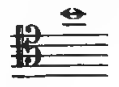
Their use is generally indicated by the sign ? placed above the note on which the thumb is to rest, thus:
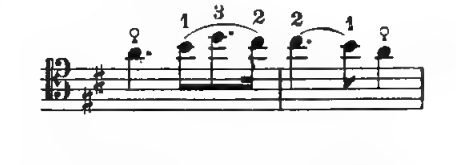
In orchestral music it is scarcely necessary to bother about this, as the players will find out the technique best adapted to their individual requirements. Some discretion, however, must be used in mixing the high thumb-positions promiscuously with the lower positions. There is considerable difficulty in jumping! to the thumb-position and accurately iixing it, though, when once it is fixed, other thumbpositions can be taken with comparative ease. Even here, however, there are ways out of the difficulty. A series of note-groups that involve a continual shifting of the register up and down can be played across the strings without any shifting, provided the lowest note of the upper group is not more than a fifth above the lowest note of the lower group. This is, of course, obvious. The difficulties, however, become serious when a player is asked to play a note-group in a high thumb-position near the bridge, then to swoop down for a few notes to his Ist or 2nd position; and, immediately afterwards, to make a wild dash for his thumb-position again. That way madness lies.
Besides its use in the top-register technique the thumb is employed for stopping the lower note of those octaves whose lower note cannot be taken as an open string. For instance
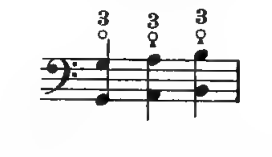
This is not of great importance to the composer, for all octave-passages on the Cello are really too risky for orchestral use. Occasional isolated double-stopped octaves may, however, quite well be used if not taken too hastily. The following example, from which the whole of the Wood. Wis at ar be, ard mited, will berate this porat The passage occurs at Bar 25 phony. The interpolated note! in the Cello part (Bar 8 ot the extract) needs no change of position, as it merely involves litting the third finger and sounding the open string. The finger is then replaced and the octaves resumed in the original position.
1 When the thumb-note jumped-to "happens to be the first harmonic of an open string • the danger is minimized, because this first harmonic will come out, even if the position of the finger is not mathematically correct."— Widor. By " first harmonio" the octave above the open string is meant. The expression "position of the finger" would be more correctly "position of the thumb."
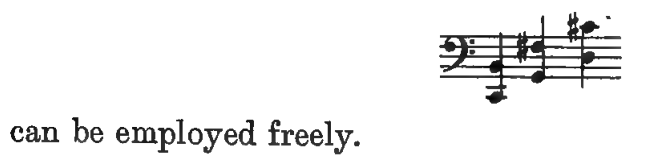
The three octaves in which the lower note is an open string, viz.

can, of course, be used with freedom in the orchestra, but anything in Even brilliant the nature of octave passages had better be avoided. regularly in public, never
Chromatic Left-Hand Technique.
Cellists have a very simple and regular chromatic technique. It consists in filling up the six semitones which oceur between any two open strings with a repetition of the fingering 1, 2, 3. This is applicable to all the strings and all the keys. The differences of b or i cause no alteration in the fingering.
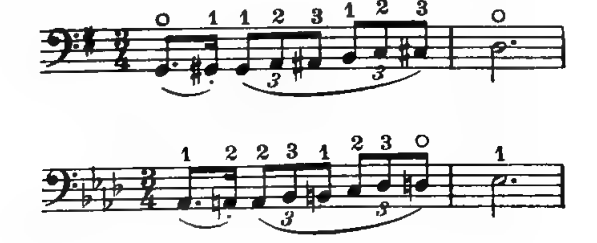
It will be seen that this technique is much more satisfactory than that of the Violin and Viola. Each separate note has a separate finger, and even ordinary players are able to obviate the bad effect that might be supposed to be inseparable from passages where there is so much shifting. Furthermore, this system of separate fingers gives each individual semitone a clear-cut consonantal distinction. There is an absence of that blurred portamento effect which is inevitable on the Violin when two adjacent semitones are produced by sliding one finger backwards or forwards on the string. It only remains to add that the chromatic technique is applicable from the low C (4th string) to the A one octave above the Ist string. Above that it is as well to avoid chromatic passage-work altogether. To be effective and even possible in that register chromatic passages must be quite short and simple. Lengthy chromatic scales and figures which have an elaborate chromatic contour are best transferred to the Violas.
Three clefs are used for Cello music-
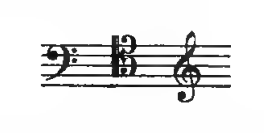
The bass-clet is employed for the lower- and middle-registers, the tenor-clet for the next higher register, and the treble-clet tor the topmost notes of all. All these three clefs are used nowadays with their proper pitch-significance. It is quite obvious that the use of the tenorclet is something of an anachronism. The sole object in using more than one clef is to avoid leger-lines. The treble-clet, however, owes its general acceptance principally to the fact that it follows the bass-clef
In a few Cello-passages, however—those which lie
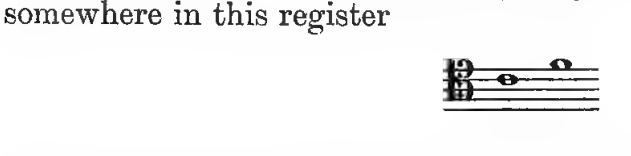
—the employment of the tenor-clef obviates the use of leger-lines. l'assages, therefore, which lie in and near this register, let us say,
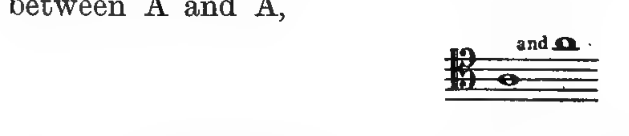
are generally written in that clef. Anything that lies continually above middle U is much better confined to the treble-clef
The convenience of using the treble-clef for the top register of the Cello was quite understood by the classical German masters. However, the medicine-man's primitive idea of surrounding his craft with as much mystery as possible was too much for their good intentions. Having adopted the clef for the sake of its convenience, they wrote their passages in that clef an octave too high. This prevented it becoming too convenient. Consequently these few simple notes

appear in Beethoven's Eb Quartet thus :
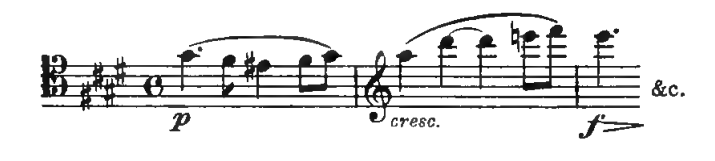
Sixteen leger lines used where none is necessary. Any argument which justifies the good sense of writing the passage an octave higher will also justify the better sense of writing it two octaves higher.
Upward Compass.
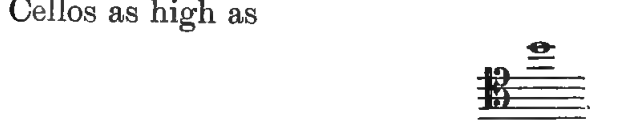
The note
nay be suggested as a reasonable upward-limit for orchestral writing ut it is difficult to lay down a hard and fast rule on this point. On must remember that cellists play with comparative ease in the higher positions on their top-string. " This is by no means a recently acquired accomplishment on their part. Haydn? writes for the mass of his
and Beethoven does not hesitate to take a Solo Cellist a fourth higher. This is the phrase in his own step-ladder notation:
Example 261

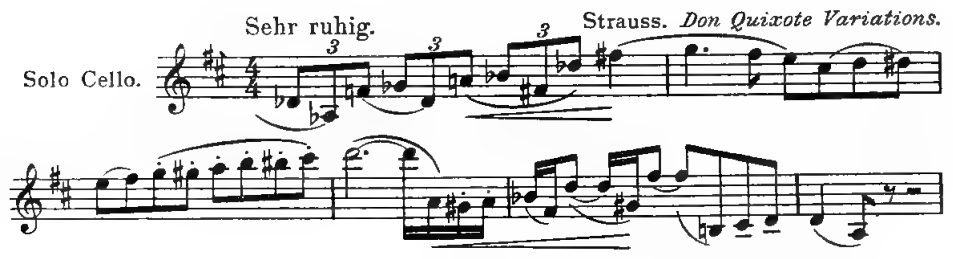
Passages written in these lofty nipping altitudes are fairly common in the most modern school of orchestration. On the other hand, it must not be overlooked that such passages, it they are really to come off when played by a dozen instrumentalists, must have a certain simplicity and suitability of outline. Cellists as a body are excellent
1 As in the Viola, the Natural Harmonic A a fourth higher may be included in its normal upward compass.
¿ Largo of Symphony in G (No. 13, B. and H.).

it would need a very rare group of executants to perform satistactorily Strauss's solo-phrase which portrays the last struggle and aspirations of the dying Knight.
Example 262
Chords.
Owing to the length of the strings and the consequent difficulty in copping groups of notes with the fingers, the number of Cello-chord ' a good deal smaller than those available on the Violin or Viol
Double-Stops.
Needless to say all combinations of adjacent open strings are possible. Furthermore, it is unnecessary to detail all the double-stops They follow the same general intes ish one of the to string heading Toly
Double-stops in which no note is open.
The best general rule to give here is that all perfect fifths, mino and maior sixths, diminished and minor sevenths, mav be used oro vided the top note is not higher than
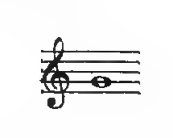
(1) Avoid all major sevenths. Their stretch is too great.
(2) Perfect fifths are more satisfactory, and may be used with less
apprehension on the Cello than on the Violin and Viola.
Triple-stops in which two notes are open.
These follow the same general rules as those applicable to the Violin. See page 320.
Triple-stops in which one note is open.
The following are available: Combinations of the open note
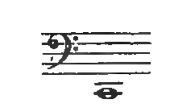
with any kind of fifth or sixth of which the lower note is either of the
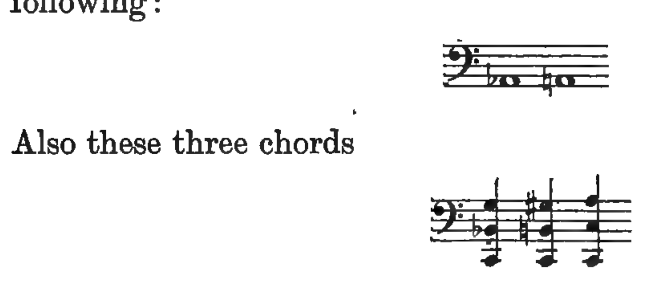
Combinations of the open note

with any kind of fifth or sixth of which the lower note is any of the

In combinations of the open note

the bro-he od not of the hond are of course tral the Beared 4e strings.
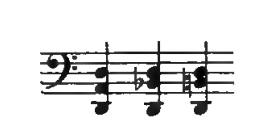
In combinations of the open note
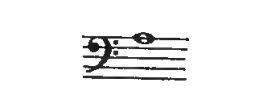
the two-stopped notes of the chord are on the 2nd and 3rd strings. The only chords which have any orchestral value are these three:
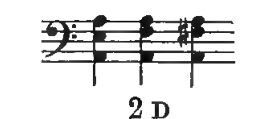
Triple-stops in which no note is open.
The general rule here is the same as that for the Violin. See and

There are, however, these two added limitations:
(1) No chord may contain any sort of seventh.
(2) The topmost note must not go higher than
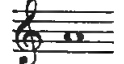
Quadruple-stops in which three notes are open. The rule is the same as that for the Violin. See page 322.
Quadruple-stops in which two notes are open. Combinations of the two open notes
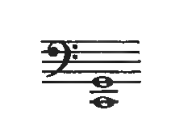
with any simple fifths and sixths on the two upper strings built on
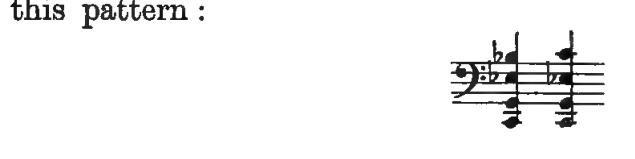
The upper parts of the chords must not go beyond
Quadruple-stops in which one note is open.
Practically only those in which the three upper parts are arranged on this model
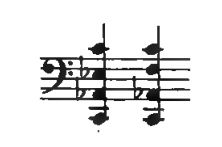
The upper parts of the chords must not go beyond


Quadruple stops in which no note is open.
Practically only those in which the four parts are arranged on this model
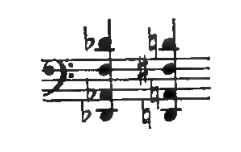
The upper parts of the chords must not go beyond
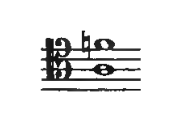
The above are the general rules, stated as concisely as possible. The following is a list of the most serviceable chords for orchestral use. They and for-ped fino ad simple tw-part intervals, and then as three-
Iwo-Part Intervals.
Seconds. Only those which contain an open-string—viz.,
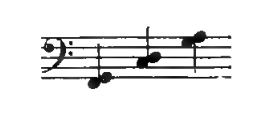
The following are less satistactory :
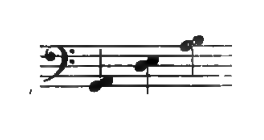
• these cases the lower (open) note is playea on the upper strın hile the upper (stopped) note is played on the lower strin
Thirds.

But note that those taken on the top strings are the most satistactory,
ane tsed- top, min ie, or botte string se e lat sihic hie ever stringr
positions (for the left hand) are most certain.
Fourths. In addition to the augmented fourth on the low Db
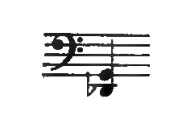
all perfect and augmented fourths are possible, provided the lower note is any note chromatically from
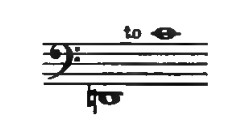
Fifths. All perfect fifths chromatically upwards from
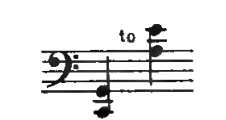
Augmented fifths may be regarded for purposes of technique simply as minor sixths.
Sixths. All minor and major sixths chromatically upwards from
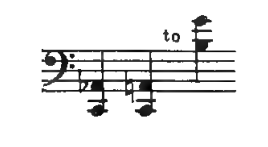
Sevenths.
Minor sevenths are as well avoided unless the lower of the two notes is an open string,
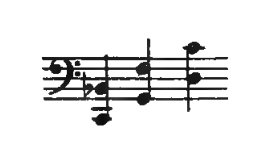
All other minor sevenths are somewhat uncertain in the orchestra. However, they have to be used occasionally when writing for the Strings alone. If no other arrangement of the seventh can be made they may be used at a pinch. In that case the limits of
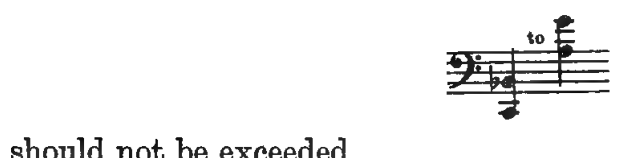
Avoid stopped major sevenths altogether. Only rarely can cellists stretch so great an interval with ease and accuracy. The three major sevenths which involve no stretch—viz., those which have an open string as their lower note,
Three-Part and Four-Part Chords.
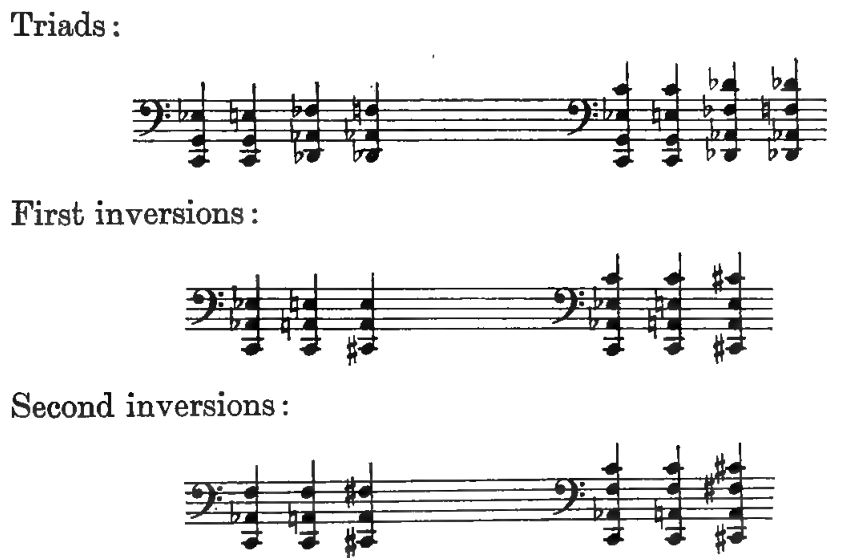
Triads and their inversions.
All major and minor triads and their first and second inversions, provided the note
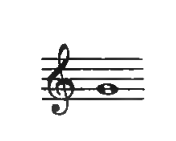
is not exceeded as the top note in any chord. There is only one pattern for each group of these chords, and that pattern, in three-part and four-part harmony, is as follows:—
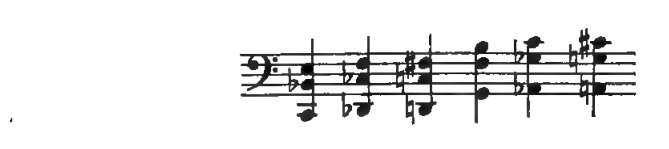
Dominant Sevenths.
These chords, which can be obtained in a practicable form in most keys on the Violin and Viola, are scareely worth using on the Cello. Le saree-parts only six are worth considering-viz., those in the , Go, Gа, о, До, 24. They are as follows:
In four-parts, only this chord in the key of F is of any use:
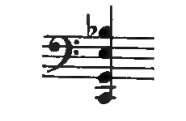
All the other four-part dominant sevenths are impracticable in the orchestra, tor a simple reason. The bass-note and fifth have to be BALE stopped by the Ist finger on the two bottom strings. The natural method of playing a four-part string chord is then to stop the 2nd string with the 2nd (or 3rd) finger slightly farther away trom the nut, and to stop the top string with the 3rd or 4th finger still tarther insay This is the nort, leade the in is on l stridd dominant seventh. The third of the key-note is higher on the 2nd string than the minor seventh is on the Ist string. The notes of the chord have therefore to be taken in an awkward and unnatural position. In reference to their nearness to the nut, the bass note and fifth come first: then comes the dominant seventh (on the top string): then the major third (on the 2nd string). This artificial placing of the fingers is possible as well on the Cello as on the Violin and Viola. At the same time, it is not congenial to their nature. Chords so arranged are never very effective in performance.
Dominant Ninths. None possible but these two:
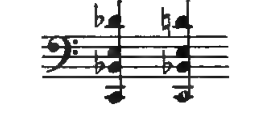
and, for reasons given above, these are better avoided.
Parts of "Diminished Sevenths."
In three-parts these may be used at a pinch, but they almost all involve the awkwardness of fingering which has just been described The awkwardness is least felt in those which have an open string ar bass-note
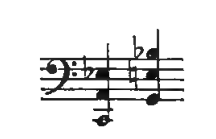
When the Ist finger has to be used to stop the bass-note the chords are much more crooked and tiresome to play. If they cannot possibly be avoided, they may be written on the pattern given above. The upward limit should be top G
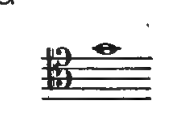
In four-parts all "diminished sevenths" are out of the question.

These are quite practicable in three-parts. In four-parts all, except the lowest possible chord which has open C (4th string) for its bassnote, require a certain amount of time. The player has to adjust each ot his four fingers on the four strings in an ascending semitonic degree He must therefore have the opportunity of fairly fixing the chord before playing it. Otherwise it will tend to sound like two two-part chords broken in the middle. The upward limit for the top notes of these chords is the same as that for the triad and its inversions-high G—and the only models on which they should be written are
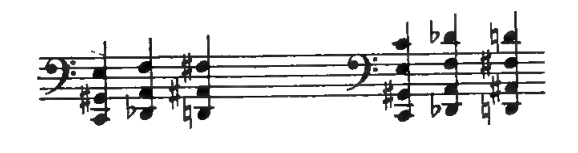
Chords built up on any of the three following models must be avoided
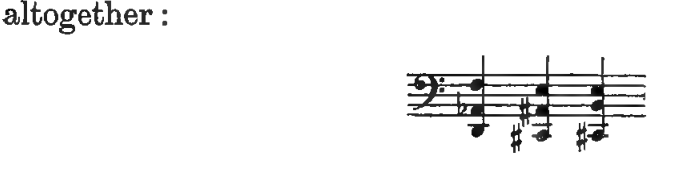
Any playable chords can be taken in arpeggio; but harmonic accompaniments built up in this way, though by no means unknown, are less common on the Cello than on the Violin and Viola. This is partly due to their weight, and partly to the almost necessarily wide downward spread of the chords. Still they are quite practicable, and, especially in the mf and J, very ettective.

The technique, notation, and available list of Natural-Harmonics s exactly the same on the Cello as on the Violin and Viola ras said above under the heading «Violin "1 can therefore be read o the Cello, if transposed down a twelfth.
Artificial Harmonics.
The technique is the same as on the Violin and Viola. The compass, however, is a little more extended. On the Violin and Viola the upward limits are about
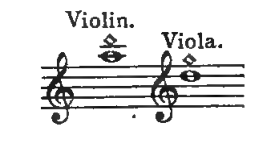
1 Page 328.
On the Cello the limit may fairly be extended to
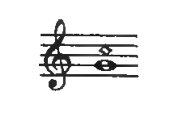
The complete Harmonic compass of the Cello in both Natural and Artificial Harmonies is therefore

Of these notes the first three can only be played in Natural Harmonics. The rest can all be played in Artificial Harmonics, and the notes which are marked thus + can be taken both ways.
A very simple example of a chord for two Solo Cellos playing in Artificial Harmonies has already been quoted from Humperdinck's Hänsel und Gretel.! The notation in the Full Score is of course not the one printed above, but this:
1st Cello Solo.
19p Flageolet.
End Cello Solo.
pp Flageolet.
The upper of these two parts is another example of the license mentioned above? The sound two octaves above the open string is actually performed as a Natural Harmonic. The second Cello-part can only be played as an Artificial Harmonic.
Shakes.
As with the Violin and Viola, shakes, both whole-tone and halftone, may be emp ped through pratoly tele of the a ing vibrations produces, on the Cello, a somewhat tubby effect. This applies in some degree to the bottom string of the Viola also. On the Cello it is as well to avoid, except for a particular effect, shakes on the C string.
The Cello Bow.
The Cello Bow is shorter, heavier, and less elastic than the Violin arrever he greater constructional peretion of the Violin coups d'archet. Cello gives it an advantage over the Viola. All the bow-strokes, not merely the heavier bow-strokes, are quite congenial to its easy, freespeaking nature. Nevertheless it shares with the Viola its antipathy to lengthy slurs. In the f and mf especially these should be dealt out

with a somewhat niggardly hand. More particularly in cases where an appreciable melodie crescendo is called for, the player is handicapped by long slurs. He is compelled either to alter the phrasing or to harden and tighten the tone. If the composer breaks up the phrases and remembers (1) that the point and the nut are respectively the weak and the strong parts of the bow, and (2) that therefore the V is the best crescendo stroke, he will secure an accurate ensemble in the phrasing and a better melodic effect.
In a more general way it may be repeated that the careful adjustment of slur-lengths to tone required is an insurance against careless orchestral playing. In p and pp passages the judicious lengthening oi the slurs makes a crescendo or an "orchestral mezzo-forte' a practical impossibility. Then, when a crescendo is required, the breaking up of the slurs gives the String-players a surprising ease and freedom of movement. Attention to small points of differences, such as this, meets its due reward at rehearsal.

Both Bowed- and Fingered-Tremolos are in common use, and there is little to add to what has been already said on the subject? Bowed tremolos in the upper register are naturally not otten allotted to the Cellos. In the middle-orchestral-register, even it the Violins are not at liberty to make the tremolo, it is generally better to secure the chord by a division of the Violas rather than by employing the Cellos that purpose. Lower still, in the bottom- and lower-middleregister of the Cello, tremolos are often written for special purposes.
In arranging Fingered-Tremolos for the Cellos it is important to notice that the utmost stretch possible between the Ist and 4th fingers on the same string is only a major third: with the Ist finger on one string and the 4th finger on the next higher string the maximum stretch for most players is a minor seventh. A point to be kept in mind with regard to the Cello tremolo is that it is something more of a "fact," something slightly more present to the consciousness than the tremolo of the upper stringed instruments.
Everything that has been said already with regard to the ponticello, the sul tasto, the col legno applies as much to the Cello as to the Violin. The Mute is in regular use. It must, however, be contessed that one rarely hears a group of orchestral Cellos adequately muted. The little "clip" mutes scarcely veil the tone at all. In fact they rob the instrument of its romantic tone-colour, and do not substitute for it the proper mysterious muted quality. Then, again, light wooden mutes without sufficient substance are often chosen so that their loose clutch shall not harm the bridge. In either case the result is disappointing. The lower strings are enfeebled without being much altered, while the tone-colour of the top-string changes, not trom one kind of poetry to another, but from poetry to prose.
1 See what was said on this subject above, page 390. & For Cello-tremolos, see Exs. 86, 191, 231, 234, 275.
The Pizzicato.
A special word must be said with regard to the Cello pizzicato for, besides its stereotyped usetulness as the ordinary bass of the string pizzicato, it possesses exactly the right mixture oi suppleness an what may be called left-hand pianoforte resongs. Used ayin, it giat a deligh call piquancy and a sort of subordinate prominence to its part. It is happiest when contrasted in a quiet ensemble with the bowed upper Strings or with the Wood- Wind. A Cello part of this sort generally lies, especially in the lighter forms of music, somewhere between the 3rd string and the note D one twelith above. It usually includes a statement of the true bass at the beginning of each bar followed by an easy and not too rapid arpeggio on the two upper strings. These pizzicato parts never stray very far outside the bounds of a somewhat severe simplicity. Broken chords that he well under the hand and short, easily-played scale passages are the most effective. In this medium even the simple alternation of tonic and dominant sounds charming. Here are the first tour bars trom the Upening Chorus of The Mikado (Act II.).
Example 263
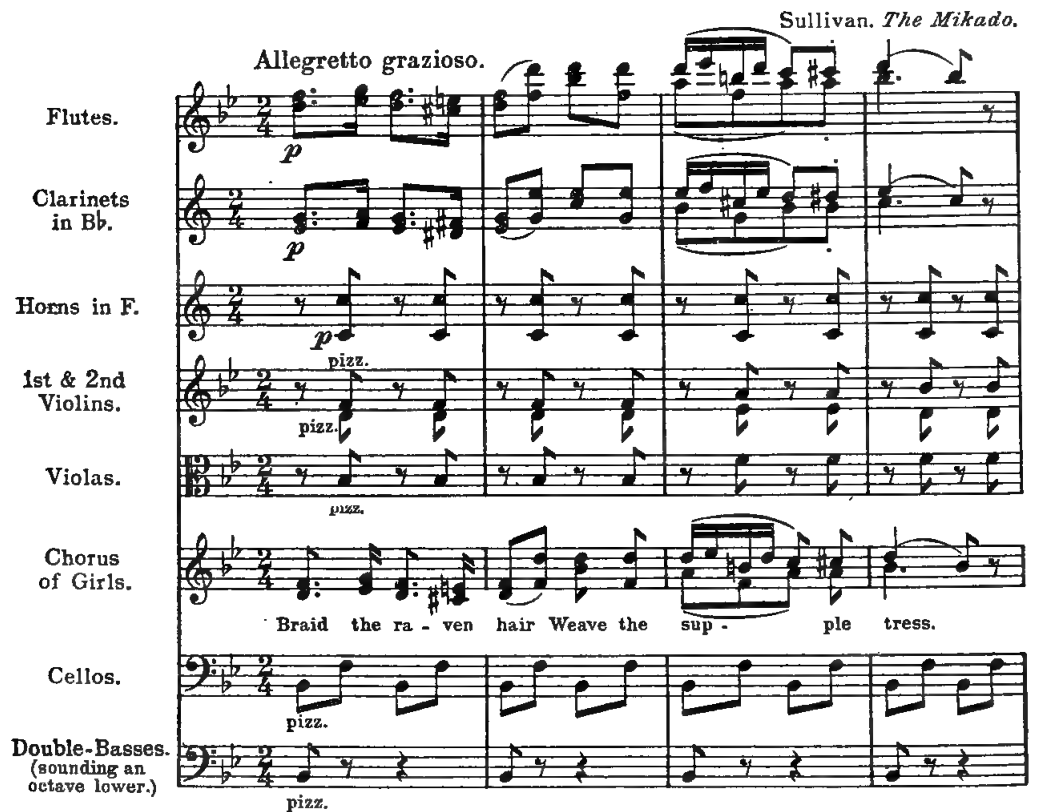
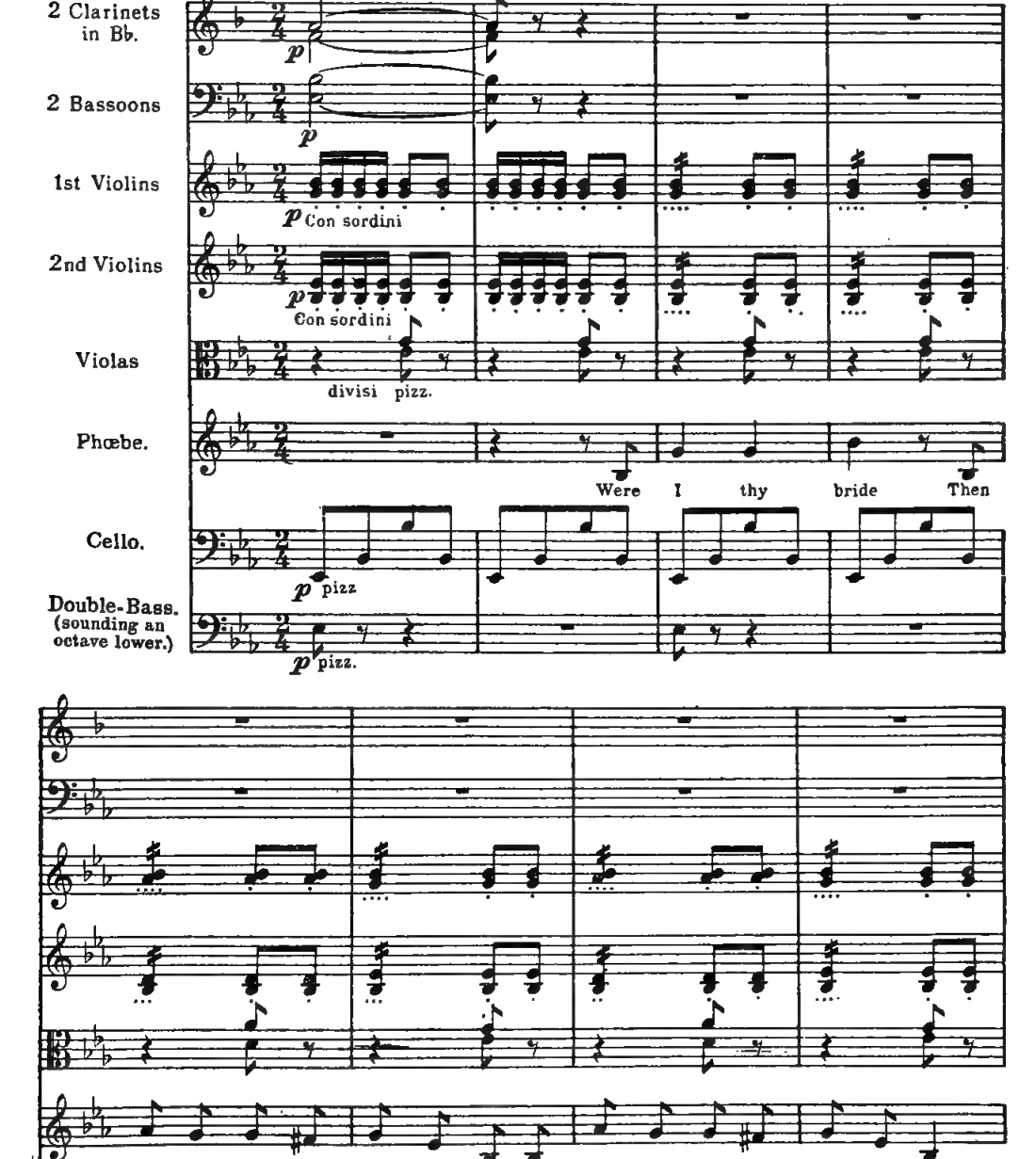
Sullivan's touch in passages of this sort was of the lightest. Of all the accompaniments in his Comic Uperas perhaps the most graceful is that to Phoebe's song, Were I thy bride, in Act I. of The Yeomen of the Guard. It is simplicity itself, merely repeated chords on the muted
Violins, a simple puzzicato quaver figure on the Cellos, helped on the second halt of the bar by the divisi Violas, a pizzicato Bass-note every other bar and a four-part Wood-Wind chord to set things going. As a miniature it is exquisite.
EXAMPLE 264. Allegretto Grazioso. Sullivan. The Yeomen of the Guard.
To hold my wealth of love all the world be

The student would do well to compare the sound of this as played on the pianoforte with the intended 'sound in the orchestra. He would also do better to consider, not only the notes which Sullivan has written, but the many other notes which he might have written but didn't.
The type of Cello pizzicato seen in the last two examples is equally. effective when the upper parts are played by the Wind. In the general mf ensemble of Strings, Wood-Wind, and Horns, the Cello part may be associated with the dry staccato of the Bassoon. In the latter case it is often wise, either to divide the passage up between two Bassoons, or, if the figures are allotted to a single instrument, to omit the bassnote. The lower staccato notes of the Bassoon are sometimes a little too heavy and the Double-Basses, of course, supply the omission. In addition this arrangement gives the Bassoonist regular places for breathing.
In the more serious forms of music the Cello pizzicato, without being bound down to a persistent figure of accompaniment, appears in delightful combinations with the Wood-Wind and Horns. Brahms often makes a very happy use of this method in his Allegrettos. Of these one cannot quote a better example than the opening ot the sro Movement of his Symphony in C minor.
Example 265
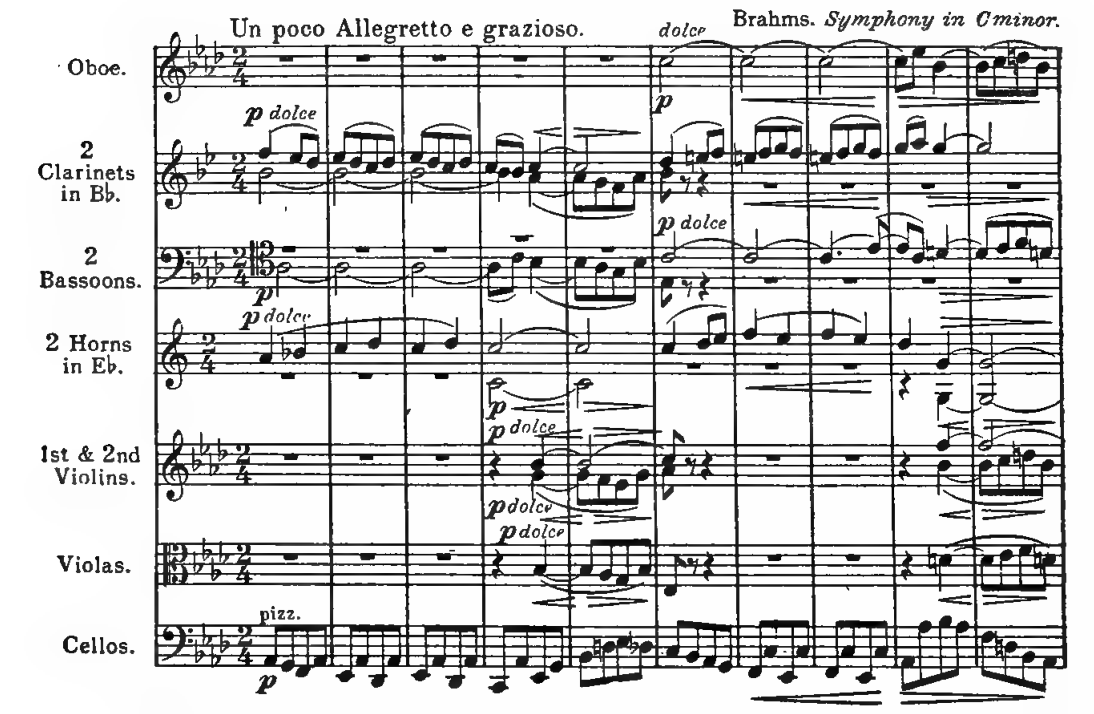
Here the flowing Clarinet-tune and the easy upward movement of the Horn are charmingly contrasted and combined with the pointed Cello-bass. Notice also the unexpected and happy entry of the three upper String-parts, p dolce - -, and their no less unexpected and happy exit. The held Oboe-C with its little crescendo, followed by two bars of movement diminuendo, and then twelve bars rest, is well worth noting for its tiny perfection. The student should examine the whole of this movement in the full score, as the pizzicato Cellobass plays quite a prominent part in it throughout.
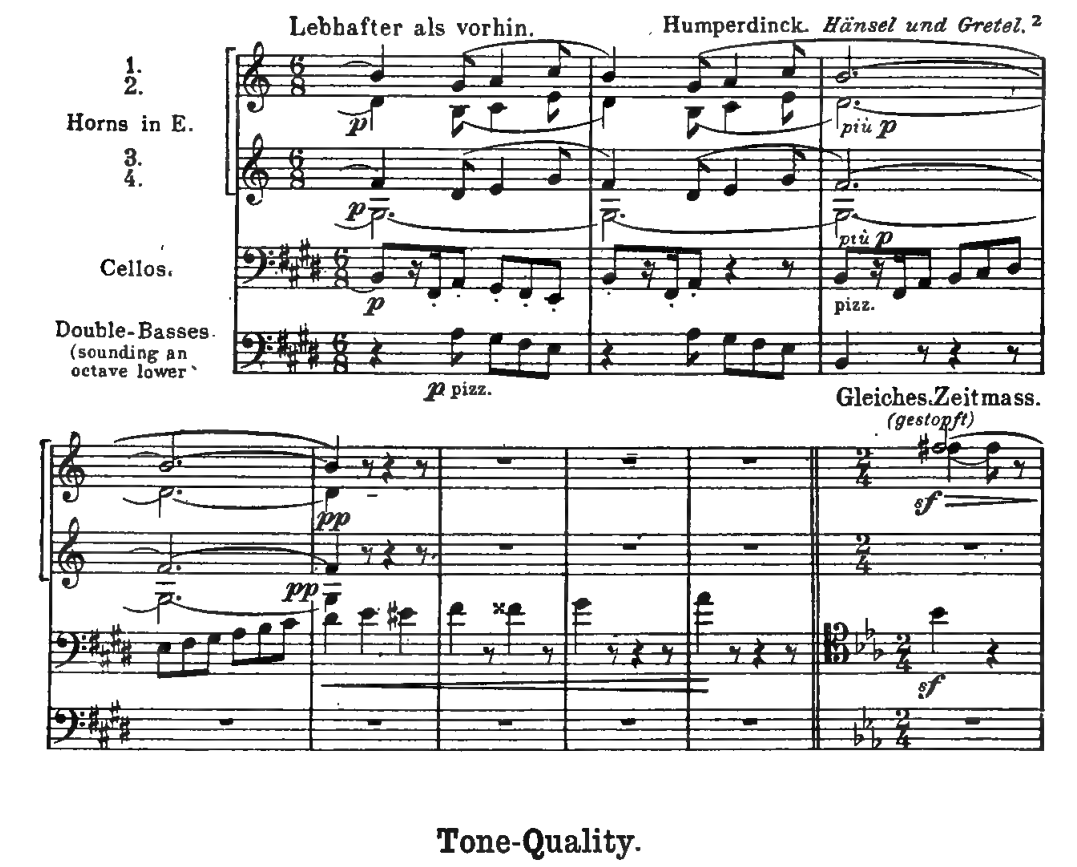
As with the other Strings there is a certain upward limit beyond which it is inadvisable to write the pizzicato. This limit, fixed by the shortness of the string and the consequent dryness of the tone, may be exactly Illustrated by the little unaccompanied scale-passage whic leads from Scene II. to Scene III. in Act III. of Humperdinck' Hansel und Gretel. Anything higher than the last note of this passage-top Bo-is not very effective.
Example 266
The Cello is, in the instrumental force, the vocal complement of the Violin. The one is the poet of the orchestra, the other the poetess. The one associates itself with our ideas of the Male-Voice, the other with those of the Female-Voice.
1 The slow movement of the same Symphony contains a good example of the Cello and Brain ho or leg be all a are ray cal polin pet man e, The rest of
"A Bassoon-fifth, B and F$, is omitted from the first beat of this quotation.
It is scarcely necessary to describe the poignant aching quality of the Cello top-string, which, in the three semitones of Iristan, is able to foretell a drama. The use of this tone-colour for melodie purposes is so common nowadays that one may almost call it an abuse. It 18 wise to bear this point in mind. The singing ecstatic quality of the Cello top-string is not for all tunes. Unless they have something of grief, of passion, or of chivalry they will suffer from an excess of emphasis.
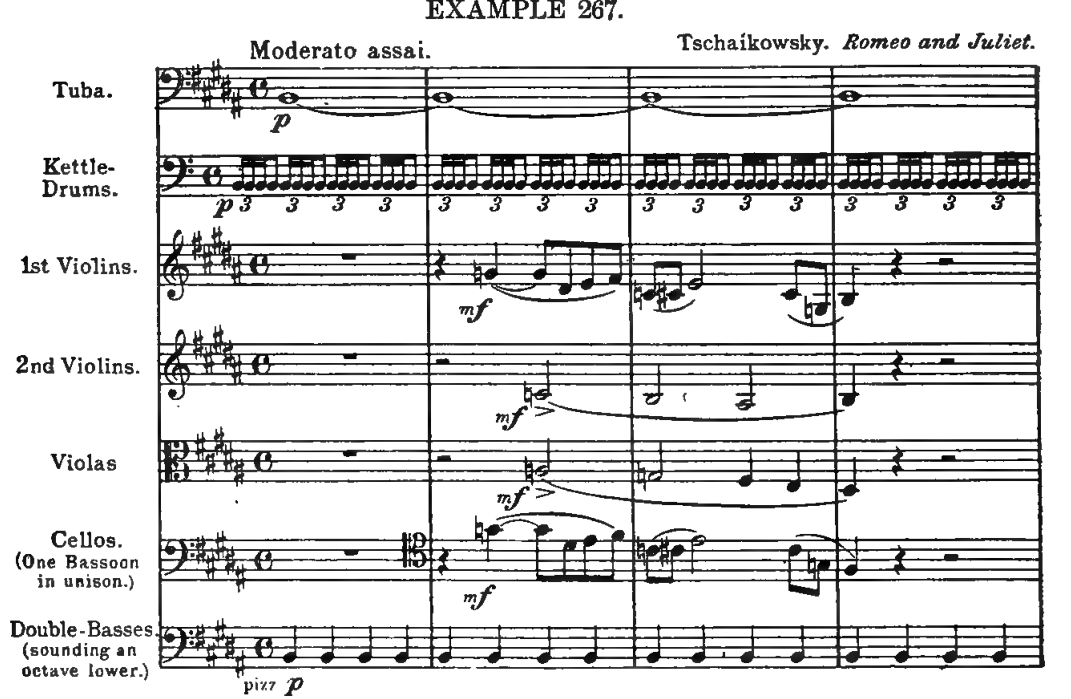
Some few examples of the Cello used on its top string have already been given.! The following extract, however, shows the somewhat unusual melodie unison of the Cellos with the Ist Violins and one Bassoon. The passage occurs at the extreme end of Ischaikowskys Fantasy Overture Romeo and Juliet, and is interesting, not only from the point of view of the string ensemble, but as an example of a persistent. Drum rhythm supported by the Bass pizzicatos and the tenuto of the Tuba.
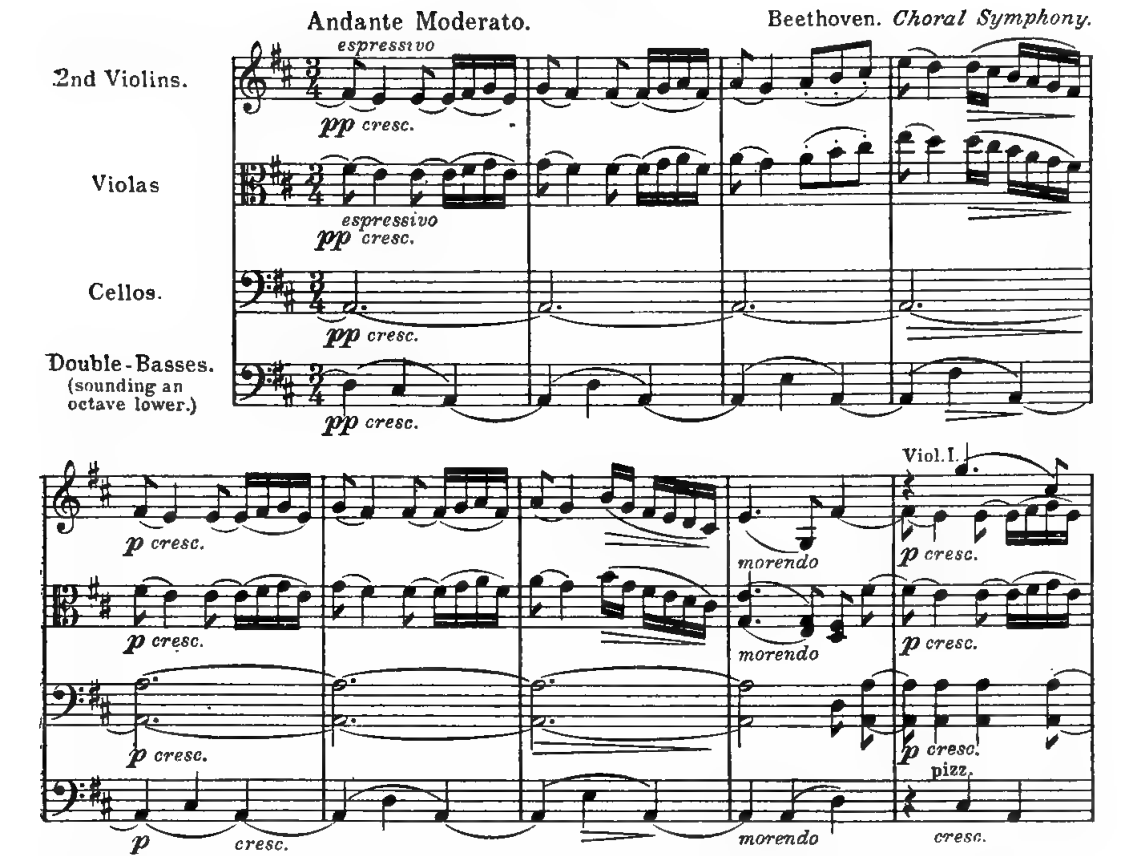
To the musical ear the "D" is probably the most beautiful string on the Cello. Its notes differ totally from • the same notes when played on the Viola. The latter instrument has a certain hollow tragic sound on its C string, a sound that is easily capable of orchestral prominence On the other hand, the Cello "D" is characterized by a sort of caressing reticence. In fact, it is not going too tar to say that, ot all the sott, silky sounds in the orchestra, it is the softest and silkiest. Forceful it

example of its lovely tone-quality one need travel no further than

EXAMPLE 268. Allegro assai. Beetboven. Choral Symphony.

The bottom (covered) strings of the Cello bear some analogy to those of the Viola, but their tone is more "straightforward" and less unexpected. In solo passages they have a certain mingled smoothness and austerity which fits them for the pertormance of very serious and deeply-felt passages. An excellent example covering the range of the three bottom strings is to be found in the familiar Cello passage with which the 3rd Act of Die Meistersinger opens. Another and even better instance may be quoted here from the 2nd Act of Lohengrin.
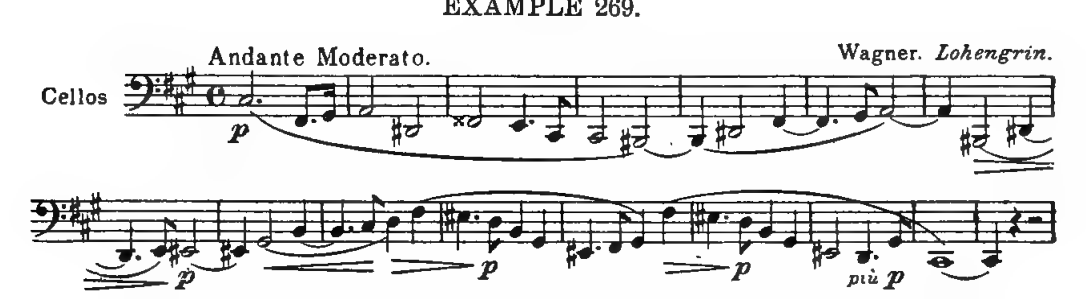
In the above example the long slurs, so characteristic of Wagner, are, ot course, absolutely impracticable as tar as the orchestral player They are, in tact, not bow-marks at all, but merely directions that a legato performance is required. the players adopt a bowing each at his own sweet will. Fortunately it is quite easy to break up a passage like this into its component bowphrases. Even in the first long legato, which extends for six bars and a crotchet, it is quite obvious that a new bow must be used for the repeated Ci at the beginning of bar 4. Similarly the second crotchets of bars 5 and 9 would be naturally played with new bow-strokes. Nor are these the only places where this long legato can be broken up to suit the exigencies of the Stringtechnique. The student may profitably examine any of Wagner's colossal slurs from this point of view, always' remembering that the breaking up of a cantabile into its necessary bow-phrasing does not destroy its legato character, and that the difference between the two ways of writing involves the difference between personal accuracy and the merely haphazard.
It need hardly be said that one of the principal functions of the Cellos, in their middle and bottom registers, is to play the bass, and this they do quite efficiently, provided there are enough of them in the orchestra. "Remember that violoncellos supply a perfectly adequate and sonorous bass without any double basses at all, and that the double basses are only an adjunct to them in this capacity for purposes of reinforcement and not vice versa."1 This is true in a general sense, but more particularly with regard to the String legato, as can be seen from the many pages in Die Meistersinger where the Basses are omitted. In other cases even when the Cellos are the main support of the barmony an occasional pizzicato for the Basses helps the Cellos
As more and more Wood-Wind is added to the orchestra. mass the addition of the Basses becomes more imperative, and when the weight of the Horns is superadded, they cannot be dispensed with, even in the concert-room. Un the other hand, in those theatres which are devoted to light Upera-that is to say, in the vast majority ot Houses —where the orchestra averages about 35, the Cellos are, except on the rare occasions of quiet legato String-harmony, a not sufficiently solid foundation. The Basses, therefore, have to be used much more continually, though, even when both are playing the bass, in a manner different from that appropriate to the Cellos.
One may note that, in those cases where the Cellos alone are supporting the weight of the other strings, they do so more satistactorily when their notes are fairly near the rest of the harmony. When, in these circumstances, they descend to their bottom-string, a certain hollowness becomes apparent. This may be an acoustic fact or it may be due only to our ideas which associate this type of passage with the Double-Bass, and so call for its solidity of utterance and its easy power of reintorcing the harmonies with its own wealth ot upper-partials.
The union of the Violas and Cellos as a separate tone-group has already been discussed under "Viola." Nothing more need be said on that point. Two other combinations may be mentioned.
(I) The union of Cellos with Basses in a low-pitched harmonic or contrapuntal combination. In passages of this sort, providea the string-quality is called tor, there is usually only a choice in the arrangement of parts. It there are not more than two of these the arrangement is obvious. The Cellos take the upper and the Basses the lower part. In three parts it is usually better to divide the Cellos; and, it necessary, to reduce the number of Basses. The Cello drvisi is better than double-stopping even when the latter is practicable. This applies more especially to the p and the mp. In the rare cases where there are more than three parts and the top-part cannot be played by the Violas, it is, as a rule, better to subdivide the Cellos again. However, if the two lower parts are merely playing in fifths and octaves, there is not so much danger of the unpleasant clash of overtones resulting from the divided Bass-parts. If the Basses are divided it is always better for safety's sake to indicate the use of more Bass-players on the bottom part.
(2) The Cello Divisi. This highly effective combination is occasionally used to form a rich harmony accompanying the lat Cello. The chords are generally well spread in tour or five parts so that the two top Cellos at least are playing on their A-string. In arrangements of this sort a Solo Cello usually plays the melody, while each of the
1 Stanford, Musical Composition, in this Series, page 106.
middle parts is assigned to two players; a couple of Basses doubles the bass-part either in the unison or the octave below. See the wellanor begiodi on of infine where el overdurand the passage, It may be mentioned that though this Cello divisi is generally used in a sort of full-dress way, it is highly interesting when employed merely as a passing ettect. The rich sound of three or four Cellos playing in harmony on their top-string makes a delightiul change from the eternal Horn-harmony. In smaller combinations and in arrangements trom larger works it can, of course, be used to represent the Horns, and, in doing so, it often throws a new light on the orchestra. prospect
Up to the end of the eighteenth century the Cello in the orchestra was, like the Double-Bass, merely a bass-player. The two instruments ran together, a stag and an elephant in double-harness. Haydn and Mozart, asking only for a quiet uneventful journey, drove the pair well enough. So long as the ground was smooth and the pace easy the arrangement answered admirably. When, however, the musical coach was enlarged, rebuilt, and furiously driven by Beethoven, the old ruts and the old yoke-fellows were found unsatisfactory. Beethoven unyoked his pair. He saw that, except when every solid ounce of strength was needed for collar-work on a heavy road, the lighter animal would do better in a light cart of its own. in other words, he recognized the possibilities and the greater individuality of the smaller instrument. And his curriculum in these matters can be followed asily step by step trom its first starting-point in the Erorca symphony o its goal in the 0 minor and Choral Symphonies. Reference has already been made to the numerous places in his Symphonic works where he detaches the Cellos for purely melodie purposes. Un such occasions he usually doubles them either with a Bassoon, with the Violas, or with both. But his reformation is not merely the discovery of the Cello as a vehicle for orchestral melody. He also discovered the fact that the Cello demands a sort of writing different from that of the Double-Bass. If the student will take a Score of the Choral Symphony, see at once many places where the outline of the upper part is distinct from that of the lower. Greater freedom and range is allowed to the lighter instrument. In a Mozart work these differences scarcely exist. In a Beethoven work they do exist. Of course it would be an exaggeration to say that they show the same width of divergence as would be normal in a modern work. But the patent—in this case of nobility—goes to the inventor.
1" Mozart hardly ever gives the Violoncellos a separate part; Haydn does so somewhat oftener."—Gevaert. It is to be noted that the old masters all knew the capabilities of the Cello as a solo instrument, but hesitated to employ them with any freedom in the Haydn's Concerto in D is still reckoned a diffcult work by cellists, Mozart occasionally wrote florid passages for the instrument, for instance in the obbligato to Zerlina's song, Batti, batti (Don Giovanni, Act I.).
2 See pages 396, 399.
The Cello then is bequeathed to modern orchestral music in a three-fold capacity:
(1) As a plastic bass-instrument, either alone, in unison, or in octaves with the Double-Basses. (See the Storm at the beginning of Die Walküre, where for the first sixteen bars the Cellos and Basses are In actual unison and afterwards in octaves.) This use is, in modern music, rather more strictly confined to the quieter modes of expression.
(2) As a melodic vehicle. (See any modern score, for instance the top part of the Cello divisi in Act I. of Die Walküre or the Preislied phrases in Act III. of Dre Merstersinger.) In this use the Cello may e said to stand to-day very much where Beethoven leit it. The character of its tunes is altered, and their upward range a good deal extended, but otherwise there is little difference.
(3) As a medium for elaborate passage- and figure-playing. It is in this particular that the modern Cello writing differs most from the ancient. Beethoven foreshadowed the change, but did not bring it bodily forward. If, however, we open any score of to-day, say Strauss's Don Juan or Ein Heldenleben, we shall be at once struck by the tact that for a considerable portion of the time the Cellos are wholly detached from the Basses, and are playing difficult complex passages which have comparatively a much greater value in the general orchestral ensemble than is apparent in the classical style of Cello-writing. It is not merely that the compass is extended, but that the whole outlook on the instrument's capabilities and its proper place in the orchestra is

student, however, can hear its importance by attending any concert where a late eighteenth century work is brought into juxtaposition with one of the late nineteenth or early twentieth century.