 Playable Books
Cecil Forsyth · section 52 of 60
No. 48. The Viola d'Amore
Read and hear this section in the playable edition →
Er. Viole d'amour; Ger. Liebesgeige.
Ihis semi-obsolete instrument, a modification of the old lenor- Violin, need only be briefly mentioned here because of its use by Bach? and Meyerbeer, and its occasional appearance at antiquarian concerts.
Of its seven "principal" strings the three lowest are "covered" like the bottom strings of the Viola. The tuning is strictly in the
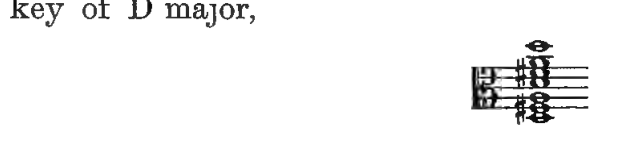
and the practical compass 3 is about three octaves and a fifth.
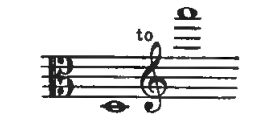
As with the Viola the alto-and treble-clefs are used at discretion.
The characteristic feature of the instrument is its apparatus of "sympathetic-strings." This, according to Gevaert, was a seventeenthcentury innovation based on the study of certain Asiatic instruments. Made of steel wire, each of the seven sympathetic-strings lies just above the belly of the instrument, and directly underneath the string with which it sympathizes. The exact tuning of these seven strings is not quite constant; that is to say, different players have at various times adopted different systems of tuning. But in any case the tuning is kept strictly to the chord of D major. Excessive accuracy in the tuning of the strings is an absolute necessity. This is a source of continual anxiety to the player.* If either of the sets of strings deviates in the slightest degree from truth they cease to be sympathetic one with another. The sympathetic-strings are of course out of reach of the bow, and are merely excited into a faint tinkling murmur by the vibrations set up in the air by their "principals." rather more curious and toy-like than musical.
The instrument is larger, heavier, less manageable, and less responsive than the ordinary Viola. It has two fundamental defects: irst, the defect of all the old Viol-family, an irregularly-spaced systen f tuning which precludes a regular and adequate lett-hand technique
1 See above, pages 299, 301.
2 There are two Viola d'Amore parts in the Bass solo, 'Betrachte meine Seel' (St. John Passion), and in the Tenor air that follows it. Bach writes both in the alto-and bassclefs for the instrument.
3 Without Harmonics, see below, page 406.
4 It used to be said facetiously at Covent Garden that when the Huguenots was put on, the Viola d'Amore player was always to be found in the theatre soon after lunch trying to get on tune.
and, second, a system of tuning too definitely attached to one key.! The instrument is, as it were, stamped or hall-marked with a keysignature. Its path is marked out for it before it begins to play. It Is a musica. chained-dog. When it strays out of the back-yard it is not merely bad-tempered and difficult to control, but it loses its snarl— the chief virtue of a watch-dog. In other words, when it is compelled to play in flat or in very sharp keys—that is to say, in keys where open D's, A's, and Ff's do not abound-the sympathetic-strings are either not heard at all or else only occasionally make their presence often extremely irritating to the musical sense.
preordained when the first modern Viola was strung. It has now only the interest of the unusual. However, its quiet tone-quality might still be used to characterize antiquarian melodies or stagescenes, In the key of D major, and in the sharp major keys immediately surrounding D, it has very great ease in playing chords, arpeggios, and simple passages founded on arpeggios. Indeed, when and ingen ground to de polk of Vasuch aly to yat be of it thod Only it must be on its own hall-acre of ground. It the student will remember the tuning, and the fact that the stretch of the fingers on the neck of the Viola d'Amore is about the same as on that of a large orchestral Viola, he will have no lifficulty in writing practicable chords and arpeggios
One of the chief features of the instrument is its power of playin groups of Natural Harmonics in the sharp keys. The Harmonies employed are Nos. 2, 3, 4, and 5. These are the Harmonies produced would hire the triage, the athen fouler nd the my someon 1, and the major third They can be taken on any of the "principal" strings, and the resulting sounds are as follows:
No.2

[In the above example the two "Svas" refer to all the notes below them, fourteen notes in all, and not merely to the top note of each The first of the above four bars contains the series of Octave- Harmonics (No. 2) produced from each of the seven strings.
The second bar contains the series of notes produced as Harmonic No. 3 from each of the seven strings, and so on with the other bars.
It follows that the four Harmonics possible on the bottom-string are to be found by reading the four lowest notes of the above chords from left to right. Similarly, the Harmonies of all the other separate strings may be dissected out from the chords.]
With regard to these Harmonics the student cannot fail to notice
1 As a way out of this difficulty Berlioz suggested sets of instruments tuned in different keys, such as C major and Do major.
that some of them are duplicated or even triplicated on more than the Violin. It is, bowever, at uch gen tea importance on am nstruone string marmonic te Viole d'A may ba as of ben to malaguintent it the Harmonic-technique. to confuse in his mind these two facts:
(1) On all stringed-instruments, including the Viola d'Amore, every Harmonic except No. 2 (the octave-Harmonic) can be produced on the same string in at least two ways.
(2) On the special instrument under discussion, the Viola d'Amore, its cast-iron system of tuning gives the player considerable latitude in the choice of string. He can often get the same sound by taking it as a differently-numbered Harmonic on a different string? This choice of string is a quite different thing from the choice of method in taking the same Harmonic in different ways on the same string.
To give a concrete instance on the Viola d'Amore, the note
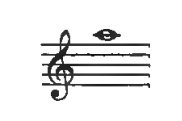
can be taken, by only one method, as the octave-harmonic (No. 2) on the 2nd string. It can, however, also be taken by two different methods, as Harmonic No. 3 on the 4th string; or, again, by two different methods, as Harmonic No. 4 on the 5th string.
'The choice both of method and of string is a matter for the player. In writing Harmonic-arpeggios, however, when this choice exists it 1s renerally satest to contine them where possible to a single Harmoni Series (No. 2 or No. 3, etc.) This has been done in the short exampl given below.
The best notation for all these Harmonies is to write the open string in the length of note required, and to add diamond-shaped note at the place where the finger is to touch the string. Thus, it we suppose that a note one crotchet long is requirec by the music, the bottom notes of each of the four groups of Harmonies printed above, page 406, would be represented by
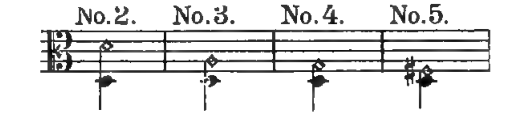
If this method is not adopted the passage should be written out at its proper pitch and the sign o placed above each note. In this case the bottom notes of each of the four groups of Harmonics printed on page 406 would be represented by

'Very much in the same manner that a Brass-player can often produce the same soun in various ways as Harmonics of a different number from different " fundamentals.'
Both notations will be made quite plain by the following example:
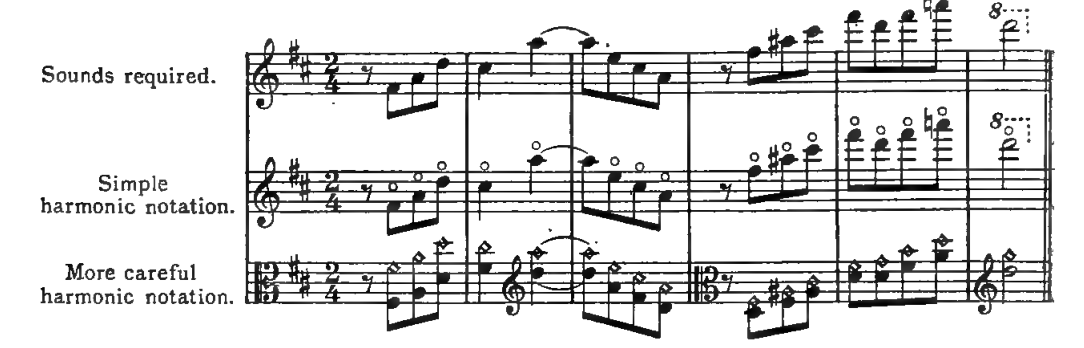
but the student is advised to adopt the plan of indicating the fingering by means of the diamond-shaped notes. If he does this he will keep more in touch with the difficulties which he is setting before the
Note.—In Berlioz's quotation from Raoul's Romance! the three bars of Harmonies with which the passage concludes appears thus:

This is confusing and inaceurate. With the exception of the last two notes ot the first bar these notes, if read in the treble cet, give one of the correct fingerings of the passage, but they do not indicate the string on which to finger. The correct notation and the actual sounds
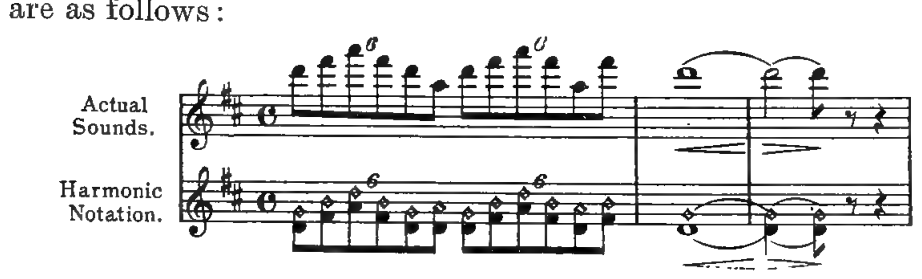
The high Ft which occurs five times in the first bar can, of course: be produced in four different ways as a Harmonic on the 4th string,
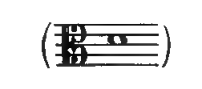
Of these only two enter the sphere of practical politics, viz.,

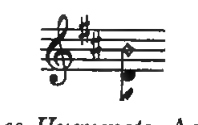
Gevaert, in citing the passage, writes the note thus :
1 Les Huguenots, Act I.
which is quite accurate and represents what a modern Violin-or Viola-

No. 5 Harmonic on a D-string.!