 Playable Books
Cecil Forsyth · section 60 of 60
No. 56. The Dulcimer (or Cimbalom).1
Read and hear this section in the playable edition →The Dulcimer is, like the Pianoforte, a percussion instrument in which the strings are set in vibration by means of hammers. As manufactured for use in Hungarian orchestras, it has a complete chromatic compass oi four octaves from
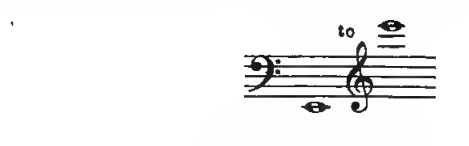
The scale is a "tempered" scale, and there is an arrangement for lamping the sound-waves. Two small wooden hammers are used by the player to set the strings in vibration. These are used one in each hand, and a surprising degree of agility and cunning is exhibited by the finest Magyar players in executing music which would at first sight appear to be quite out of the reach of such a primitive instrument. True two-part music is, of course, a stand-by in the Duleimertechnique; but, in addition to that, all sorts of complex chord passages and even elaborate part-writing can be, as it were, outlined by means of rapidly, pertormed arpeggios. Melodie passages, broken . chords, figures, and shakes are all in the character of this facile and adaptable instrument.
The part is generally, written, as tor the flanotorte, on tw bracketed staves in the treble- and bass-clets. It must be added that a great many of the most expert Hungarian players merely perform by ear. Their knowledge of the instrument and its capabilities is complete, and a single hearing of the piece to be performed is sufficient to suggest to the player an extemporization which adds materially to the effect of a small orchestra.
' Ger. Cimbal or Hackbrett.
APPENDIX. The Phagotus of Afranio.

its history and chief characteristics.
In the early part of the sixteenth century there lived a man called Afranio. He belonged to the house of the Counts Palatine of Albonese, and, according to the fashion of the times, was known as Afranio degli Albonesi, or, in Latin, Afranius Albonesius. He was a native of Pavia, a canon of Ferrara, and, though not strictly an instrument-maker, at any rate an enthusiastic musical amateur and an indetatigable collector of instruments. This man invented or perfected the instrument in question. If he did not actually christen it phagotus, he knew it by that name.
Very little more would probably have been heard of the Phagotus in musical history but for the fact that he had a nephew who combined the best elements of Paganism and Christianity in his imposing name of Teseo Ambrogio degli Albonesi (Theseus Ambrosius Albonesius). This nephew was, like his uncle, a priest. He was also a celebrated jurisconsult, a canon of the Lateran, and professor of Syriac and Chaldaic in the University of Bologna. In 1539 he published at lavia what we should call an advanced text-book on the Chaldale and Syriac languages, with mystica, and cabbalistic interpretations and notes thereon.
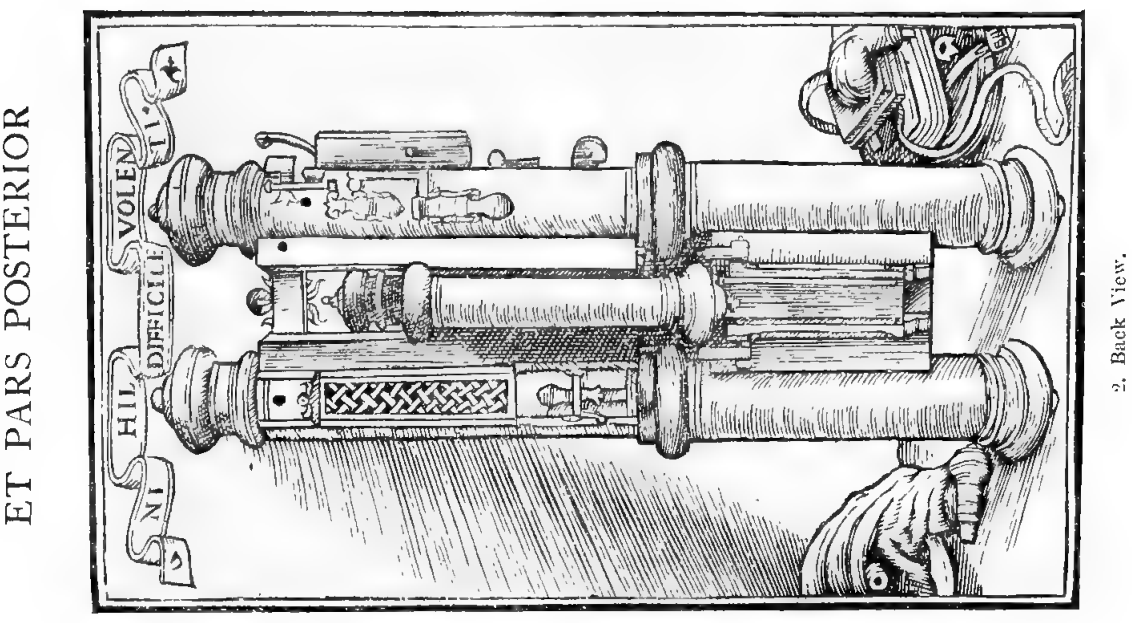
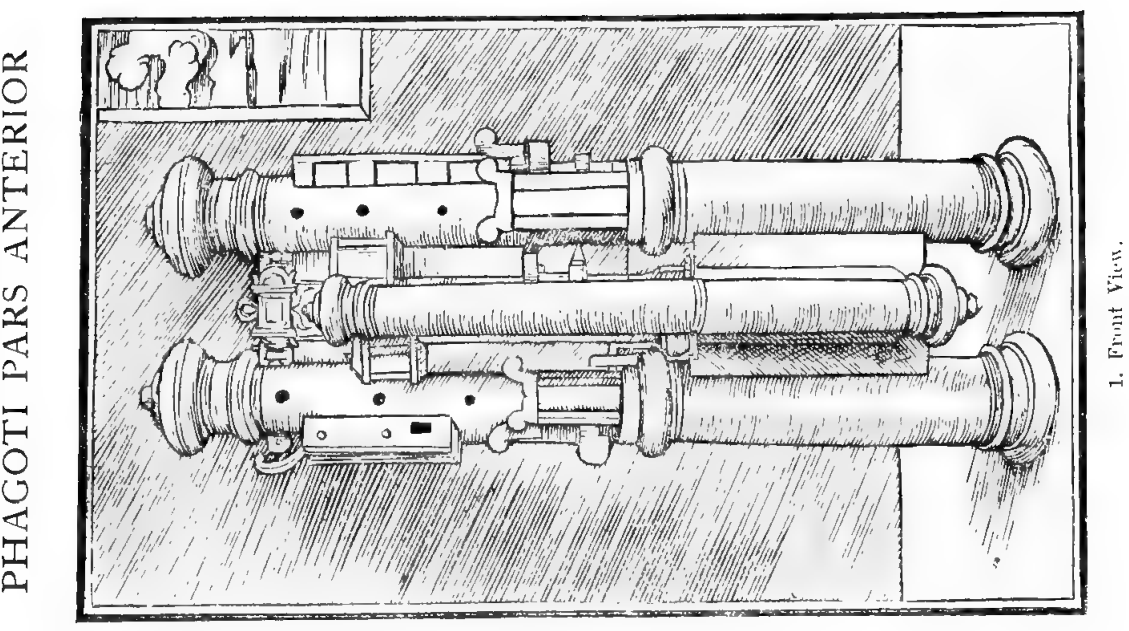
The greater part of this work is naturally devoted to linguistic and philological studies. On folio 33, however, having taken the root phag as far in "my uncle Afranio's as the Greek word ayóra, he suddenly drags singular instrument, the Phagotus," with the remark that its name is probably derived from the same root. After a fantastic and rubbishy justification of 1, and somewhat inflater description of the instrument. This odd proceeding, which would be looked on as a sign of madness in a twentieth century Professor of Oriental Languages, is, of course, in the best manner of the minor literature of the sixteenth century. After this surprising digression, he then drops the topic and resumes his Chaldaic and cabbalistic investigations. No more is heard of the Phagotus till folio 179, where he suddenly confronts his readers with two engravings of the instrument-"Phagoti pars anterior," front-view of the phagotus, "Et pars posterior," and back-view. He also adds a tew short remarks on the subject.
1 Introductio in Chaldażcam linguam.
These two engravings are reproduced in small on Plate XII. Ihe description given in the early part of Theseus Ambrosius Albonesius's book certainly deserves reprinting, but unfortunately it is far too long for inclusion An attempt, however, will be made to summarize its main points. This is not a very easy task, as, apart from his infamous dog-Latin and his strong leaning towards the mythological, the author is vague on those very details which demand precision. However, those points on which there is any doubt will be noted as they occur.
Afranio was, if not the inventor, at any rate the perfector of the instrument (vel inventore aut certe perfectore). He tried unsuccessfully to get it manufactured abroad. After more than one attempt, he tell in with one Giambattista Ravilio, a celebrated mechanician and instrument-maker of israment coitisted of hollat hepattons ideas to practical shape mine ornamental capitals, and bases turned on the lathe out of boxwood. The two small additional tubes (of unequal length), which are seen in each view between the two main tubes, had no musical value. They were beautificatons, not necessities. The smaller of these two, however—that which is seen in the back-view between the two main tubes—was used as an airpassage. Apparently only the upper portions of the two main tubes acted strictly as resonating-chambers, so that, of the whole monster, only about one-sixth or one-seventh was "practicable." The size of the tubes is given in one sentence of doubtful meaning. The author speaks of them as vix ad medii cubiti longitudinem protensas, where "medii" may mean "middle" or "middling-sized," and "cubiti" may be either "elbow" or "cubit." most probable meaning is "scarcely as long as a cubit of moderate size."
The tubes were bored with two sorts of holes: the round open holes which were directly controlled by the fingers, and the square holes which were covered by keys plated with silver. The one set of holes was open, the other closed. The author, however, states that some of the apparently open holes were really closed, and "versa vice." The open finger-holes were used for the fundamental note.it is just possible that the closed-keys gave access to a lower octave altogether. This is not definitely stated by the author, but he seems to imply it from one of his comparisons, and indeed makes a distinct statement that the instrument could descend below the ten-foot reeds1 of the Organ.
Ravilio's share in the instrument lay in the provision of two tongues of metal—the one of silver, the other of brass. The author further describes them by using the Italian word piva, which means a bagpipe, sometimes the reed of a bagpipe-chanter (geminas linguas sive ut vocant pivas fabrefecit). These ¡exible metal-reeds were placed one in each of the two tubes. in disposition and shape, and, from a consideration of these differences and of their actual material, we may fairly conclude that they were the soundproducers for the treble- and bass-octaves respectively. The principal clain nade for Ravilio is that, by means of ten additional holes, he turned the Phagotus "from an instrument of twelve imperfect notes into one of twentytwo very perfect and clear notes" (a duodecim imperfectis rocibus ad duas et. vigint perfectissimas candidissimasque reduxit voces).
1 The old method of measurement. "Eight-foot reeds" according to our modern nomenclature.
Facing p. 4S8.
Two pairs of bellows were needed. These may be seen, lying on the floor detached from the instrument, in Plate XII., back-view. left was of stitched skin about the size of a bladder or a shepherd's wallet. This we may call the "wind-sack." It had two small attachments or windpassages. These also may be clearly seen in the engraving. was the ingoing, the other the outgoing wind-passage. The pair of bellows on the right was made of skin and provided with two small wooden boards. This we may call the bellows proper.
Elaborate directions are given for the fixing of the wind-sack and the bellows under the two arm-pits of the player. When he had securely strapped them to his person, he attached the ingoing wind-passage of the wind-sack to the bellows. He then removed the ornamental cover from the smaller of the two additional tubes and fastened the outgoing wind-passage to an attachment there. Next, he took the Phagotus in his hands, sat down, and held it upright against his thigh, keeping the round open finger-holes in front. His next move was to pump the bellows with his right arm. This filled the wind-sack under his left arm, and by pressure on that he could maintain a steady air-stream into the resonating chambers. He then had to employ his disengaged faculties (if any) in the production of music by means of the various holes and keys.
But before he could do this he had to turn on the air-stream in the instrument itself: for a "cut-off" key was provided in the upper part of the Phagotus. This is apparently the large curved key seen on the right-hand side of the back-view and the left-hand side of the front-view. Until this key was brought into action the air-stream could not enter the resonating chamber. Theseus Ambrosius Albonesius takes immense delight in drawing attention to this subtlety. Apparently its only object was to prevent an ignorant person from playing the instrument. unnecessary. Even a mediæval Italian would scarcely have had the necessary mixture of cunning and hardihood to make the attempt.
The conclusions with regard to the total want of connection between the Phagotus and the Bassoon have already been drawn. They can be reterred to on page 230. It may be added that the Phagotus was never in general Indeed, so far as is known, only one specimen ever existed. There is nothing to show definitely that the elementary idea of cutting up the long Bass-Pommer was suggested by Afranio's "freak."
Finally, it is curious to notice that on the one point which Theseus Am rose are still in the dao the or fagotame usually derived fam tes tion-we are still in the dark. fagot of sticks. How then comes it that an likeness of the Bassoon to a instrument "invented or perfected" just prior to the invention of the Bassoon came to be called phagotus? It can hardly be an accident, and the author's ridiculous explanation as to the Phagotus eating' and digesting mood that hord in the wind, and then vomiting it forth in sound, has no value except as humour. It is to be noted that he does not say that his uncle invented i, and the subseauent invention of s tar-letched explanation, is a commonplace of sixteenth-century philology.
A modern study of the Phagotus has been made by Luigi Francesco Valdrighi in his brochure Il Phagotus di Afranio (Milano, 1881).
Index
Compositions and works are entered under the author's or composer's name. Unless otherwise stated all numbers refer to pages.
Acoustics. See also Tone-production and Anvils, 40. Scale-variation.
Bass-Drum, 28.
Bells, 53-5.
Cello, 409.
Clarinet, 253.
Double-Bass, 458.
Dulcitone, 65.
Flute, 184, 186.
Half-tubes and Whole-tubes, 86.
Horn (hand-notes), 76, I11.
Oboe, 205.
Side-Drum, 24.
Trumpet mouthpiece, 90.
Viola, 381, 382 (footnote).
Violin, 304, 337, 377; Natural Har- Concerto for two Violins, Ex. 206.
monics, 305 (footnote), 330, 331. A due (à 2), two meanings of, 94. Afranio, 229, 487. Air-reed, 183. Air Vibrations. See also Acoustics.
How set up, 15.
Shape of, set up by Violin, 377. Albonesius, 487. See also Phagotus. Alliterative Poem (quoted), 41. Altföte. See Flute, Bass-. Althorn, 158, 163, 165. Altklarinette. See Clarinet, Alto-. Alto. See Viola. Alto e Basso, 90.
Alto Ophicleide. See Ophicleide, Alto-. Alto Violoncello, 301. Altposaune. See Trombone, Alto-. Alvars, 475.
Am steg, 355. See also Ponticello. Amati, Andreas, 302. Ame, 304. Angel, the Ophicleidiary, 175.
Classification, 23.
Notation, 10. Archlute, 293.
Arm-Viol. See Viola da Braccio. Arpa. See Harp. Aubagne (Provence), 31. Au chevalet, 355. See also Ponticello. Aulos, 180. Autophonic Instruments, 22.
Bach, 395. And the String Ensemble, 396. Christmas Oratorio, 220, Ex. 206. Church Cantata, Eighth, 220. Gottes Zeit, 434, Ex. 270. Magnifical in D major, 220. Mass in B minor, Ex. 53. St. John Passion, 405, 434, 435. Schlage doch, 56. Solo for the Cello, Sixth, 302. Treatment of the Horn, 119; Oboi da caccia, 220, 221, 222, 227; Oboe d'Amore, 220; Trombones, 147; Trumpet, 91, 120; Viola da Gamba, 434; Viola d'Amore, 405. Violin Sonata, Second, Ex. 210, Ex.
212, Ex. 213. Violin Sonata, Third, Ex. 205, Ex. 209. Wie schon leuchtet, Ex. 53. Bach-Trumpet, 120. Bagpipe chanter, 488. Bagpipes, 16, 228, 230, 251, 294. Bainbridge and Wood, 182. Balfour-Gardiner, 481. Bantock, 475. Barbella, 303.
Baritone in Bb, 154, 158, 163, 165. Baritone Oboe. See Heckelphon. Barlow, 157. Bärmann. See Müller. Barret, 205, 253. Baryton, 164, 165. Bass. See Double-Bass. Bass-Clarinet. See Clarinet, Bass-. Bass-Drum, 27. Classification, 23. Funeral-Marches, 30. Muffled, 28. Notation, 9, 29. Pitch, 28. Roll, 29, 51. Ruthe, 28. Sticks, 28. Tone-colour, 30. With Kettle-Drum sticks, 30, 447. Bass Fiddle, 480. See also Cello. Bass-Flute. See Flute, Bass-. Base-Horn, 175.
Classification and method of tone- Bass-Drum, 28, 39. production, 19, 71, 89, 172. Bass Klarinette. See Clarinet, Bass-. Bass Ophicleide. See Ophicleide, Bass-. Cymbals, 35, 36. Bass-Trombone. See Trombone, Bass-. Duleimer, 290, 293-4, 486. Bass-Trumpet. See Trumpet, Bass-. Bass Tuba. See Tuba, Military; Tuba, Gong, 39.
Orchestral; Tubas, Wagner. Bass-Tuben. See Tuba, Military-;
Tubas, Wagner. Bass-Viol, 300. See also Viola da Gamba. Tabor, 31. Bass-Violin, 301. Bassflügelhorn, 163. Bassposaune. See Trombone, Bass-. Basstrompete. See Trumpet, Bass-. Bassett-Horn. See Clarinet, Alto., in F. Basso, 90.
Basso-da-Camera, 301. Basson. See Bassoon. Basson quinte, 250. Bassoon, 229. An adaptation of the Bass-Pommer, Egmont, 37, 48, 203, 216, 396.
As bass, 245.
Caution with regard to, 236. Classification, 180. Compass and notation, 4, 233. Description of, 231.
Bassoon-continued. Doublings, 245. Early history, 230. Illustration of a, Plate IX., 232. Number used in orchestra, 246.
Basson endle, 346, Batman upon Bartholome (quoted), 35,
Batterie, Introduction of the, 30. Bauern-Leier. See Leier. Beak-Flutes. See Fipple-Flute. Recorders. Beaters and Hammers. See also Ruthe. Anvil, 41. Bell-Machine, 54. Clavichord, 294.
Glockenspiel, 61.
Kettle-Drums, 29, 42. Pianoforte, 290, 294. Side-Drum, 24, 50. Tambourine, 32. Triangle, 34. Xylophone, 67. Becken. See Cymbals.
Analysis of Clarinet key-signatures in
Choral Symphony, 256. Battle of Vittoria, 30. Clarinet Trio in Bb, 264. Coriolanus, 368. Fidelio, 125, 376, Ex. 10, Ex. 32, Ex.
58, Ex. 59, Ex. 175, Ex. 284. Fidelio, Overture to, Trumpets in, 81. King Stephen, 370. Leonora No. 1, 258. Leonora No. 2, 258, Ex. 30. Leonora No. 3, 258, Ex. 31, Ex. 107, Ex. 171.
Beethoven—continued. Prometheus, 283, Ex. 261. Quartet in CF minor, 356. Quartet in Eb, 396, 415. Quintet for Wood-Wind, 264. Ruins of Athens, 30, 121. Septet in Eb, 264.
Symphony No. 3 in Eb (Eroica), 30, 81, And the Bass-Clarinet, 272, 278; Bas-
118, 121, 123, 125, 261, 433, Ex. 57,
Ex. I19. Symphony No. 4 in Bo, 48, 368, Ex.
120, Ex, 161, Ex. 281, Ex. 282. Symphony No. 5. in O minor, 49, 81, Benvenuto Cellini, 41, 216.
121, 147, 237, 246, 368, 396, 433, Ex. Carnaval Romain, 33, Ex. 85.
116, Ex. 150, Ex. 259, Ex. 280. Symphony No. 6 in F (Pastoral), 121, Harold in Italy, 396.
203, 313, 396, 147, Ex. 108, Ex. 204, Rirg Lear, 216, Ex. 240.
Ex. 275. Symphony No. T in A, 43, 81, 121, 396. Mass, 287. Symphony No. 8 in F, 51, 271, Ex. 8. Symphony No. 9 in D minor (Choral), Romeo, 38, 376.
121, 147, 246, 271, 356, 396, 412, 433, Symphonie Fantastique, 216, 226. Ex.
447,451, Ex. 9, Ex. 44, Ex. 121, Ix.
126, Ex. 159, Ex. 173, Ex. 174, Ex. The 5th of May, Ex. 287.
220, Ex. 260, Ex. 268, Ex. 272, Ex. Treatment of the Double-Bass, 459-
283, Bx. 285. Treatment uf the Bassoon, 244-5, 246 ;
Bass-Trombone, 140; Clarinet, 261, Berton, Aline, 31.
271; Double-Bass, 454-6; Double- Besson, 85. Bassoon, 249 ; English-Horn, 227 ; Bettler-Leier. See Leier.
Hand-Horn, 110, 121-5; Trombones Biber, 303.
138, 147; Viola, 396; Viola and Bizet-
Cello unison, 399. Violin Concerto, 368, 376, Ex. 36, Ex.
55, Ex. 170. Violin Sonata in I major, Ex. 207. Violin Sonata (Kreutzer), 313, Ex.
211. Bells, 52. Associative ideas in connection with, Bleting musicke, 230.
Classification, 23. Combined with Tenor-Drums, 31. Compass and notation, 11, 53. Egyptian and Greek, 461. Imitations oi, on Organ, etc., 35. On Bass-Drums, 28. Orchestral imitations of, 55-6. Orchestral substitutes for, 53-5. Orchestral suggestions of, 57-8. Saucer-shaped, 53. Tone-colour, 53-4.
Bells—-continued.
Tubular, compass and notation, 11, 53, 54; musical difficulties of, 54
Word "Cimball " used for, 35 Bell-Machine, 54. Bériot, de, 303. Berlioz-
soon, 235; flute in Gluck's Urteo, 189; Muted Trumpets, 100; Pic colo, 202, 203; Serpent, 287 : Viola d'Amore, 406, 408, 409.
Faust, 174, 175, 203, 402, 471.
Les Troyens, 38.
Requiem, 36, Ex. 76.
123, Ex. 195.
60; Trombones, 147, 151; Viola,
Carmen, 49, 201, 243, 473, Ex. 43, Ex. 106, Ex. 117, Ex. 144.
L' Arlésienne Suites, 32, 58, 169, 379, 473, Ex. 19, Ex. 69, Ex. 169. Blaikley—
Automatic Vaive-System, 85
On stopped-notes (Horn), I11 Blümel, 82. Boccherini, 301.
Boehm's mechanism, 178, 184, 252, 253. Bogen (crook), 74. Bogen-clavier, 297. Bogenflügel, 297.
Bogenstrich. See Violin, Bow-strokes. Bofeldieu, La Dame Blanche, 470. Bombard. See also Pommer.
Early use of word, 231. Bombardon, 88, 89, 156. Boosey, 85.
Bosh, the word, 303. Bottesini, Bow, 445.
Concerto in I# minor, 458.
See under Bugle, the Military-
Bow, Bowing, Bow-strokes.
Violin. Brahms—
Gesang der Parzen, 202. Symphony No. I in Ominor, 46, 189, Buzine. See Buysine. 216,429, 446, Ex. 64, Ex. 163, Ex. 164, Ex. 176, Ex. 265. Symphony No. 2 in Dmajor, Ex. 62, Caisse roulante. See Tenor-Drum.
Ex. 63. Treatment of the Double-Bassoon, 249. Campane (Campanelle). See Bells. Viola, 396. Brass Bass. See Tuba, Military. Brass Ensemble, 159-61. Cornets in the, 107, 108.. Mediæval, the, 18, 70-2, 133, 172, 287. Carillon patterns and imitations in the See also Cornett (or Zinke). Sackbuts. Trombones in the, 138, 147. Trumpets in the ancient, 93.
Valve-Horns in the, 130-1, 125-6; Castagnettes. Castañuelas. See Casta-
muted, 132-3, Ex. 4, Ex. 134. See also Horn. Mutes and Muting. Violas and the, 392. Wood-Wind in the, 161. Brass Ensemble, number of instruments Castrucci, 302, 303. in the— Flügelhorns in Bo, 165; Horns, 121, Catgut, 304. 132; Sarrusophones, 171; Saxo- Celesta, 64. phones, 169 ; Trombones, 133 (16th Classification, 23. and 17th cents.), 134, 141 (footnote), Compass and notation, 11, 64. 142 (footnote); Trumpets, 90, 91; Pianoforte as substitute for, 294. Tubas, Wagner, 151-2; Tuba, Or- Tone-colour, 65. chestral, in F, 159. Brass instruments—
Compass-extension of, 83. See also Acoustics, 409-10.
Compass-extension. General classification of, 19, 20. Limitations of the early, 73, 80-2. Particular classification of, 89. Physical basis of tone-production. See
also Tone-production and Scale- Chords, 419; Augmented fifths, 432;
Variation, 72. Preliminary study, 68. Standard of lip-tension in, 82. "Bratsche, 381. See also Viola, Bridge. Isabella, 392, Ex. 248. Bass pizzicato in, 451. Bowing in, 344. Wind chords in, 238. Bruce, 461 (footnote).
| Bruch, Ave Maria, 402. Buccina, 68, 89. Buffet, 253.
Classification, 19, 89. Buysine, 69, 70, 120. Buzaun, 70. See also Buysine.
Caisse claire. See Side-Drum.
Campagnoli, 303.
Campanetta. See Glockenspiel.
C'annongate, Register of the (quoted), 32.
Canova, 454.
Carillon, 35, 60. See also Glockenspiel.
orchestra, 56-9. Carte. See Rudall. Cassa. See Bass-Drum. nets. Castanets, 39. Classification, 23. Notation, 10. Catel, Alexandre chez Apelle, 226.
Celestina, 297. Cello, 409. And Basses, 432. As bass, 431-2. Bow-strokes, 424-5. Caution with regard to the interval of
Diminished sevenths, 422; Domininths, 422; Dominant nant sevenths, 421-2; Fifths, 420; Fourths, 420; Octaves, 412-3; Seconds, 419; Sevenths, 420-1; Sixths, 420; Thirds, 419; Triads and inversions, 421; Chords taken in arpeggio, 423. Classification, 20, 291, 294.
Nomenclature, 302, 409.
Normal spread of fingers, 422.
Phrasing, 431.
Pizzicato, 426-9
Position technique, 411.
Shakes, 424.
Shifting, 411.
Size in relation to pitch, 409.
Skips, 411.
Stops, quadruple-, double-, 418-9; triple-, 416-8.
Sul tasto, 425.
Technique, chromatic, 413-4; diatonic, 110-2.
Thumb-positions, 411-2.
Tone-colour, 429-31.
Treatment, modern, of, 434.
Treatment of, by Beethoven, 433; Reed, the, 253. Haydn and Mozart, 433.
Tremolos, 425.
Tuning, 409.
Tuning, doubtful early, of, 301.
Upward compass, 415-6. Cervelat. See Sausage-Bassoon. Chalumeau-
An early generic name of reed-pipe Key-signatures, 284. instruments, 251.
The ancestor of the Clarinet, 251.
Used by Gluck, 271. Chalumeau notes. See Clarinet in
Bb-A. Chaucer, 292.
Knight's Tale (quoted), 41.
Miller's Tale (quoted), 298. Cherubini, Lodoiska, 121. Chiarina, 251.
Chime-Bells, 60. See also Bells. Glocken- Chalumeau notes, 258, 261, 262, 266, spiel. Chirula, 31. Chittarone, 293. Chitarra. See Guitar.
Chords—
Cello, list of, 419-23.
Double-Bass, 443.
Viola, 385-8.
Violin, list of, 321, 322, 323, 324-6. Chorus, 292.
Chromatic Harp. See Harp, Chromatic. Chyfonie-à-roue. See Hurdy-gurdy. Cimbal. Cimbalom. See Dulcimer. Cinelli. See Cymbals. Circular Bass, 69. See also Helicon. Citole, 292. Cittern. See Gittern.
laquebois. See Xylophone. 'larina-Heckel. See Heckelclarinc Clarinet, 251.
Beak-mouthpiece, the, 252.
Chalumeau, the early, 251.
Classification, 17, 180.
Description of a, mouthpiece, 253.
Downward compass, the original, 252.
Illustration of a, mouthpiece, Plate VIII., 180.
Ligature, the, 253.
Mechanical improvements in the, 251-2.
Notation, old French, 255.
Overblowing, 253.
Scale, the fundamental chromatic, 253.
Scale, the natural, 253.
Speaker-key, the, 251.
Tone-production, 253. Clarinet, Alto-, in Eb, 283.
A military instrument, 284.
Compass and notation, 3, 283-4.
Clarinet, Alto-, in F (Bassett-Horn), 282.
As a background-instrument, 283.
Compass and notation, 3, 282.
Tone-colour, 282-3.
Use of, 272, 284. Clarinet in Bb-A, 254.
As a background-instrument, 243, 261, 262.
A top-and-bottom instrument, 263.
Compass and notation, 3, 255, 262.
In the Military Band, 272.
Key-signatures, 255, 258.
Clarinet in Bb-Acontinued.
Key-signatures, analysis of, in thi Clarone, 272, 282. Choral Symphony, 256-8
Mechanical extensions downwards, 258. Clashpans, 35. See also Cymbals.
Number in orchestra, 271-2.
Octave skips, 260.
Shakes and tremolos, 259-60.
Tone-colour, 261-2, 263, 269-71.
Tone-colour, differences in, between Wood-Wind Instruments, 180. the 3 Clarinets, 255.
Tonguing, 260.
Use in orchestra, 271, 280, 285.
Vertical arrangement of, and Oboes, Clavichord, 294.
Weak notes, 259, 260.
Wide skips, 265, 266. Clarinet, Bass-, in Bb-A, 272.
As bass in the Wood-Wind Ensemble, 278.
Compass and notation, 3, 273-4.
Illustration of a, Plate X., 273.
In the Wind Ensemble, 246.
Obsolete instruments, 273.
Tone-colour, 274-5, 277.
Use in orchestra, 271-2, 285. Clarinet in C, 254.
compass and notation, 3, 20i
Tone-colour, 256 Clarinet in D, 280.
Compass and notation, 3, 280-1.
Key-signatures, 281. Clarinet in Eb, 278.
Compass and notation, 3, 279.
In Heldenteben, 225, 280.
Key-signatures, 279.
Tone-colour, 279-80.
Use in orchestra, 271-2, 285. Clarinet in (high) Ab, 281. Clarinet in (high) F, 281. Clarinet, Pedal, in Bo, 286.
Compass and notation, 3, 286.
Tone-colour, 286.
Use of, 272. Clarinette, Clarinetto. See Clarinet. Clarinette alto. See Clarinet, Alto-. Clarinette basse. See Clarinet, Bass-. Clarinette contrebasse. See Clarinet, Trombone, Bass-, in G and F, 140.
Pedal. Clarino (=Clarinet). See Clarinet. Clarino (=Trumpet), 90, 91, 251. Clarino contrebasso. See Clarinet, Pedal-. Trombone, Tenor-, 134-5. Clarion, 41, 69, 70.
| Claro, 69.
Clarsech, 461.
Classification-
Brass Instruments, 89.
Percussion Instruments, 15, 22-3.
Wind Instruments, 15.
Stringed Instruments, 20, 290. Classification, General, 13-21. Clavicembalo. See Harpsichord. Clavicymbalum, 35. See also Bells.
Glockenspiel. Clef- Conventional use of the bass, 75-6;;
Conventional use of the treble., 414-5. Clinton, 253. Cloches. See Bells. Col legno-
Cello, 425.
Double-Bass, 449.
Viola, 391.
Violin, 363-5. Collective tone-colour, 378, 380. Colofonia. Colophane. See Colophon-
ium. Colophonium, 336. Compass-extension downwards-
Bassoon, 232.
Clarinet, 253, 258.
Clarinet, Alto-, in Eb, 283
Clarinet, Alto-, in F, 282, 284
Clarinet, the early, 252.
Cornet, 103-4.
Double-Bass, 439-40.
Double-Bassoon, 247-8.
Horn, 110.
Keyed-Bugle, 173.
Oboe, 206.
Pommers, 204.
Saxhorns, 164.
Saxophones, 168.
Trombone, Alto-, 139.
Trombone, Double-Bass-, 143.
Trombone, Seven Cylinder Indepen-
Trumpet in C, Bb-A, 95.
Compass-extension-continued.
Trumpet in F, 92.
Trumpet, Bass-, in C, 102.
Tuba, Military, in Bb, 87, 156.
Tuba, Military, in BBb, 87.
Tuba, Military, in Eb, 87.
Tuba, Orchestral, in F, 156-7. Concertina, 482 (footnote).
Contrabass-Saxhorn, 88, 164. See also Attempted application of, to Trom-
Saxhorns. Tubas, Wagner. Contrabasso. Contre basse. See Double- Description of, 74-80.
Bass.
Contrafagotto. See In Haydn's Symphony No. 24 (or 51),
Contra-Basson.
Double-Bassoon. Contralto, 163. Cor. See Horn. Tenor Cors. Cor-a-pistons. See Horn, Valve-. Cor Anglais. See English-Horn. Cor Anglé, 220.
Cor de basset. See Clarinet, Alto-, in F. Cor de chasse, 69. Corder, 55, 373. Coriun. See Chorus. Cornet à bouquin. See Cornett (or Zinke). Limitations of, 80-2. Cornet à pistons. See Cornet. Cornet in Bo-A, 103.
Classification, 19, 89.
Compared with the Trumpet, 107-8.
Compass and notation, 5, 103-4.
Compass-extension of, 86, 104.
Echo-, the, 107.
Illustration of a, Plate IV., 93.
Key-signatures and crooks, 104-6.
Mute, 107.
Shakes, 107.
Tone-colour, 107-8.
Tonguing, 107. Cornet in Eb, 103, 163. Cornett (or Zinke).
Compass and notation, 5, 133.
Early reference to; 204.
Illustration of a, Plate II., 72.
In Dan. iii. 294.
Mediæval use of, 133, 287. Cornett (Ger.). See Cornet. Cornetto (the ancient). See Cornett (or Cymbals, Ancient, 37, 461.
Zinke). Cornetto or Cornetta (the modern). See Compass and notation, 10.
Cornet. Corno di Bassetto. See Clarinet, Alto-, Cythara Anglica, Teutonica, 461. in F.
And key-signatures in Cornet, 104-6;
in Trumpet, 96.
First mention of, 73.
List of, necesary in Don Giovanni,
List of Trumpet- and Horn-, in Beethoven's day. 78. Occasionally still necessary for Horn,
Trumpet-, in the 18th century, 91. Crook System, The Ancient- A useless survival to-day, 97. Cross-fingering, 179. Cross-Flute Classification, 16.
The characteristic German Flute, 182. Crwth, 292. Cuckoo-Instrument, 288.
Compass and notation, 4, 288. Cuivré, 58, 113, See also Horn. Mutes
and Muting. Curtal
Classification, 180.
Transition Instrument between Pommer and Bassoon, 230-1. Cylinders. See Valves.
Classification, 23. Early use of word, 50. Notation, 10, 36.
Methods of tone-production, 35-6. Roll, 36, 37, 56. Tone-colour, 35.
Use in orchestra, 36, 51, 59, 147. Ancestors of the Castanets, 39. Cymbales. See Cymbals.
Dämpfer (in String-technique), 374. See | Double-Bass—continued.
also Mutes and Muting. Dämpfer (in Horn-technique), 113. See
also Horn. Mutes and Muting. Dan Michel, Ayenbite of Inwyt (quoted), Five-stringed, the, 439, 460.
Daudet, 31. Daumenventil, 141. Debussy, Pelleas et Mélisande, 337, 361- Mute, 50, 449, 452-3.
2,466, 473, Ex. 233. Delaborde, Scherzetto, Ex. 294. Delibes, Sylvia, 369, Ex. 236. Denner, J., 252. Denner, J. C., 251. Dent, 100. Détaché, 339. Détaché, moyen, sec, 340. Deutsche Leier. See Leier. Dies Irae, 31. Discant-Viol, 300. Distin, 85. Divisi-
Cello, the, 432.
Cello-and-Bass, the, 432, 444.
Double-Bass, the, 240, 446, 458-60.
Flexibility secured by the, 386.
In String Harmonics, 331.
Meaning of the word, 94.
Viola, the, 386 ; in Don Quixote, 397.
Viola-and-Cello, the, 400-1, 403.
Violin, the, 379-80. Donaldson Collection, 300. Doppelt-Quint-Pommer. See Pommer,
The Double-Bass-. Double-Bass, 436.
A "dangerous rogue-elephant," 461. Double-Bass Violin, 301.
And Cello unison, 454.
And Wind Ensemble, 457.
Bow, the Bottesini, 445; the Dragonetti, 445.
Bow-strokts, 445-6.
Chords, 443.
Classification, 20, 495.
Col legno, 449.
Combination of three-stringed and The Mahillon-Schöllnast, 247. four-stringed in orchestra, 441.
Compass and notation, 12, 436, 442, Treatment of, by Beethoven and 443.
Compass-extension downwards, methods of, 439-40.
Compass in Natural Harmonics, 443. Drag, 25, 26.
Descending passages, 439.
Divisi, 240, 446, 458-60. Finger-stretches, 441, 448. Fourth string, addition of the, 437-8. Harmonics, Natural and Artificial,
Nomenclature, 301, 436. Phrasing, 445. Pizzicato, 449-52. Players, 454. Ponticello, 449. Shakes, 445. Shape, 302.
"Simplified Bass-parts," 457. Single-stave double-part, 436-8, 456,
Solo, 50, 453, 457. Standardization of, 440. Technique, chromatic, 142; diatonic,
Three-stringed, the, 436-7; cantabile
powers of, 141, 453. Tone-colour, 452-4. Treatment of, by Beethoven, 454-6;
Berlioz, 459; Mozart, 454. Treatment, modern, of, 457-60. Tremolos, Bowed, 446-8; Fingered,
Tuning, 436-40. Upward compass, 442-3. Double-Bass-Oboe. See Hautbois-Con-
trebasse. Double-Bassoon, 246. Classification, 17, 180. Compass and notation, 4, 246, 247, 248. Derived from Double-Bass-Pommer
Pedal-Clarinet as substitute for, 286. Sarrusophone as substitute for, 171. The Heckel, 248. The Stone-Morton-Haseneier, 246-7.
Brahms, 249-50. Double-Curtal, 231. Douçaine. See Curtal. Dragonetti, 301.
Dragonetti Bow, 445. Dan an eat in 3, 2
Bass-Flute in, 197.
Early reference to, 42.
Flutes and Piccolos in, 203.
Swiss Corps of, 32.
Tenor-Drum in, 31. Drumslade, early use of word, 24. Dubois, 475.
Ronde des Archers, Ex. 291. Dukas, Li Apprenti Sorcier, Ex. 155. Dulcian. See Curtal. Dulcimer (or Cimbalom), 486.
A national Magyar instrument, 294.
Capabilities of, 486.
Classification, 13, 20, 23, 290, 294.
Compass and notation, 12, 486.
Difference between, and Psaltery, 294 Euphonium. See Tuba, Military, in Bo.
(footnote).
Mistranslation for Bagpipe, 294.
Tenuto of, 371.
The early Assyrian, 293.
Word "Cimball " used for, 35. Dulcitone, 65.
Classification, 23.
Compass and notation, 11, 65.
Tone-colour, 65. Dvořák-
Carneval Overture, Ex. 79.
New World Symphony, 236, 258, Ex. Cello, 410, 425. 65, Đx. 98, Dx. 103, Ex. 104, Ex. 140, Double-Bass, 441, 448. Ex. 187.
Edward I., his minstrels, 41. Egyptian Instruments, 37, 39, 461. Elgar-
Cockaigne, 33, Ex. 42, Ex. 77, Ex. Classification, 16, 180.
Grania and Diarmid, 132, Ex. 4. In the South, 403.
Pomp and Circumstance Marches, 246, The characteristic English Flute, 182.
401. The Kingdom, Ex. 56, Ex. 72.
Treatment of the Bassoon, 246; Viola, Fistula Anglica, 182. See also Fipple- Variations (Enigma), 50, 186, 246, 401, | Fistula Germanica, 182. See also Flute.
Ex. 11, Ex. 257. Violin Concerto, 371-2, Ex. 242. Elizabeth, Queen, 291, 292. Elyot, Castel of Helthe (quoted), 142.
Embouchure, 72, 82, 90, 122, 203, 233.
Illustration of a modern Flute, Plate VIII., 180. Englisches Horn. . See English-Horn. English Flute. See Fipple-Flute. English-Horn, 220.
Classification, 17, 180.
Compass and notation, 2, 221.
Descended from Alto-Pommer, 220.
Double-reed, the, 220.
Number in orchestra, 227-8.
Obsolete notations, 221-2.
Shakes and tremolos, 222-4.
Staccatos, 225, 236.
Tone-colour, 222-4.
Use in orchestra, 225-6. Enharmonic Unisons. See Harp. Erard, 464. Euphonion, 164.
Faber, Mass, 271.
Factitious notes, 110.
Fagotgeige, 301.
Fagutt, Fagotto. See Bassoon.
Fagottino, 250.
Farina, Capriccio Stravagante, 315.
Fiddle. See Violin.
Fife, classification of, 180. See also
Drums and Fifes. Finger-stretches—
Viola, 391.
Viola d'Amore, 406.
Violin, 357 (footnote). Fipple-Flute. See also Recorders.
Description of a, mouthpiece, 181.
Illustration of a, mouthpiece, Plate VIII., 180.
First Empire, popularity of Harp under,
472. Flute.
Cross-Flute. Flageolet-
Classification, 16, 180.
Compass and notation, 2, 182.
Flageolet--continued. Introduction of, 181. Method of tone-production, 181. Iwo speaker-keys in, 181.
Use by Händel, Gluck, and Mozart, Franck, Symphony in D minor, Ex. 37.
182. Flageolet Notes, 329. See also Violin,
Harmonics. Flam, 25, 26.
Flatterzunge. See Tonguing, Flutter-. Flautando. Flautato, 329. See also Gaifire, 462.
Violin, Harmonics. Flauti Traversi. See Cross-Flute. Flute. Galpin, 28, 69, 120, 291, 298. Flauto. See Flute. Flauto ottavino. Flauto piccolo. See
Piccolo. Flautone. See Flute, Bass-. Flicorno Basso, 88. Flöte. See Flute. Flügelhorn-in-B, 163. Flügelhorns, the, 165.
Classification, 89. Flute, 182.
Air-reed, the, 183, 199.
Associative appeal, lack of, 199, 270.
Boehm's mechanism, 178.
Classification, 16, 180.
Compass and notation, 2, 184.
Description of, 183.
Description of a, embouchure, 183.
Flutter-tonguing, 193.
Fundamental scale, 179.
Harmonies, 184-5.
Illustration of a, embouchure, Plate Glockenspiel, 60. VIII., 180.
In Dan. iii., 294.
Major and minor modes, 194.
Military instruments in Ab, Db, Eb, Use in orchestra, 62-3. 203.
Number used in orchestra, 194.
Overtones, Lack of, 186.
Player taking Piccolo, 194, 203.
Shakes and tremolos, 190-1.
Sostenuto and legato, 193.
Tone-colour, 183, 184, 185-9, 199.
Tonguing, 191-3.
Unison doubling of Piccolo, 201-2. Flite Alto. See Flute, Bass-. Flute, Bass-, 196.
Ancient large, 197.
Classification, 16, 180.
Compass and notation, 2, 196-7.
| Flute continued.
Military, in Bb, 197.
Tone-colour, 197.
Use in orchestra, 197. French Horn. See Horn.
Fusiliers, 3rd Royal, 27. Fuwater (Fitzwalter), Lord, 42.
Galoubet, 31.
Gama damo, 3o See Viola da Giamba.
Gedämpft (in String-technique), 374.
See also Mutes and Muting. Gedämpft (in Horn-technique), 113. See
also Horn. Mutes and Muting. Geige. See Violin. Geigen-Clavicymbal, 297. Geigenwerk, 297.
German Flute. See Cross Flute. Flute. Gestopft (in Horn-technique), 113. See
also Horn. Gevaert, 53, 64, 72, 91, 92, 97-8, 120, 133,
Gigue, 297. Gittern, 292. Glazounow. Symphony No. 4, Ex. 218.
Use of Bass-Flute by, 197. Glocken. See Bells. Classification, 23. Compass and notation, 11, 61. Tone-colour, 62. Gluck, 71, 246. Alceste, 147, 226, Ex. 228. Armide, 188.
Die Pilgrime von Mekka, 182. Echo et Narcisse, 280. Iphigénie en Tauride, 30, 147, 203, 362,
395, Ex. 223. Orfeo, 133, 147, 189, 209, 226, Ex.
125. Use of the Bowed - and - Fingered Tremolo, 362; Chalumeaux, 271; Trombones, Piccolo, 203; Undulating Tremolo, 350-1. Goepffert, 462.
Goldmark. Ländliche Hochzeit, 263. | Half-Tube Instruments, 20, 85, 152. See
The Queen of Sheba, 41. Gomez, 253. Gong, 38.
Classification, 23.
Notation, 10.
Tone-colour, 38.
Use in orchestra, 38-9, 51, 55, 58. Gongs, clockmaker's, 55. Gongs, Marimba, 61. Gounod, Philémon et Baucis, 41. Gower, Conf. (quoted), 231. Grain (in Trumpet mouthpiece), 90. Grainger-
Father and Daughter, Ex. 296.
Innovations in the Guitar-technique, Saul, Ex. 21.
Scotch Strathspey and Rcel, 67, 482.
Willon willow, Ex. 295. Grand choeur, 380.
Grand Détaché. See Violin, Bow. Harmonic Series, the, 72, 73, 179-80.
strokes. Graupner, Dido, 45. Greek Instruments, 38, 461 (footnote). Grétry, 396.
Andromague, 194.
L'amant jaloux, 478. Grosse caisse. See Bass-Drum. Grosse Trommel. See Bass-Drum. Group-staccato, 345-7. Guillaume of Auxerre, 71. Guitar, 479.
Barré, the, 479.
Classification, 20.
Compass and notation, 12, 479.
Egyptian varieties of, 461.
Grainger's innovations in the, tech- Harp, 461. nique, 481-3.
Harmonics, 479.
Resemblance to the Gittern, 292.
Stopping, 293, 479.
Tuning, 479.
Use in Opera, 479. Gutteridge, 141.
Hackbrett. See Dulcimer. Hadrian, 292. Halévy-
La vuive, 226, 447, Ix. 60, Ex. 86.
First use of ValveTrumpetsand Horns, Glissando notation, 468-9. 125.
also Tuba. Tubas, Wagner.
Description of, 86.
Independent Valve-System applied to, 144. Hand-Horn. See Horn. Hand-notes. See Stopped notes. Hand-technique (Horn) -
The ancient, 76-7, 111.
The modern, 111-2. Handbassel, 301. Händel, 246.
Acis and Galatea, 182.
Alexander's Feast, 119.
Orlando, 302.
The Messiah, Ex. 225.
Use of the Double-Bassoon, 247 ; Trumpet, 9l. Harfe. See Harp. Harmonica, 63. Harmonies-
Cello (Artificial), 423-4; (Natural),
Double-Bass, 443-5.
Flute, 184-5.
Guitar, 479.
Harp, 470-1.
Viola (Artificial), 389 ; (Natural), 388.
Viola d'Amore, 406-9.
Violin (Artificial), 332-4 ; (Natural), 328-31, 334; (Simultaneous), 305 (footnote). Harmonium, method of tone-production
in the, 17.
And the String-pizzicato, 370.
Best compass, 474.
Classification, 20, 290.
Compass and notation, 12, 464, 469-70.
Description of, 464.
Early treatment of, 472.
Egyptian, the early, 293, 461.
English and German, the, 461.
Enharmonic Unisons, 465.
Glissando, the, 466-9.
Glissando, abuse of, 468.
Glissando-chords, the possible, 467, 468 (footnote).
Harmonics, 470-1.
Harp-continued.
Harmonics with Wood-Wind, 34.
In Dan. iii., 294.
Irish Clarsech, the, 461.
Noturally an "arpeggio" instrument, Classification, 180.
Pedals, the, 164-5.
Pianoforte as substitute for, 294.
Recommendations with regard to, Henry VIII.- parts, 473-5.
References to Examples, 473.
Scottish, an early, 476.
Settings, 466-70.
Shakes and tremolos, 472.
Sons étouffés, 471.
Sons près de la table, 471.
Tuning, 464.
Welsh chromatic, the early, 461-2. Harp, the Chromatic, 476.
of, Apollo and the Seaman, 169, 171-2, 278,
Advantages and disadvantages
Description of, 476.
Early prototypes of, 461-2, 476.
Glissandos, Impossibility of, 477. Harp, the Single Action in Eb, 462.
An instrument of chromatic formulae, 463.
Chromatic restrictions of, 463.
Compared with the Double Action Classification, 19, 89. Harp in Co, 463-4. Harpe Pleyel. See Harp, the Chromatic. Harpsichord (or Clavicembalo), 293.
Classification, 290.
In 17th century Opera, 90-1. neier, see Oboese Heokelphon Haseneier, 247. Hautbois. See Oboe. Hautbois Baryton. See Heckelphon. Hautbois-Contrebasse, 247. Hautbois d'Amour. See Oboe d'Amore. Hunting-, 68, 73, 74. Hautboy. See Oboe. Hayden, 297. Haydn-
Concerto in D for Violoncello, 433.
Symphony (farewell), 78.
Symphony in G, 415.
Symphony No. 24 (or 51), 79.
The Creation, 194, 374.
The Seasons, 91, 376, Ex. 52.
Use of the Cello, 415, 433; Clarinets, Treatment of, by Beethoven, 121-5;
271; English-Horn, 227; Flute, 194; Hand-Horn, 120, 122 ; Viola,
| Heckel, 228, 229, 248. Heckelclarind, 229.
Compass and notation, 3, 229. Heckelphon (Baritone Oboe), 228.
Compass and notation, 2, 228. Helicon, 69, 156. Hempel, 76.
Introduction of Kettle-Drums by, 41.
Letter to (quoted), 42.
State Papers and Privy Purse Expenses (quoted), 24. Herabstrich, 339. Hérold, Zampa, 135. Herunterstrich, 339. Hobday, 458. Hochbrucher, 462. Holbrooke
Ex. 96, Ex. 97, Ex. 201, Ex. 202.
Children of Don, Ex. 200, Ex. 208. Holtztrompete. See Tarogato. Holzharmonica. See Xylophone. Homophones. See Harp, Enharmonic
Unisons. Horn (Instrument maker), 282. Horn-
Compass of Natural, 5.
Crooks lilie, to, 73, 74-80.
Crooks occasionally still necessary,
Early example of word, 69.
First introduction into the orchestra, 119.
Hand., 76-82.
Illustration of Hunting-, Hand-, and Modern Orchestral Valve-, Plate III. 85.
Mediæval, 69.
Original type of, 68.
Restrictions of the Hand., 80-2.
Standard of lip-tension, 82.
Stopped notes, 76-7.
Transpositions, explanation of, 75-6.
the contrapuntal school, 119-20; the Haydn-Mozart school, 120.
Valves applied to, 82-5.
Horn, Valve-, in F, 109. Best compass, 122. Classification, 19, 89. Continental instruments, 109. Comparison of, with
Natural-Horn, Kastagnetten. See Castanets.
118. Compass and notation, 5, 110. Description, 109-10. Dove-tailing of chords, 122-3. Factitious notes, 110-1. First use of, 125. Hand-Horn technique still persistent Classification, 23.
in, 117-8. In accompaniment, 224, 227. In the Brass Ensemble, 159, 160. Key-signatures, 115. Modern usages, 125-32. Mouthpiece, 110. Muting, 100, 132, Ex. 4, Ex. 68, Ex. Muffled, 50.
75, Ex. 134, Ex. 203. Notation, Question of modern, 96-8, Origin, 41.
Shakes, 117. Stopped notes, ancient and modern Solo, 45.
practice, 111-4. Tessitura of, 122. Tone-colour, 118, 126; of stopped, Tone-colour, 47.
muted, and factitious notes, 77, Treated as transposing instruments, 45.
Tonguing, 116. Trumpet octaves with, 404. Hornpipe, 251. Humperdinck-
Hänsel und Gretel, 132, 245, 379, 424, Used in Beethoven's Eighth Symphony,
Ex. 100, Ex. 136, Ex. 203, Ex.
Hunting-call, traditional, Ex. 52. Hunting-Horn. See Horn. Hurdy-gurdy, 295. Classification, 20, 290. Constitutional inability to develop,
297. Origin of, 295. The modern, 296-7.
Independent System, 85, 144-6, 158. See also Trombone, Tenor, in Bb. Valves. Indy, d'—
Chant de la Cloche, 65. Ferraal, 169, 286. Symphony No. 2, 142.
, Jeu de Timbre. See Glockenspiel.
Jews' Harp, 17.
Karlino, 300.
Kempe. See Loseley. Kenthorn. See Bass-Horn. Kettle-Drums, 41.
Alterations in tuning, 46, 47.
Best compass, 44.
Chords, 45.
Combined with Tambourine, 33.
Compass and notation, 10, 42, 44, 45.
Early tunings, 43.
Early use of word, 42.
Illustration of, Plate I., 42.
Marking of parts, 48.
Not a "neutral element," 47.
Played with Side-Drum sticks, etc., 50.
Roll, 45, 48, 49, 51.
Sticks, 42.
Sticks used with Bass-Drum, 29, 447.
Treatment of, in Beethoven's day, 42, Kettle-Drums, Mechanical, 50.
Potter's Mechanism, 51.
Tone-colour, 51.
Keyed-Bugle, 172.
Classification, 19, 89.
Case pals pench, tation, 9, 173-4.
Illustration of a, Plate II., 72.
Intonation, 174.
Irregular key-technique, 173.
Method of tone-production, 18-9, 71, 163.
Tone-colour, 72, 165. Keyed-Carillon, 35. See also Bells.
Keyed-Harmonica, 63
Compass and notation, 11, 64 Keyed-Horn. See Bass-Horn. Keyed-Serpent. See Ophicleide, Bass-. | Kit, 297.
Kithara, 290, 291, 292.
Klappenhorn. See Bass-Horn.
Klarinette. See Clarinet.
Kleine Flöte. See Piccolo.
Kleine Trommel. • See Side-Drum.
Klosé, 252.
Klussmann. See Rudall.
Knarre. Sce Rattle.
Koch, Musikalisches Lexikon, 437.
Kontrabass. See Double-Bass.
Kontrabass Klarinette. See Clarinet,
Pedal-. Kontrabass Tuba, 164. See also Tubas, Symphony No. 1, Ex. 13.
Wagner. Kontrafagott. See Double-Bassoon. Kreutzer, Coup d'archet de, 347. Krummbogen, 74.
Lalo, Rapsodie, 34, Ex. 115.
Lampe, 247.
Laneham's letter (quoted), 204.
Lanier (quoted), 209.
Lay (quoted), 292.
Lebrun, 144.
Leero: See Lyra-.
Leg-Viol. See Viola da Gamba.
Legrenzi, Eteocle, 91.
Leicester, Earl of, 292.
Liebesgeige. See Viola d'Amore.
Lip-tension, standard of, necessary, 82. Mechanical Violin, 297.
Lira (Tedesca, rustica, pagana). See | Méhul, Le Jeune Henri, Ex. 52.
Leier. Liszt-
Ce qu'on entend, 29.
Mazeppa, 273, 280, 361, Ex. 68, Ex. Italian Symphony, 368, 392, Ex. 47,
198.
Mephisto-Walzer, Ex. 289.
Pianoforte Concerto in Eb, Ex. 6. Lituus, 68, 89. Lolli, 303.
London Choral Society, 481. London Gazette (quoted), 299. Long bows, 339.
Loseley Manuscripts (quoted), 42. Louis Philippe, 85. Louré, 343-4. Lully, 218.
Armide, 374. Lutes, the, 291-3, 298. Lyon, 476.
| Lyra, 297. Lyra-Viol, 299. Lyre. See Kithara.
Machya, Diary (quoted), 42. Macpherson, 472. Mahillon, 229, 247. Mahillon-Schöllnast, 247. Mabler, 356.
Ruthe in Second Symphony, 28.
String Harmonics in First Symphony, 334.
Symphony No. 6, Ex. 28.
Use of high Wood-Wind by, 281. handline
Classification, 20, 290.
Compass and notation, 12, 478.
Question with regard to Don Giovanni, 478.
Use of, in Opera, 478. Mandolino. See Mandoline.
See Tromba Marina.
Maurin. See Marin.
Membrane Instruments, 22. Mendelssohn, 81, 457.
Ex. 109.
Midsummer Night's Dream, 91, 174,
Reformation Symphony, 271.
The Hebrides, 194, Ex. 112.
Violin Concerto, 263-4, Ex. 162, Ex. 188, Ex. 215, Ex. 216, Ex. 237. Mersenne, Harmonie Universelle, 372. Meyerbeer, 174.
Le Prophète, 275, 458, Ex. 286.
Les Huguenots, 52, 203, 226, 274, 275, 276-7, 402, 408, 452, Ex. 7, Ix. 190.
Robertle Diable, 173, 224, 235, 236, Ex. 249.
Meyerbeer-continued. Use of the Bass-Clarinet, 275-6; Bass Idomeneo, 121, 254. Saxhorn in Eb, 164; Viola d'Amore, Il Seraglio, 182, 283, Ex. 3. 405. Michel. See Dan. Middle Fiddle, 480. See also Viola. Military Band. See also Drums and Symphony in Eb, 261. Fifes. Brass Instruments in, 89. Clarinets in, 272, 274, 278, 279, 284. Flutes and Piccolos in, 203. Saxophones in, 169.
Military Bugle. See Bugle, the Military. Minnesinger Fiddle, 298, 299.
Classification, 291. Minot, Poem (quoted), 41. Modified Horns. See Tubas, Wagner. Müller-Bärmann, 253, 255. Mondonville, de, Les Sons Harmoniques, Musette, 3, 228, 251.
328. Monteverde- And the Measured Tremolo, 348-9. Il Combattimento di Tancredi, 395, Ex. Double-Bass, 50, 449, 452-3.
Use of the Natural-Trumpet, 90. Morton, 247. Mottl, 54. Mouthpiece, shape of, its importance, 19, Viola, 391.
Mouthpieces-
Сир, 19, 89, 90, 134, 165, 174, 175, 180, Nakers, early examples of word, 41.
Cup-and-funnel-, 19, 89. Reed, 16, 17, 1, 810, 180. Whistle-, 16, 180, 181-2. Mozart, Leopold, 301, 302, 328.
Versuch einer gründlichen Violinschule, Nomenclature- Mozart, W. A.— And the Wind Ensemble, 133. And the Wood-Wind Ensemble, 246. Clarinet Concerto, 252, 271, Ex. 178, Harp glissandos, 468.
Ex. 179. Clemenza di Tito, 254, 283. Cosi fan tutte, 254.
Don Giovanni, 82, 147, 149, 246, 261. Phagotus, 230, 489. 399, 433, 452, 478, Ex. 34, Ex. 160, Schalmeys, 251. Ex. 271. Figaro, 283, Ex. 158.
Mozart-continued.
Quintet in A, 264.
Requiem, 283, Ex. 82, Ex. 03.
Serenade in Bo, 283.
Symphony in G minor, 236, Ex. 54.
Symphony (Paris), 271.
Use of the Bass-Trombone, 140 ; Cello, 433 ; Clarinet, 254, 256, 261, 271; 454; English- Double-Bass, 452, Horn, 227; Flute, 194; Hand- Horn, 117, 118, 120, 121, 122; Mandoline, 478; Trombones, 138, 147, 149; Trumpet, 91; Trumpet muted, 100; Viola, 395-6, 399.
Zauberfiöte, 147, 283, Ex. 22. Müller, 252.
Mutes and Muting-
Cello, 425.
Cornet, 107.
Harp (sons étouffés), 471.
Horn, 76, 77, 112-3, 129, 132, 214.
Trumpet, 100-1.
Tuba, 162.
Violin, 372-6.
Nanga, 461. Nardini, 303.
Natural-Horn. See Horn. Naturale (in Horn-technique), 113. Nefer, 461. Nikisch, 356. Cello, 302, 409 (footnote).
Double-Bassoon, 247-8.
Early reed-pipes, 251.
Flutes and Piccolos, 182, 203.
Harp homophones, 465-6.
Modern Brass, 88, 158, 163, 165.
Organ reeds, 488.
Violin-family, 301-2.
Violin Jeté, 342.
Nomenclature-continued.
Violone, 301, 436. Nonnengeige, 299. Notations, special-
Clarinet, Bass, Crunch tor German )boe, Military, in Eb, 229
Clarinet, Bass-, non-transposing, 274. Octo-Bass, 301.
Conventional, of Violin-chords, 314-5. Odo of Cluny, 295.
Double-Bassoon, non-transposing, 248. Oktargeige, 301.
English-Horn, the four, 222. Nottingham loun Records (quoted), 23. Ophicleide, Alto-, in Eb and F, 175. See
Oberthur, 475. Oboe, 204.
An early generic name of the, 251. Ophicleide, Bass-, 174. See also Ophic-
A middle-compass instrument, 209, 263.
A solo instrument, 218.
As played in Germany, 205, 213.
Best compass, 209, 216.
Bottom fifth, 217.
Classification, 17, 180.
Compass and notation, 2, 206-7.
Descended from the Discant-Schalmey, Compass and notation, 9.
Description of, 205.
Description of an, mouthpiece, 205.
Double-reed, the, 205.
Early use of word, 204.
Fundamental scale, 206.
Illustration of an, mouthpiece, Plate VIII., 180.
Number in orchestra, 218.
Shakes and tremolos, 207-8.
Sostenuto, the, 217-8.
Speaker-keys, the, 206.
Staccatos, 208-9, 217, 225.
Tone-colour, 209, 216, 217.
with Oboe Bassoon, 232-3. Tone-colour compared d'Amore, 197, 219-20.
Tonguing, 208.
Type of melody most suitable, 216.
Use in orchestra, 218.
Vertical arrangement of, and Clari- Reed-pipes, 178-9. nets, 262-3. Oboe da caccia, 220, 221, 227. See also Syrinx, 180.
English-Horn. Oboe d'Amore, 219.
Classification, 17, 180.
Compass and notation, 2, 219.
Shakes, 219.
Oboe d'Amore-continued.
Tone-colour compared with Oboe,
Use of by Bach and Strauss, 220.
Compass and notation, 2, 229 Octare-Fiddle, 301.
Olifant Horn, 68.
also Ophicleide, Bass.. Ophicleides, The.
Compas, Ind notation, 9, 174.
Illustration of a, Plate VII., 174.
See also Ophicleide, Bass-.
Classification, 19, 89.
Ease of speech, 174.
Intonation, 174.
Method of tone-production and scale-
Clarinet, 253, 254.
Horn, 113-4
Oboe. 206.
Saxophones, 166-7.
Iwo uses of the word, 100.
Paganini, 303, 315. Pageant, English Church, 31. | Pandoura, 291-2, 478.
Pan's Pipes. See Syrinx.
Pape, 476.
Paradiddle, 26.
Paris Opera House, 52, 380.
Parry, Symphony in C, Ex. 276.
Pauken. See Kettle-Drums.
Pedal-Clarinet. See Clarinet, Pedal-.
Pelittone, 88.
Percussion Ensemble, 51, Ex. 14, Ex. 79. Pochette, 297.
Percussion Instruments-
General Classification of, 15.
Particular Classification of, 22-3.
Preliminary Study, 22. Perinet, 85. Petit choeur, 380. Petit Détaché, 340. Petit Flate. See Piccolo. Phagotus, 229, 487.
Illustration of the, Plate XII., 488. Philharmonic Society, 458. Philidor, Iom Jones, 328, Ex. 52. Pianoforte-
Arpeggios, 293, 312.
As substitute for Celesta or Harp, 65, Cello, 425. 294.
Classification, 13, 20, 290.
Resonance of in lower register, 402, Violin, 336, 355-6.
Skips on, 308.
Translation of, arpeggios, 475. Piatti. See Cymbals. Pibcorn, 250. Piccolo, 198.
Associative appeal, lack of, 199-200. Praetorius, 297.
Classification, 16, 180.
Compass and notation, 2, 199.
Limitations, 199-201.
Number in orchestra, 203.
Player taking Flute, 194, 203.
Shakes, 199.
Tessitura, average, 202.
Tone-colour, 199, 202.
Unison doubling of Flute, 201-2.
Use in orchestra, 203. Piccolo-in-Es, 163. Piccolo, Military, in Eb, 203. Pickelflöte. See Piccolo. Pickwick, 174. Pipes, Cylindrical and Conical, 17, 18, Quartfagott, 250.
Piston (Fr.), 103. Pistons. See Valves.
Pistone, 103. Piva, 488. Pizzicato-
Cello, 426-9.
Double-Bass, 449-52.
Viola, 391.
Violin, 366-72. Pizzicato tremolando, 371-3.
Polyphonic Wind-Instruments, 16. Pommer-
The Alto-, and the English-Horn, 220.
The Bass-, and the Bassoon, 229, 230-1, 489.
The Double-Bass-, and the Double- Bassoon, 246.
The Tenor-, and the Curtal, 230-1. 'ommers, the, 204. See also Schalmeys
Ittempts to revive the family of. 229 247.
Classification, 17, 180.
Tone-colour, 181, 204-5. Ponticello—
Double-Bass, 449.
Viola, 391.
Portamento. See Violin. Trombone. Portamento, Vocal, 366. Posaunen. See Trombone. Post-Horn, 103. Poussé, 339. Poynting, 15. Principale, 91. Prout, 275, 309. Prume, 303. Psaltery, 35, 292.
Difference between, and Dulcimer, 294 (footnote).
Mistranslation for Dulcimer, 294.
Word "Cimball " used for, 35. Puccini, Madame Butterfly, 38. Punch, 175. Purcell, Fairy Queen, Ex. 12, Ex.
243. Pure scale, 139, 312.
Quintfagott, 250. Quinto, 90. Quintons, the, 300-1.
Racket. See Sausage-Bassoon. Rameau, Acante et Céphise, 271. Rattle, 40.
Notation, 10. Ravilio, 488. Rebab, 292. Rebec-
Classification, 291.
First introduction of, 297.
Originally a bowed-instrument, 292
Probable compass, 298. Rebibe, Ribibe, Rubible, Rubybe, Ry- Sackbut, the Treble-, 91.
bibe, 298. Recorders, the. See also Fipple-Flute.
Classification, 16, 180.
Speaker-key in, 181.
Tone-colour, 181.
Tone-production, 181. Reeds--
Double-, 17, 18, 177, 205, 220, 232, 251; Illustration of a, Plate VIII., Safonoff, 55. Free-Single-, 16, 17.
Metal-, of the Organ, 17; of the Phagotus, 488.
Single-beating-, 16-8, 177, 229, 251, La Jeunesse d'Hercule, 169. 273 ; Illustration of a, Plate VIII., Rouet d'Omphale, Ex. 124. 180. Rosal, tone precion de heusik, 348.
Rimsky-Korsakow, Mlada, 197. Risler, Petite Fantasie, Ex. 292. Ritter, 404.
Roll-
Bass-Drum, 29.
Cymbals, 36, 37.
Gong, 38.
Kettle-Drums, 45, 48, 49.
Notation, 24, 25.
Side-Drum, 24, 27.
Tambourine, 32.
Tenor-Drum, 31. , Triangle, 34. Rolltrommel. See Tenor-Drum. Roman Instruments, 68, 89. Rossini-
Il Barbiere, 479.
Semiramide, 132.
Rossini-continued.
William Tell, 203, 224, 250, 433, 458, Ex. 122. Rote, 461.
Rudall-Carte-Klussmann, 85. Rübrtrommel. See Tenor-Drum. Russian Bassoon, 176-7.
Classification, 19, 89.
Compass and notation, 9, 176.
Method of tone-production, 71, 172, Ruthe, 28.
Sackbuts, the—
As a medical prescription, 142.
Buysine, the, 69.
Classification, 89.
First use of slide, 70.
In Dan. iii., 294.
In the mediæval Brass Ensemble, 71,
Saint Saëns--
Danse Macabre, 57, 364, 473, Ex. 17, Ex. 27.
La Cloche, 59.
Samson et Dalila, 40. Saltando. Saltato, 341. Salteriun, 292. See also Psaltery. Sarrus, 170. Sarrusofone. See Sarrusophone. Sar-
rusophones. Sarrusophone, the Double-Bass-, in C,
Compass and notation, 171.
Tonical us, it of, 171. Sarrusophones, the, in Bo and Eb, 170.
Classification, 89.
Compass and notation, 171.
Tone-colour, 171.
Use in orchestra, 171-2. Sassophone. See Saxophones. Sattel, 303. Sausage-Bassoon, 231. Sautillé, 341, 342. Sax, 144, 163. Sax-Clarinets, 255.
Saxhorns, the, 163.
Bore, 164.
Classification, 19, 89.
Compass and notation, 6, 7, 164-5.
Half-Tube and Whole-Tube Instruments, 164.
Modified form of, used for " Wagner Clarinet, 259-60. Tubas," 153.
Shakes, 158. Saxophones, the, 166.
Classification, 89, 180.
Compass and notation, 7, 8, 167-8.
Illustration of the, Plate VI., 167.
Military and Orchestral Series, 167.
Shakes, 168.
Tone-colour, 169.
Use in orchestra and military band, Saxophones, 168. Saxotromba, 153. Scale-variation. See Tone-production Trumpet, 98-9.
and Scale-variation. Scarlatti-
Mitridate Eupatore, 100.
Use of the Tromba Marina, 299. Schalmey, the Discant-, ancestor of the | Shaulmes (Shalmz), 142, 204. See also
Oboo, 204. Schalmeys, the, 204. See also Chalu- Shoulder-Viol. See Viola da Spalla. meau. Pommers.
Classification, 17, 180.
Tone-colour, 181, 204-5. Schlesinger, 180, 275, 291. Schubert-
Mass in Eb, Ex. 81.
Symphony in O major, 127, 149, 336, Muffled, 27. Ex. 127.
Unfinished Symphony, Ex. 33, Ex. 128, Paradiddle, 26. Ex. 129, Ex. 273. Schubert (Clarinettist), 252, 255. Schumann—
Manfred, 224.
Pianoforte Concerto in A minor, Ex. Simon, 462. 255, Ex. 256. Sciolto, 339.
Seriabine, Prometheus, 294. Serpent, 286.
Bass of the Zinke, 172, 287.
Classification, 19, 180.
Compass and notation, 4, 287.
Illustration of a, Plate XI., 287.
Present occupation, 288.
Tone-colour, 287.
Two patterns of, 287.
| Seymour, Sir T., letter quoted, 42. Shakes and Tremolos-
Bassoon, 233-5.
Brass Instruments (Independent System), 158.
Cello, 424, 425.
Cornet, 107.
Double-Bass, 445, 446-9.
English-Horn, 222.
Flute, 190-1.
Harp, 472.
Horn, 117.
Oboe, 207-8.
Oboe d'Amore, 219.
Piccolo, 199.
Trombone, Bass-, 141.
Trombone, Tenor-, 137.
Tuba, 158-9.
Viola, 391.
Violin (shakes), 347-8; (tremolos),
Chalumeau. Schalmeys. Side-Drum, 23.
Batter-head and snare-head, 24.
Classification, 23.
Drag, 25, 26, 27.
Flam, 25, 26, 27.
Long-roll, 24, 27.
Notation, 9, 25; of Roll, 24, 25.
Pitch, 24.
Snares, 24, 27.
Sticks, 24.
Tone-colour, 26.
Sleep (in Stringed Instruments), 382. Slide-Instruments, possible modification
in, 146. Slides, 20, 21, 89. See also Sackbuts. Trombone.
Applied to the Buysine, 70.
Attempted application of, to Trumpet,
Description of, 83. Slow March, Ex. 2. Slur, the Violin., 339, 343.
Snares-
Bass-Drum, 28 (footnote). Side-Drum, 24, 27. Tabor, 31. Tenor-Drum, 30. Sons bouchés. See Horn. Mutes and
Muting. Sons étouffés, 471. Sons près de la table, 471. Sordino (Mute). See Mutes and Ein Heldenteben, 236, 383, 434, 454, Ex.
Muting. Sordino (Kit), 297. Speaker-key— In Clarinet, 179, 251, 252. In Flageolet, 181. In Oboe, 206. In Recorders, 181. Spinet, 293. Spohr, 339, 341, 344.
Ninth Concerto, 344, Ex. 226. Spontini, 174.
La Vestale, 38, 392. Staccato, the Violin-, 345-7. Stanesby, 247. Stanford- And the Double-Bass, 461. And the String Ensemble, 432. Clarinet Concerto, Ex. 180, Ex. 181, Cello pizzicato, 426-9.
Ex. 182. Much Ado about Nothing, Ex. 16. On collective tone-colour, 378. Opinion on Horn-crooks, 118. Requiem, Ex. 217. Steinbach, 356. Stelzner, 404. Stölzel, 82. Stone, 247. Stopped Notes (Horn), 76-7, 111-2.
Beethoven's use of the, 121-2. Stradivarius, 302. Stradler, 252. Strauss-
Also sprach Zarathustra, 29, 202, 368, Viola and Cello unison, 399-400, 403-4.
389, 446, Ex. 235, Ex. 238, Ex. 274, Violas, Cellos, and Basses, 385. Ex. 288. And the Basset-Horn, 283; Bassoon, Violas and Cellos, 400-1, 403. 246; Cello, 434; Clarinet, 254, 250 ; Chromatic technique of the Violin, Violin unisons, 379. 313; Double-Bass, 441, 452, 451, Stringed Instruments- 460; Flute-compass, 184; Harpnotation, 469; Modern Brass-nota- Clavichord-type, 294. tion, 97-8, 114-5; Trombones, 147,
| Strauss-continued.
151 ; Valve-Horns, 125 ; Viola, 397 ;
Wood-Wind Ensemble, 263, 281. Ariadne auf Naxos, 294. Don Juan, 392, 434, 460, 473, Ex. 71,
Ex. 134, Ex. 168, Ex. 247. Don Quixote, 40, 275, 397, 473, Ex. 46,
Ex. 89, Ex. 95, Ex. 110, Ex. 135,
Ex. 251, Ex. 262, Ex. 290.
1, Ex. 142, Ex. 143, Ex. 147, Ex.
148, Ex. 165, Ex. 166, Ex. 196, Ex.
197, Ex. 245. On Berlioz's King Lear, 371. Salome, 228. Sinfonia Domestica, 169, 280, 313, 331,
Ex. 18, Ex. 118, Ex. 138, Ex. 139,
Ex. 193, Ex. 293. Till Bulenspiegel, 40, 280, Ex. 41, Ex.
50, Ex. 67, Ex. 167, Ex, 199. Stravinsky, 162. String Ensemble- Bowed legato, the, 338. Cello and Bass divisi, 432, 444. Cello and Bass octave-combination,
Cello divisi, 432-3. Double-Bass divisi, 446, 458-60. Double-Bass octave-divisi, 458. Double-Bass pizzicato, 449-52. Doublings with Wood-Wind, 269. Muted Strings tutti, 214, 223. Pizzicatos, 367-73. Pizzicatos and Wind, 369-70. String backgrounds, 379. String backgrounds in arpeggio, 326-8,
Stringo, 3akgrounds, the Violin tre- String unisons, 379, 430, 450, 454. Viola and Cello octaves, 404.
Viola divisi, 386, 397. Violin divisi, 379-80.
Dulcimer-type, 293-4.
Stringed Instruments—continued.
Eighteenth century misfits, 302.
Harp, 293.
Harpsichord-type, 293.
Hurdy-gurdy-type, 295-7.
General Classification of, 20.
Lute-type, 291-3.
Particular Classification of, 290.
Plucked, 291.
Preliminary Study, 290-302.
Quintons, 300.
Rebec, 297-8.
Struck, 293.
Tromba Marina, 298-9.
Troubadour and Minnesinger Fiddles, Tenor, the. See Viola.
Viols, 299-300.
Violins, 301-2. Strings..
Free, 293, 298, 300 (footnote).
Principal, 298.
Sympathetic, 298, 299, 300, 302. Strohfiedel. See Xylophone. Sul tasto, 337. Sullivan-
Golden Legend, Ex. 15.
Ivanhoe, Ex. 250.
The Mikado, Ex. 263.
The Yeomen of the Guard, Ex. 264. Sur la touche, 337. Süssmayer, 149. Swegelhorn, 251.
Symphonie-à-roue. See Hurdy-gurdy. Tenor-Tuben. See Tuba, Military, in Bo.
See Harp, Enharmonic Uni- Syrinx, 14, 16.
Description of, 180.
Tablature, 293. Tabor, 31.
A Provençal Drum, 31.
Early use of word, 41.
Notation, 10.
Snare, 31.
Sticks, 31.
Use in orchestra, 32. Tabor, English, 32. Taborers, Guild of, 31. Talon, 341. Tam-tam. See Gong. Tambour militaire. See Side-Drum.
| Tambourin. See Tabor. Tambourin du Béarn, 31, 290. Tambourine, 32.
Classification, 23.
Methods of tone-production, 32-3.
Notation, 10, 33.
Tone-colour, 33.
Use in orchestra, 33. Tamburo grande (or grosso). See Bass- Drum. Tamburo militare. See Side-Drum. See Tenor-Drum.
Tenor-bass-in-B, 164. Tenorbassposaune in Die Walküre, 141. Tenor Bugle, 163. Tenor Cors, 89. Tenor-Drum, 30.
Classification, 23.
Military use of, 31.
Notation, 10.
Tone-colour, 30. Tenorfagott, 250. 165. Tenor Horn in B, 163, Tenoroon-
Compass and notation, 4, 250.
In William Tell Overture, 250. Tenorposaune. See Trombone, Tenor-. Tenor-Quinton. See Quintons. Tenor-Trombone. See Trombone,
Tenor-.
Tubas, Wagner. Tenor-Viol, 300. Tenor-Violin, 301, 405. Theorbo, 292. Theorbo, Roman, 293. Thumb-mechanism, 141. Thurner Horn, 70. Tibia, 180.
Timbales. See Kettle-Drums. Timpan, the Irish, 294. Timpani. See Kettle-Drums. Tiré, 339. Tone-colour- Bass-Drum, 30. Bass-Horn, 176. Bassoon, 235, 243. Bells, 53, 54. Celesta, 65.
Tone-colour-continued.
Cello, 429-31.
Clarinet, Alto-, in Eb, 284.
Clarinet, Alto., in F (Bassett-Horn),
Clarinet, Bass-, 274-5, 277.
Clarinet in C-Bb-A, 255-6, 261-2, 263,
Clarinet in Eb, 279-80.
Clarinet, Pedal-, 286.
Cornet, 107-8, 165.
Cymbals, 35.
Double-Bass, 452-4.
Dulcitone, 65.
Figion, 1,234.
Flute, 184, 185-9.
Flute, Bass-, 197.
Glockenspiel, 62.
Gong, 38.
Harp Harmonics, 471.
Horn, 118, 126; stopped, muted, and
factitious notes, 77, 110-1, 113, 114. Pipes with reed-mouthpiece, 16-8, 180.
Horn, German, 109 (footnote).
Kettle-Drums, 47; muted, 51.
Mandoline, 478.
Oboe, 209, 216, 217.
Ophicleide, 175.
Piccolo, 199, 202.
Pommers, 181.
Recorders, 181.
Russian Bassoon, 176.
Sarrusophones, 171.
Saxophones, 169.
Schalmeys, 181.
Serpent, 287.
Side-Drum, 26.
String Ensemble (16th and 17th cen- Tubes with Valves, 19, 84, 89. See
turies), 395.
String Harmonics, 329.
String pizzicato and Harp, 370.
Tambourine, 33.
Tenor-Drum, 30.
Triangle, 34.
Trombone, Bass, 142.
Trombone, Tenor-, 138.
Trombone, Valve., 146.
I'rumpet, 92-4, 98, 165 ; muted, 101
Trumpet, Bass-, 103
Viola, W-5, and Collo divisi, 400.1; Trobte, guinton. See Quintons.
muted, 391.
Tone-colour-continued. Viola d'Amore, 405, 406. Violin, 377-8; Bowed Tremolo, 352 ;
"Collective," 378 ; col legno, 364 ;
muted, 374; Natural Harmonics,
329; Ponticello, 336, 355-6 ; Sur la
touche, 337. Viols, 299. Wood-Wind Ensemble, the mediæval,
Xylophone, 67. Tone-production-
In Stringed Instruments, 15, 20. In Percussion Instruments, 15. In Wind Instruments, 15-20. Tone-production and Scale-variation,
Methods of- Beaten Surfaces, 15, 22-3. Pipes with neither embouchure nor
mouthpiece, 16, 180. Pipes without mouthpiece but with
embouchure, 16, 180. Pipes with whistle-mouthpiece, 16,
Strings bowed, 20, 290, 294-302. Strings plucked, 20, 290-3. Strings struck, 20, 290, 293-4. Tubes with crooks, 20, 74-80. See also
Crooks. Tubes with cup, funnel, or mixed
mouthpieces, 19, 20, 89, 180. Tubes with cup-mouthpiece and lateral
holes, 18, 19, 71, 72, 163, 172-6, 181,
287. Tubes with slides, 20, 21, 83, 89. See
also Slides.
also Valves. Tonguing- Bassoon, 236. Clarinet, 260. Cornet, 107. Flute, 191. Flutter-, 193. Horn, 116. Oboe, 208. Trombone, 138. Trumpet, 98. Tourte, 336.
| Treble-Sackbut, 91.
Ireble-Viol, 300.
Tremolos. See Shakes and Tremolos.
Triangle, 34.
Classification, 23.
Notation, 10, 34.
Roll, 34.
Tone-colour, 31.
Use in orchestra, 34-5. Triébert, 205. See Trumpet. Tromba. Tromba Bassa. See Trumpet, Bass-. Tromba di tirarsi, 91. Tromba Marina, 298.
Disabilities of, 299.
Tho a to 20.
Object lesson, 299 (footnote).
Used by Scarlatti, 100, 299. Tromba ventile. See Trumpet, Valve-. Trombone, Double-Bass-, 142. Trombone. See also Sackbuts. Slides. Compass and notation, 5, 143. Trombone, Tenor-, in Bb.
Attack, 138.
Attempted application of crooks to, 73. Seven positions, the, 143.
Buysine, the, 69.
Classification, 20, 89.
Compass-extension, 83.
Dynamic range, 147-8, 160.
Ensemble with Tuba, 159, 161.
Group-instruments, 147.
History, 133-4.
Independent System applied to, 144-6. Compass and notation, 5, 134-5, 137-8.
Intonation, 139.
Octaves, 149-50, 162.
Portamento, 365.
Solo use, 149.
Sostenuto, 138.
Spacing, 148, 160.
Tone-colour, 138.
Treatment of, 147-9, 452.
Use of pure scale, 139.
Useless doubling of, 151. Trombone à coulisse, a tiro, duttile. See Irombone, Three-Valve-, in Bb.
Trombone, Valve-. Trombone, Alto-, in Eb, 139.
Compass and notation, 5, 139.
Pedal notes, lack of, 139.
Seven positions, the, 139. Trombone, Bass-.
See also Trombone, | Trombonino. See Trombone, Alto-.
Bass-, in G.
Difficulties with regard to size and com- Trompette. See Trumpet. pass, 140, 142.
Replacing Tuba, 141, 142.
| Trombone—continued.
Tone-omut, anism, the, 140)
Trombone, Bass-, in ED, 140. Compass and notation, 5 Trombone, Bass-, in F
Compass and notation, 5.
Difficulties of position, 141.
Seven positions, the, 140. Trombone, Bass-, in G, 140.
Best compass, 142
Compass and notation, 5, 140, 141.
Difficulties of position, 141-2.
Pedal notes, lack of, 141.
Seven positions, the, 140.
Shakes, 14L.
Thumb-mechanism, the, 141.
Difficulties of, 143.
Originally in Bo, 143.
Trombone, Soprano-, 91, 133. Trombone, Seven Cylinder, in Bo, 143.
Compass and notation, 6. Trombone, Tenor-, in Bo, 134. See also Trombone.
Attack, 138.
Best compass, 142.
Compass-extension, 83.
Dificulties of position, 136-7.
Independent System applied to, 145.,
Pedal notes, 133-5.
Reduplicated notes, 134, 136.
even positions, the, 13
hakes, 13'
Slide-mechanism of the, 83.
Sostenuto, 138.
Compass and notation, 6. Trombone, Valve-, 89, 103. Trombones à pistons. Tromboni a cilindri (Ventili). See Trombone, Three- Valve. Trombone, Valve-. Trompetengeige, 299. Troubadour Fidel, 298. , Trummscheit, 299.
Trumpet-
Claro and Clarion, 69-70.
Classification, 19, 89.
Compass of Natural-, 4.
Crooks applied to, 73, 74-80, 91.
Crooks, list of, 78.
Decline in techinque of, 91.
Differences between Natural, and Illustration of a, Plate IV., 93. modern Valve-Trumpet, 90, 93-4.
First introduction into the orchestra, Tessitura of, 92.
Restrictions of the Natural., 80-2.
Slides applied to, 91.
Standard of lip-tension, 82.
Stopped notes impossible on, 77.
Treatpost on by and and Bach, 01,
Valves applied to, 84-5. Trumpet, Bass-, in C, 101.
Best compass, 102.
Compass and notation, 4, 101-2.
Simpler notation of, 103.
Tone-colour, 103. Trumpet, Bass-, Military in Bo and Eb,102. Trumpet, Valve-, 89.
A new instrument, 90.
Best compass, 93.
First use of, 125.
Horn octaves with, 404.
Key-signatures and crooks, 95-8.
Mouthpiece, 90.
Mute, 100-1, 162.
Notation, question of modern, 96-8.
Overblowing, 100.
Shakes, 98, 99.
Tonguing, 98. Trumpet, Valve-, in C, Bb-A, 95. See| Best compass, 155. also Trumpet, Valve-. Trumpet, Valve-, in F.
Best compass, 99.
Compass and notation, 4, 95, 96.
Differences between, and Cornet, 107-8. The three-valve-, 156.
Differences between, and Natural. Use of, in German Tenor-Tuba parts,
Trumpet, 90, 93-4.
Extreme notes, 99.
Illustration of a, Plate IV., 93.
Key-signatures and crooks, 95-8.
Shakes, 98, 99.
Tone-colour, 94, 98.
Use in orchestra, 98.
| Trumpet, Valve, in F, 92. See also Trumpet, Valve.. Trumpet, Valve, in C, Bb-A.
Best compass, 93.
Compass and notation, 4, 92.
Differences between, and Natural- Trumpet, 93 (footnote).
In the Brass Ensemble, 159.
Tone-colour, 92-4.
Use in orchestra, 94. Trumpet, Valve-, Military, in Eb, 92. Ischaikuwsky_
Francesca da Rimini, 51, Ex. 14, Ex 186.
Hamlet, 213, Ex. 45, Ex. 133.
Marche Slave, Ex. 152.
Nut-Cracker Suite; Danse Arabe, Ex. 5; Danse de la Fée Dragée, 65, Ex. 189; Danse des Mirlitons, Ex. 113.
Pianoforte Concerto in Bo minor, 370, Ex. 102.
Romeo and Juliet, 392, Ex. 61, Ex. 141, Ex. 252, Ex. 267.
Symphony No. 4 in E minor, 369, Ex. 73, Ex. 94, Ex. 132, Ex. 172.
Symphony No. 5 in E, 129, 262, 344, 371, 379, Ex. 151, Ex. 153, Ex. 177, Ex. 185, Ex. 221, Ex. 241.
Symphony No. 6 (Pathetic), 48, 49, 148, 159, 369, 401, 460, Ex. 91, Ex. 99, Ex. 149, Ex. 156, Ex. 157, Ex. 222, Ex. 224, Ex. 244.
Use of the Trombones, 151. Tuba (ancient Roman), 68, 89. Tuba, Military, in Bb (Euphonium)-
Classification, 19, 89.
Compass and notation, 6, 155.
Compass-extension, 87.
Illustration of a, Plate V., 156.
Tuba, Military, in BBb.
Best compass, 156.
Classification, 19, 89.
Compass and notation, 6, 155
Compass-extension, 87.
Illustration of a, Plate V., 156.
Tuba, Military, in Eb-
Best compass, 156.
Classification, 19, 89.
Compass and notation, 6, 155.
Compass-extension, 87.
Illustration of a, Plate V., 156. Tuba, Orchestral, in F, 156.
Classification, 19, 89.
Compass and notation, 6, 156-7.
Compass-extension, 156-7.
In the Brass Ensemble, 159-62.
In the Wind Ensemble,
Mute, 162-3.
Shakes, 158-9.
Tubas, 151. See also Tubas, Wagner. Ventilhorn. See Horn, Valve-.
Adoption of, 175.
Compass-extension of, 86-7.
Necessity of, 143.
Whole-Tube Instruments, 175. Tubas, Wagner (Tenor and Bass), 151.
Alterations in make, 153.
Classification, 89.
Compass and notation, 6, 153-4.
Halt-Tube Instruments, 153.
Modified Horns, 152.
Original intentions with regard to, Viola, 381.
Substitution of the Althorn, 165.
Tone-colour, 153. Tubas, Wagner (The Kontrabass), 152.
Classification, 89.
Compass and notation, 6, 152-3, 155.
Original intentions with regard to, Bow-strokes, 382, 389. 152.
Whole-Tube Instruments, 152. Tuben. See Tubas. Tubas, Wagner. Tubular Bells. See Bells. Tubuphone, 61. Twelfth Night (quoted), 434. Tymbyr, 32.
Early use of word, 41. Tympanischiza, 299. Typophone. See Dulcitone.
Valdrighi, 230.
Il Phagotus di Afranio, 489. Valve-combinations, 87. Valve-systems, modern, 85. Valve-Trombone. See Trombone, Three- Pizzicato, 391. Valve-. Trombone, Valve.. Valve-Trumpet. See Trumpet, Valve-. Valves, 19, 89.
Valves—continued.
Difficulties connected with, 84.
Disadvantages of, applied to the Horn, 118.
Independent System of, 172-3; applied to the Bo-Trombone, 144-6.
Restrictions of, with regard to choice of crook, 97.
Rotary, in Flügelhorns, 165.
Shakes under the, 158.
Their part in the modern Horn-technique, 127-9. Vaughan Williams-
String Fantasia, 341, 419, Ex. 277. Ventilposaunen. See Trombone, Three- Valve. Trombone, Valve.. Ventiltrompete. See Trumpet, Valve.. Verdi
Aida, 444.
Il Trovatore, 4I.
Otello, 141, 452, 478, Ex. 279. Viellé-à-manivelle. See Hurdy-gurdy.
Organistrum. Vienna, Imperial Theatre, 225.
And Cello octaves, 404.
And Cello unison, 399-400, 403-4.
And female voice, 403.
Arpeggio backgrounds, 386-8.
As bass, 399.
Best keys, 382.
Chords, 385-8.
Classification, 20, 291, 291.
Col legno, 391.
ompass and notation, 12, 30
ompass in Natural and Artifici Harmonics, 389.
Divisi, the, 386.
Finger-stretches, 391.
Harmonic combinations, 400-1.
Artificial, 389 ; Harmonics, 382; Natural, 388.
In the String Ensemble, 398-400.
Major and minor modes, 392.
Mute, 391.
Phrasing, 389-90.
Ponticello, 391.
Positions, 382.
Proposed substitutes for, 404.
Viola-continued.
Shakes, 382.
Size in relation to pitch, 381-2.
Solo, 402-3.
Sul tasto, 391.
Technique, diatonic and chromatic,
Tone-colour, 194, 391-5.
Tone-colour compared with Violin,
Ireatment of, by Beethoven, 396, 399 ; Berlioz, 396 ; Contrapuntal school, 395; Elgar, 101-2, 403; Haydn- Mozart school, 395-6; Wagner,
Tremolos, 382, 391.
Tuning, 381.
Upward compass, 383-4.
Wolt-nutes, 382. Viola-alta, 404. Viola da Braccio, 300. Viola da Gamba, 434.
Compass and notation, 12, 435.
Popularity of, 434-5.
Treatment of, by Back, 435.
Tuning, 300. Viola d'Amore, 405.
Compass and notation, 12, 405.
Defects, 405-6.
Harmonic system, 406-9.
In Les Huguenots, 402, 408.
Notation of Harmonies, 407-8.
Origin, 299.
Sympathetic strings, 405.
Tone-colour, 405, 406.
Tuning, 300, 405.
Violetta Marina derived from, 302. Viola da Spalla, 300. Viola Pomposa, 302. Violet, the English, 302. Violetta Marina, 302. Violin, 303.
Acorstics, 304, 377 (footnote).
Best keys, 380-1.
Bow, early history of, 335-6.
Bow, elevations of, 337.
Bow, description of a Tourte, 336.
Bow-strokes (coups d'archet), Dé- Ponticello, 336, 355-6. taché, 339-40 ; Group-Staccato, 345- Portamento, 365-6. 7; Jeté, 341-2; Kreutzer, 347 ; Martelé, 340-1; Position skips, 308-10. Louré, 343-4; Sautillé, 341, 342 ; Slur, 339, 343 ; | Pure scale, 312.
| Violin—continued.
Spohr on the, 339, 341, 344; Staccato, 344-5; Viotti, 347.
Bowed legato, the, 338.
Bowed notes, 339.
owing, cleaving attack, 337; not ion of, 337; sforzando, 33
Bridge, shape of, 337
Chords, attack and sostenuto of, 313. 4; Augmented fifths, 326; Bach's notation of, 314-5; conventional notation of, 314-5; Diminished sevenths, 326 ; Dominant sevenths, 324-5; Fifths, 318 ; Four-part, 323 ; Fourths, 317; Ninths, 326; Octaves, 318 ; Seconds, 318-9; Sixths, 317; Taken in arpeggio, 326-8; Thirds, 317; Three-part, 321, 322; Tonic, 324-5.
Classification, 20, 291, 294.
Col legno, 363-5.
Col legno tremolo, 364.
Compass and notation, 12.
Compass in Natural and Artificial Harmonics, 332.
Divisi, the, 379-80.
Finger-stretches, 357 (footnote).
"Ist" and "2nd" Violins, 378-9.
Harmonies, Artificial, in passage-work, 333 ; licence in writing, 333; notation of, 332-3; technique of, 332; use of, in orchestra, 334-5.
Harmonics, mixture of Artificial and Natural, 334; use of, in orchestra, 334.
Harmonics, Natural, 305, 328; acoustics of, 329, 331 ; chords, 329, 331 ; in passage work, 333; list of, 329; notation of, 331; simultaneous, 305 (footnote) ; technique of, 330; tone-colour of, 329.
Most effective passages, 312.
Nomenclature, 301.
Outside registers, 310-1.
Pizzicato, 366-72.
Pizzicato tremolando, 371-3.
Positions, 305-10.
Violin-continued.
Shakes, 347-8.
Solo, 380.
Solo quartet, 380.
Stopping, 305.
stops, double-, 316-20; quadruple-, 322-3; triple-, 320-2.
Structure, 303-4.
Sur la touche, 336-7.
Technique, chromatic, 312-3; dia- Low Flute-notes in Lohengrin, 181. tonic, 305.
Tone-colour, 377-8 ; "collective," 378.
Tremolos, Bowed, 351-6; Bowed-and- Fingered, 362-3; Fingered, 356-62 ; Parsifal, 30, 54, 248, Ex. 35, Ex. 93. Measured, 348-50; Undulating, Rheingold, 4I, 153, 140, Ex. 75, Ex. 78,
Unaccompanied passages, 379.
Unprepared high notes, 311. Violin Family-
Classification, 20, 291.
History of, 291-5, 297-302.
Nomenclature, 301-2. Violina, la, 301. Violino Piccolo, 302. Violoncello (nomenclature), 302, 409.
See also Cello. Violoncello Piccolo, 302. Violone (nomenclature), 301, 436. See
also Double-Bass. Violotta, 404. Viols, the—
Classification, 291.
Description of, 299. Shape of, 299.
Three principal, 300.
Tone-colour and attack, 299.
Tunings, 300. Viotti, coup d'archet de, 347. Virginal, 293. Vivier, 85. Vogt, 226. Von Bülow, 51, 356.
Von Holst, Phantastes, 197, 370, Ex. 114. And the Clarinet, 269; English-Horn, Vuillaume, 301. Vulgano, 90.
Wagner.
And the Clarinet notation,
262; Freischutz, 132, 203, 271, 376, 399, 402,
Double-Bassoon notation, 248; Modern Brass notation, 97 ; String Oberon, 91, 269, 479, Ex. 51. Tremolo, 355, 361-2; Viola and Cello Preciosa, 30, 132. divisi, 400-1.
Wagner-continued.
Faust Overture, 159.
Flying Dutchman, 49, 202, 473, Ex. 70, Ex. 74, Ex. 80, Ex. 130, Ex. 229.
Götterdämmerung, 153, 154, 362, Ex. 39, Ex. 184, Ex. 234.
His slurs, 193, 240, 403, 431.
Lohengrin, 149, 227, 361, 392, 393, 401, Ex. 137, Ex. 192, Ex. 230, Ex. 269.
Meistersinger, 34, 60, 147, 401, 431, 432, 434, Ex. 24, Ex. 25, Ex. 26, Ex. 90, Ex. 101.
Ex. 154.
Rienzi, 174, Ex. 87, Ex. 92.
Siegfried, 34, 62, 154, 364, 379, Ex. 23, Ex. 66.
Siegfried Idyll, Ex. 49.
Tannhäuser, 132, 149, 245, 392, 401, Ex. 48.
Tristan, 132, 193, 223, 356, 375, 399, 401, 451, Ex. 38, Ex. 105, Ex. 111, Ex. 191, Ex. 253, Ex. 254, Ex. 258.
Use of the Bass-Clarinet, 276-7: Bass- Trumpet, 101-3; Clarinets, 268-9; Contrabass Trombone, 134, 142-3; Double-Bass, 440; English-Horn, 223, 227; Oboe, 212-3; Ponticello, 356 ; Trombones, 147, 149 ; "Tu- " 88, 89, 151-5; Valve-Horns, has, 125, 129-33; Viola, 392, 396-7.
Walküre, 30, 62, 141, 154, 280, 362, 386, 433, 434, 452, Ex. 131, Ex. 146, Ex. 214, Ex. 231, Ex. 246. Wait-pipe, 251. Wallace, tabor of, 31.
Villon, 473, Ix. 20. Walter, Hortulus Chelicus, 310. Warwick Castle, Gittern at, 292. Weber-
227; Piccolo, 203; Trombones, 151.
Clarinet Quintet, 264.
Euryanthe, 91, 376, Ex. 29, Ex. 219.
452, Ex. 84, Ex. 145, Ex. 278.
Two Concert Pieces, 264.
Weingartner, Das Gefilde der Seligen, 197. | Wood-wind Ensemble-continued. Whistle, 180.
Whole-Tube Instruments, 20, 85, 152. Strauss on the, 263, 281, 283. 164.
Description of, 86. Widor, 34, 64, 85, 274, 353, 367, 412, 437,
Wind Ensemble. See also Brass Ensemble. Wood-Wind Ensemble.
And the Basses, 457.
And the Cello pizzicato, 428.
Saxophones in the, 169.
The modern, 161, 246.
Violins and the, 392. Wind-machine, 40.
Notation, 10, 40. Wirbeltrommel. See Tenor-Drum. Wolf-notes-
On Cello, 409.
On Viola, 382. Wood (Sir Henry J.), 141, 144, 356. Wood-wind Ensemble-
Attempts to revive the ancient, 229, 247.
Bass-Clarinet in the, 278.
Bassoon in the, 243-6.
Combined with the Brass, 161.
Doublings, 201, 224, 245-6, 269.
Horizontal arrangement of the, 212,
Key-signatures in the, 196.
Mediæval, the, 181, 204-5, 218.
Mozart and the, 246.
Oboe in the, 218.
Piccolo in the, 201.
Glasgow: printed at the university press by rorert naclehose and co. ltd
Recent loss of power in the, 218.
Third players in the, 194-5.
Vertical arrangement of the, 213, 262-
Violas and the, 392.
Weakness of, in the top octave, 281. Wood-wind Ensemble, Number of Instruments used in the
Bassoons, 246.
Clarinets, 271-2.
Clarinets, Bass-, 278.
English-Horns, 226-8
Partiniar assify, tion of, 180.
Xylophone, 66. Best compass, 67. Classification, 23. Compass and notation, 11, 67 Tone-colour. 67
Zabel, 475.
Zilafone. See Xylophone.
Zinke. See Cornett (or Zinke).
Zugposaune. See Trombone, Valve-.