Playable Books
Cecil Forsyth · section 59 of 60
No. 55. The Guitar
Read and hear this section in the playable edition →
Er. Guitare; It. Chitarra; Ger. Guitarre.
The Guitar can scarcely be regarded as a regular orchestral instrument, though its occasional appearance in the theatre or concert-hall makes a brief description necessary.
In shape its incurved sound-box recalls some of the early stages in the development of the Fiddle-family. It is provided with a fretted neck, and of its six strings the three lowest are "covered" or "spun" with silver wire, while the three highest are of plain catgut.
In pitch the instrument stands between the Viola and the Cello. Its tuning, a series of perfect fourths broken between the 2nd and 3rd strings by a major third, perpetuates the old vicious tradition of the
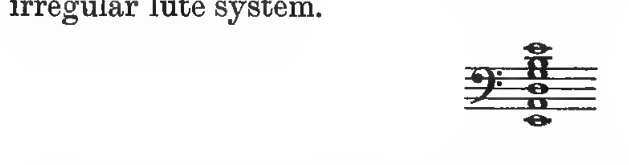
The strings are plucked by the thumb and four fingers of the right hand, while the four fingers of the left hand stop the notes on the fretted neck. A peculiarity of the left hand technique is the use of the barre. As the number of strings is six, and the number of letthand fingers only four, certain chords would be impossible unless 2, 3, or 4 strings were stopped by the same tinger. On the Violin the stopping of a perfect fifth on two adjacent strings is accomplished by means of the ordinary technique; that is to say, only the point of the finger is used. In the case of the Guitar, however, the breadth of the neck would prevent such a stopping of three or four strings. The barré, therefore, is used. The first finger is laid flat across the strings, and acts, in Berlioz's words, "as a temporary fret."
Natural Harmonics 2, 3, 4, and 5 are employed upon the Guitar, and there is a regular and peculiar technique for the production of Artificial Harmonics. It consists mainly of stopping the note with one of the fingers of the left hand. The first finger of the right hand is then used to touch the string lightly at the proper "node." At the same time the string is plucked by the thumb of the right hand.
The Guitar is always written-for in the treble-clet an octave above the actual sounds required. Though little used nowadays, it has occasionally been introduced into Opera mainly for the purpose of Riving a fat 1. of bossil Barber and Examples of its use may be in Act I. of Weber's Uberon. Broad spread chords of a simple nature, arpeggios founded on these chords, and easy figures in arpeggio, best suit the character of the instrument.
The Guitar has recently received a new lease of life through the exertions and enthusiasm of Mr. Perey Grainger. He has written
1 But see below, page 481.
some Guitar accompaniments to vocal music. In some of these accompaniments the Guitar is treated and tuned in the orthodox style. A rew bars trom his charming setting of " Willow willow" will serve as a specimen of this simple reserved style. It must be mentioned thai "Middle Fiddle" and "Ist and 2nd Bass Fiddles" are Graingerese for "Viola" and "Ist and 2nd Cellos." The horizontal lines above the Guitar part show how long the strings should be held down and allowed to go on vibrating
Example 295
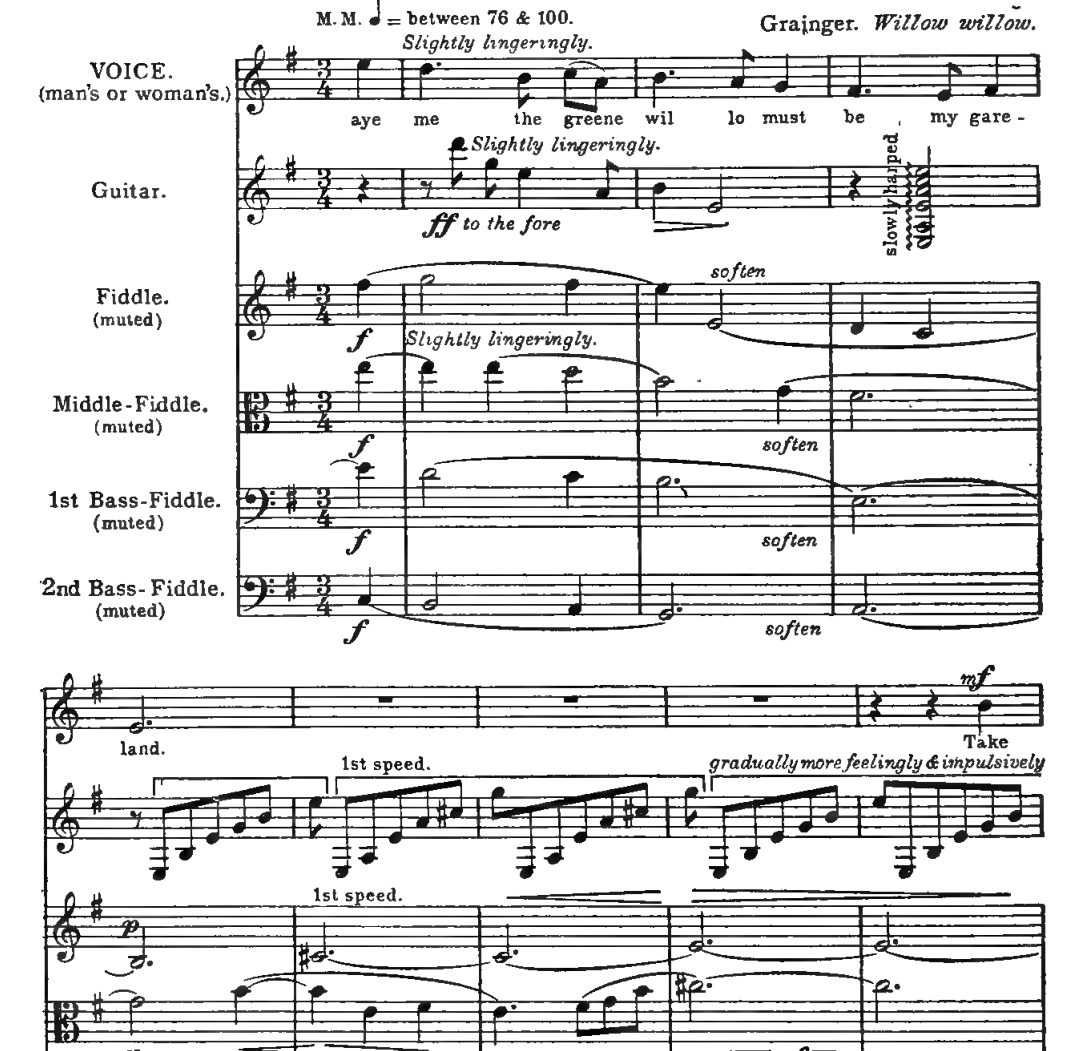
feelingly and to the fore

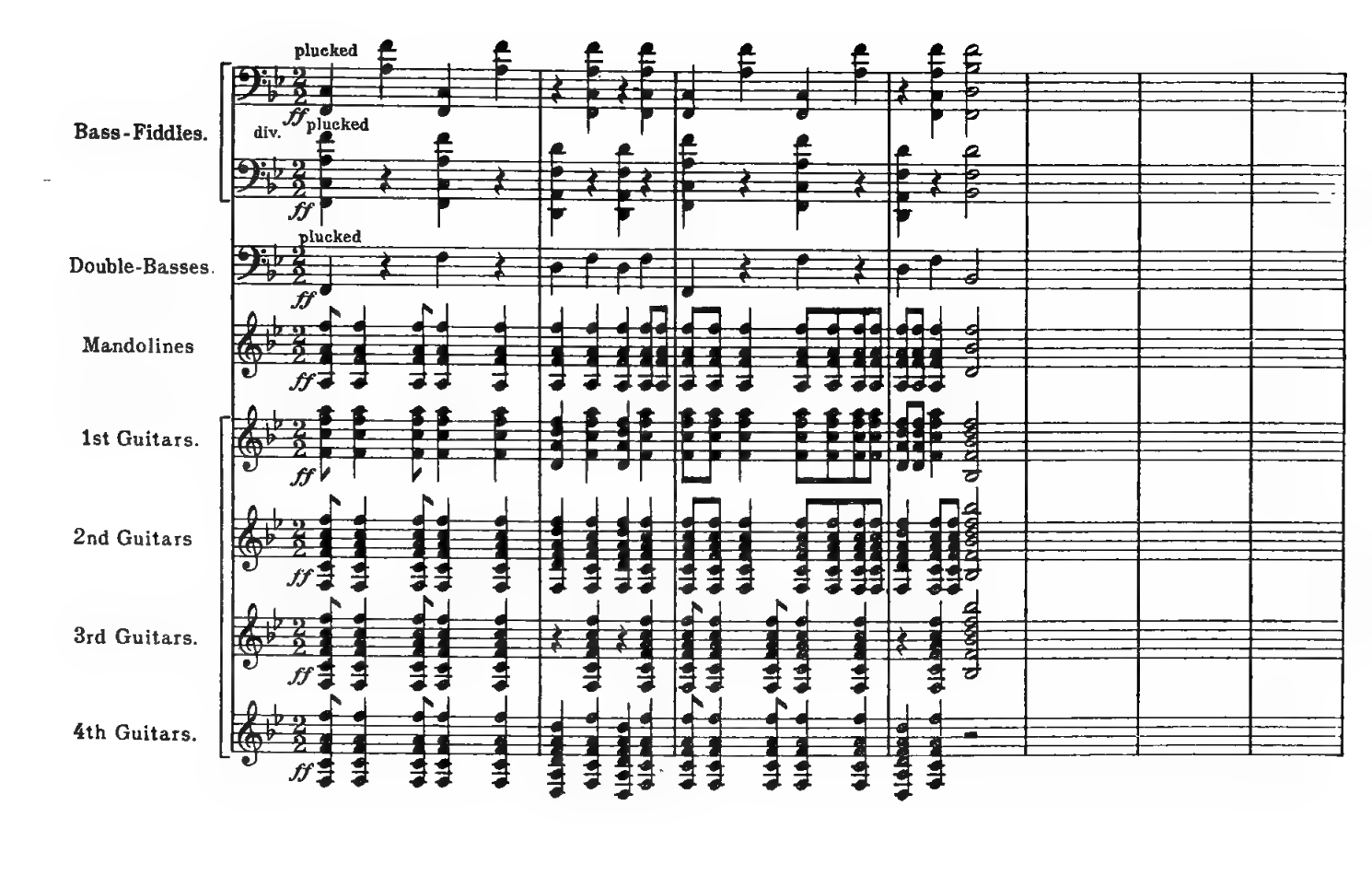
Greater interest, however, attaches to Mr. Grainger's innovations in the Guitar-technique. They constitute quite a new departure. In his setting of the Faeroe Island Dancing Ballad, "Father and Daughter, he has employed "Five Men's Single Voices, Double Chorus, Strings, Brass, Percussion, and Mandoline and Guitar band."! Mr. Grainger's innovations mainly consist in the recognition of the fact that the Guitar is by its tuning limited to only a few well-ascertained chords. He therefore alters the tuning, splits up his Guitar-band into sections, and allots to each section only easily played chords. This not only gives him the possibility of some harmonic variety, but leaves his Guitarists free to perform all sorts of mechanical evolutions with their right hands. On this point it is perhaps better to allow Mr. Grainger to speak for himself. He says:
"I have written mostly for Guitars to be played in what I call
the 'Australian' way.... This consists of tuning the Guitars to
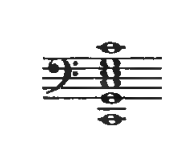
any complete chord, such as
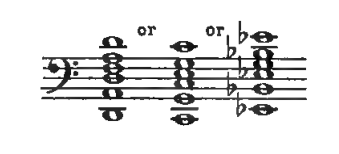
(but generally a major chord), using the lett hand mostly to stol straight across the six strings at once, and using the right hanc in various ways, with a plectrum, or hitting the strings with a paper-knife, or in various Spanish ways ("nails, etc.), but chrefly using the right hand in thrumming backwards and forwards wit/ the thumb; thrumming with the flesh when travelling from low strings towards high strings, with the nail when travelling in the other direction.
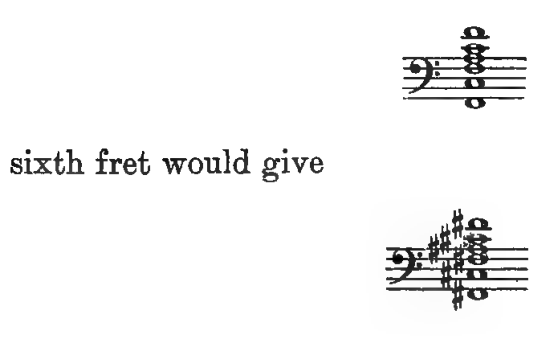
As to the left hand: If the Guitar is tuned,
right across the fifth fret would give
* First performed with forty Guitars and Mandolines at a Balfour-Gardiner Symphony Concert, and afterwards by the London Choral Society.
seventh fret would give
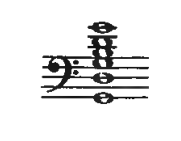
and so on, chromatically, from
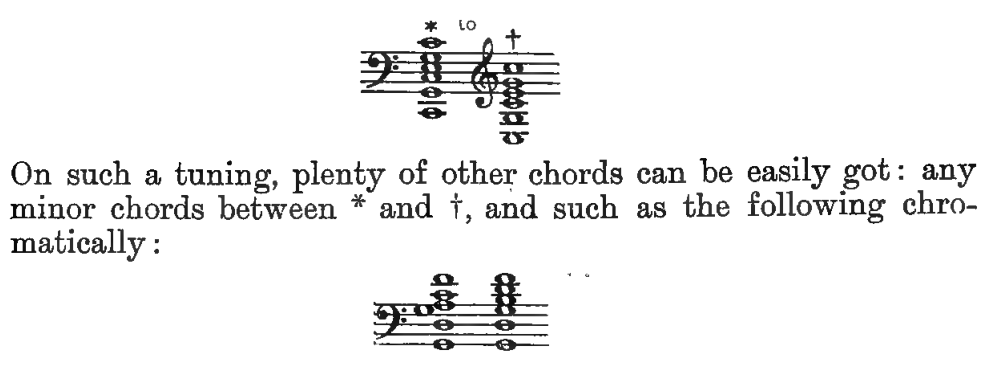
and several others. The left-hand work being easy in the way I playing, and able to shitt very quickly (as there are no laborate finger-changings), the right hand can undertake al sorts of complicated rhythms and contrasts of playing of which the 'Father and Daughter'1 parts only offer a very primitive example." In the "Father and Daughter" four separate groups of Guitars are employed. They are required to tune as follows:
Ist Guitars. 2nd Guitars. 3rd Guitars. Ith Guitars.

The Ist and 2nd Guitar parts have only four different chords to play in the work: the 3rd and fith have only three. Altogether, the players have easy access in various positions to chords of # major D minor, Bo major, Eo major, and C minor
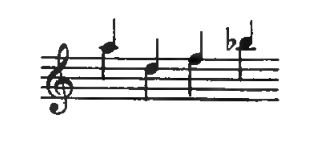
The actual parts are written out in a sort of musica. shorthand Only one double-tailed note is employed to represent each spread chord. At the top of the part the tuning is indicated for each of is expirin ups, and the techical method of playing each chord For instance, the Ist Guitar has to play tour chords ("' major, I minor, Bo major, and E major), of which three will be found in the Full-Score-quotation given below. The four doubletalled notes,
- Mr., Grainger has also written a "Scotch Strathspey and Reel " for four voices, four Wood-wind, Xylophone, English Concertina, Guitars and Strings.
are used as a conventional representation of these four chords. Thus the Ist Guitar part in the extract given below figures in the part as follows:

The chords in the t'ull Score represent the actua, sounds played, but not the technica. method by which these sounds can be obtained Thus, in the Ist Guitar part, though no chord has six notes in it, all are "six-string-chords." These are obtained in various clever ways. For instance, if we represent the open-strings by diamond-headed notes, the four double-tailed conventional notes would actually be performed as the four following chords:
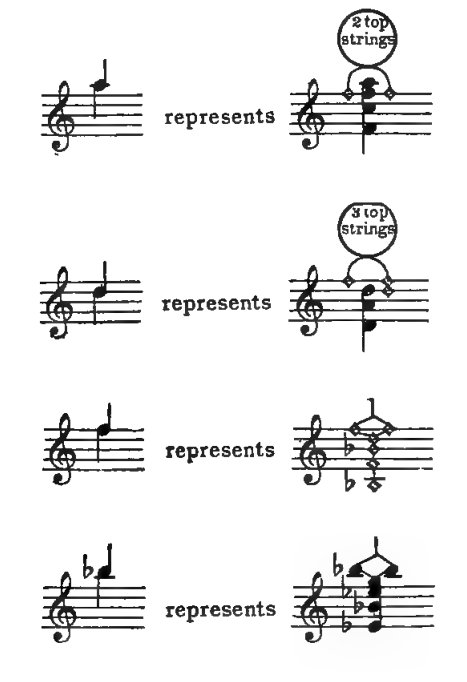
Similarly with all the other three Guitar-parts. Each has a special Finally, a certain number of chords are "marked * "to be played with the left hand in the 'upside down'

some idea of this interesting work:
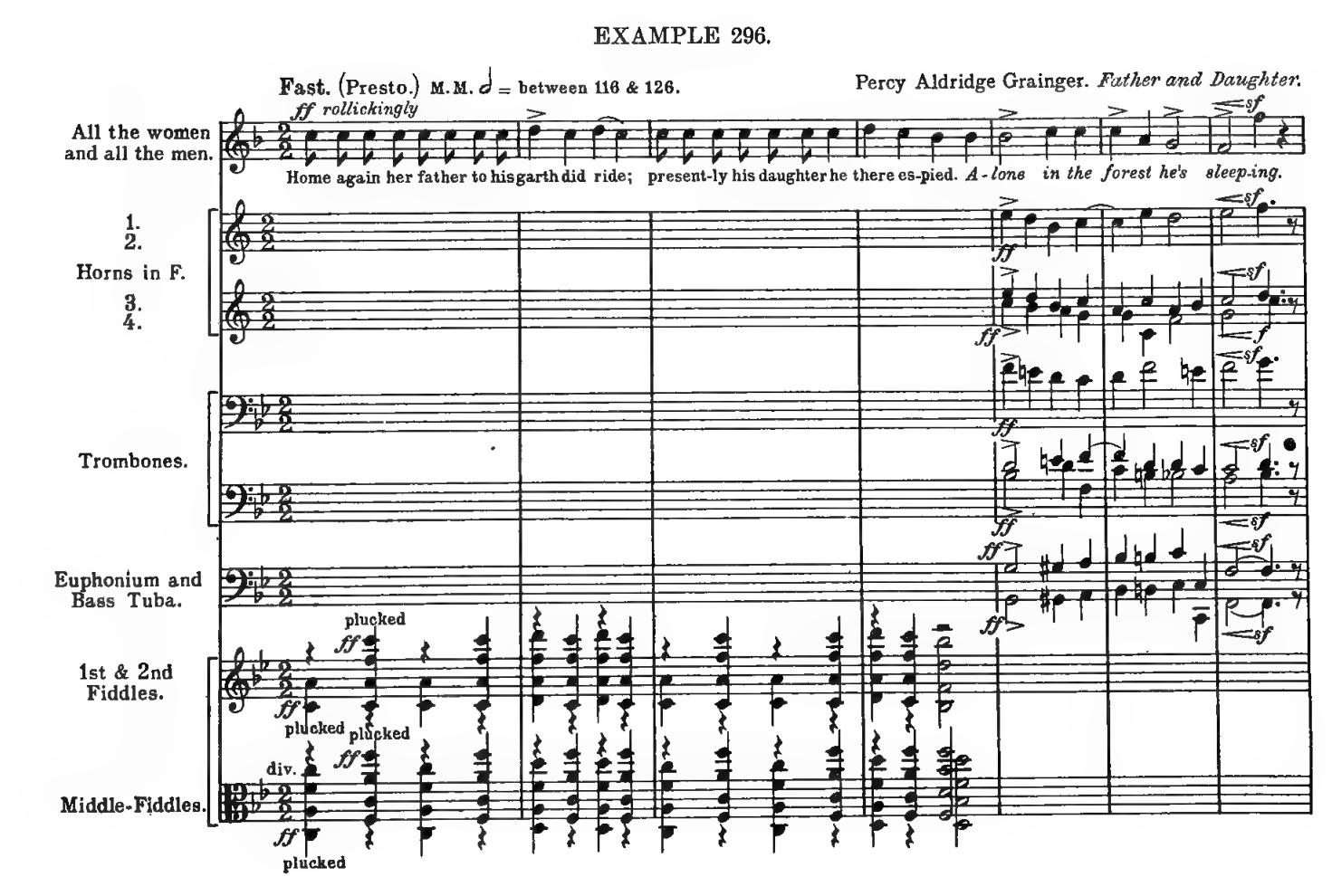
Percy Aldridge Grainger. Father and Daughter. in the forest he's sleeping. Home again her father to hisgarth did ride; present-ly his daughter he there es-pied. A - lone Fast. (Presto.) M. M. d = between 116 & 126.
All the women and all the men.