 Playable Books
Percy Goetschius · section 13 of 23
Chapter X.--the three-part song-form
Read and hear this section in the playable edition →DISTINCTION BETWEEN BIPARTITE AND TRIPARTITE FORMS.—We learned, in the preceding chapter, that the Two-Part Song-form is a composition of rather brief extent, with so decisive a perfect cadence in its course as to divide it, in a marked manner, into two separate and fairly individual sections or "Parts."
Between this and the next higher form,—that with three such Parts,—there is a distinction far more essential and characteristic than that of mere extent; a distinction that does not rest simply upon the number of Parts which they respectively contain. Each of the two classes of formal design, the Two-Part and the Three-Part, embodies a peculiar structural idea; and it is the evidence of these respective ideas,—the true content of the musical form,—which determines the species. The "number" of sections is, in this connection, nothing more than the external index of the inherent idea.
The Two-Part forms embody the idea of progressive growth . To the first Part, a second Part (of similar or related melodic contents) is added, in coherent and logical succession. It should not be, and in good clear form it is not, a purely numerical enlargement, for the association of the second Part with a foregoing one answers the purposes of confirmation and of balance, and is supposed to be so effectuated as to institute and maintain unity of style, and some degree of progressive development. But the second Part, in this bipartite design, does little or nothing more, after all, than thus to project the musical thought on outward in a straight line (or along parallel lines) to a conclusion more or less distant from the starting-point,—from the melodic members which constitute the actual germ, or the "text" of the entire musical discourse. A very desirable, not to say vital, condition is therefore {90} lacking, in the Two-Part forms; namely, the corroboration of this melodic germ by an emphatic return to the beginning and an unmistakable re-announcement of the first (leading) phrase or phrases of the composition.
Nothing could be more natural than such corroboration. Any line of conduct, if pursued without deviation, simply carries its object farther and farther away from its origin. If, as in the circle, this line is led back to the starting-point, it describes the most satisfying and perfect figure; it perfects, by enclosing space. Whereas, if it goes straight onward, it ultimately loses itself, or loses, at least, its connection with its beginning and source.
Nowhere is this principle of Return more significant and imperative than in music, which, because of its intangibility, has need of every means that may serve to define and illuminate its design; and hence the superior frequency and perfection of the Three-Part form, which, in its Third Part, provides for and executes this Return to the beginning . Its superiority and greater adaptability is fully confirmed in the practice of composition; the number of Three-Part forms exceeds the Two-Part, in musical literature, to an almost surprising degree; and it may therefore be regarded as the design peculiarly adapted to the purposes of ordinary music writing within average limits.
The three successive divisions of the Three-Part Song-form may then be characterized as follows:—
PART I.—The statement of the principal idea; the presentation of the melodic and rhythmic contents of the leading thought, out of which the whole composition is to be developed. It is generally a period-form, at least, closing with a firm perfect cadence in the principal key, or one of its related keys.
PART II.—The departure (more or less emphatic) from this leading melodic statement. It is, for a time, probably an evident continuation and development of the melodic theme embodied in the First Part; but it does not end there; it exhibits a retrospective bent, and—when thoroughly legitimate—its last few measures prepare for, and lead into, the melodic member with which the piece began. Its form is optional; but, as a rule, decisive cadence-impressions are avoided, unless it be the composer's intention to close it with a perfect cadence (upon any other than the principal tonic), and accomplish the "return to the beginning" by means of a separate returning passage, called the Re-transition.
PART III.—The recurrence and corroboration of the original statement; the reproduction of Part I , and therewith the fulfilment of the important principle of return and confirmation. The reproduction is sometimes exact and complete; sometimes slight changes, or even striking variations, possibly certain radical alterations, occur; sometimes it is only a partial recurrence, the first few measures being sufficient to prove the "Return"; sometimes, on the other hand, considerable material (more or less related) is added, so that Part III is longer than the First Part.
From this it appears that much latitude is given to the composer, in his formulation of the Third Part. All that the Part has to prove, is its identity as confirmation of the leading motive, and this it may do in many ways, and with great freedom of detail, without obscuring the main purpose. It is precisely this richness of opportunity, this freedom of detail, which enhances the beauty and value of the tripartite forms.
The following is a very regular example of the Three-Part Song-form (Schumann, op. 68, No. 20):—
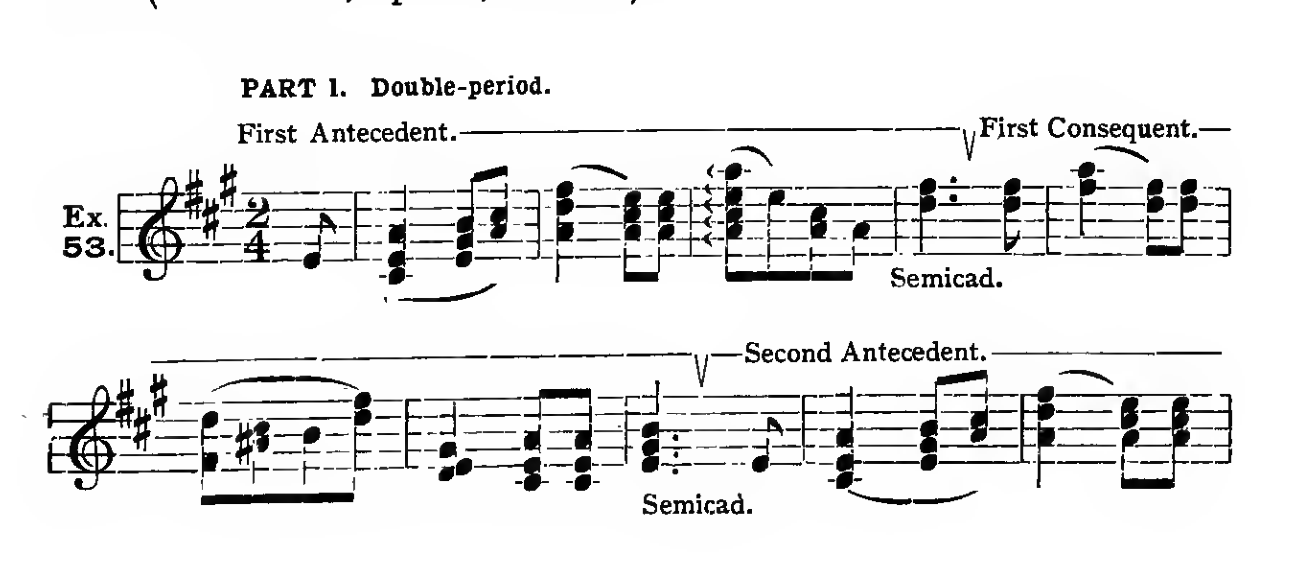
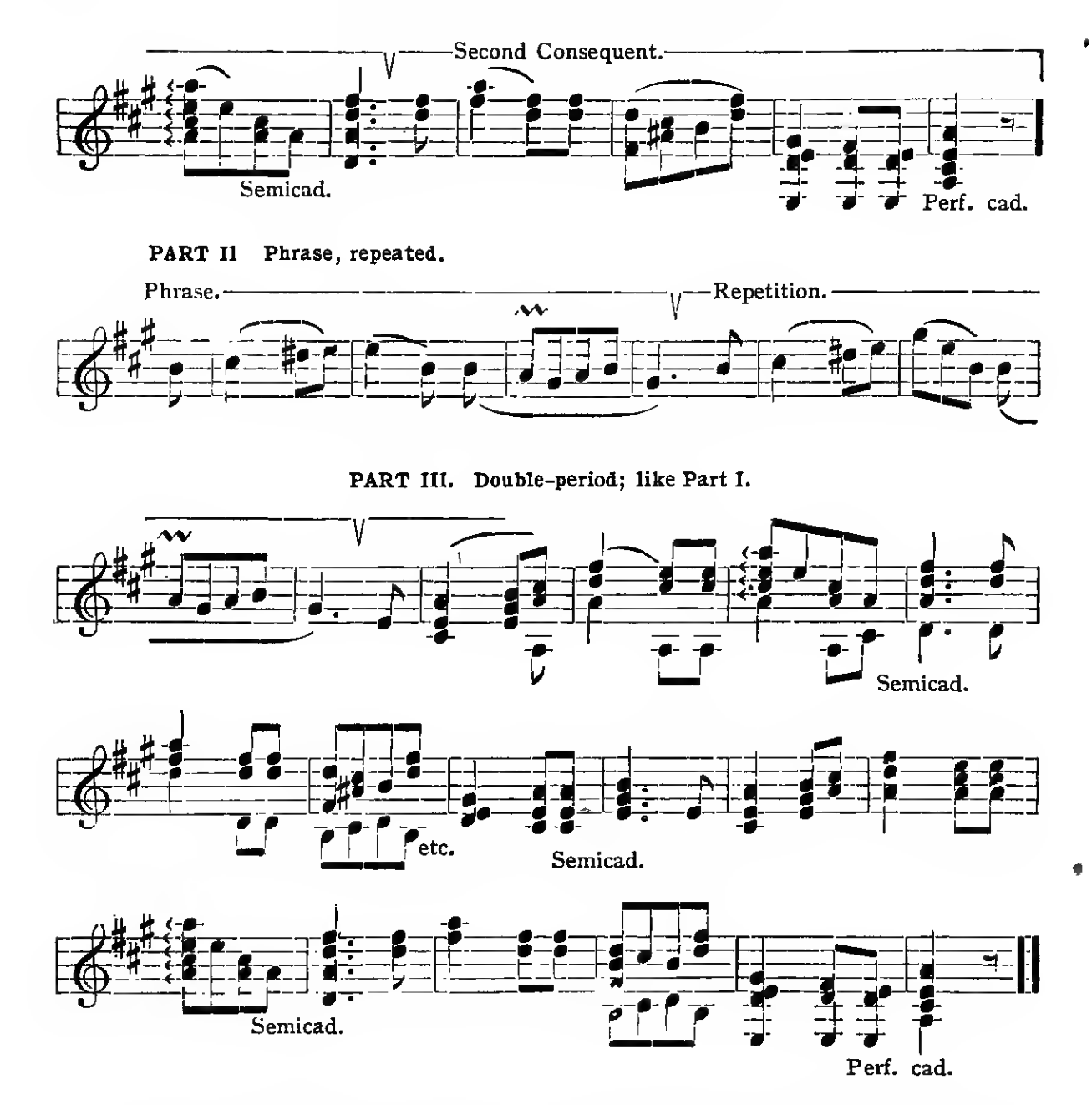
This version is as complete as it can conveniently be made upon one single staff (chosen in order to economize space); but the student will find the formal design somewhat more plastically defined in the original, complete form, and he is therefore expected to refer to the latter. Part I is an unusually regular double-period, with three semicadences and a strong perfect cadence, on the original tonic, to mark its conclusion; the double-bar is an additional confirmation of the end of the Part. The second Part runs in the key of E major (the dominant of the original key) throughout; its form is only a phrase, but repeated,—as is proven by the almost literal agreement of the second phrase with the preceding one, cadence and all . Part III agrees literally with Part I in its melodic formation, but differs a little in the treatment of the lower (accompanying) voices.
In the theme of Mendelssohn's pianoforte Variations in E-flat major (op. 82), which see, the design is as follows:—Part I is a period of eight measures. Part II is also an 8-measure period, ending upon the tonic chord of B-flat major (the dominant key), as first eighth-note of the 16th measure; the following eighth-note, b-natural, represents what we have called the Retransition (in its smallest conceivable form), as it fulfils no other purpose than that of leading back into the first tone of the First Part. Part III is only a phrase , and therefore shorter than Part I; but it corroborates the beginning , and, in fact, the entire contents of the First Part.
The plan of Mendelssohn's 28th Song Without Words is as follows:—First number the 38 measures, carefully . The first four measures are an introductory phrase, or prélude; Part I begins in the second half of measure 4 (after the double-bar) and extends, as regular 8-measure period, to measure 12. Part II follows, during the same measure; its form is a period, extending to measure 20, and closing with a very distinctly marked semicadence on the dominant chord (chord of D). Part III is 14 measures long, containing therefore six more measures than the First Part; its first phrase is almost exactly like the first phrase of Part I; its second phrase (measures 25-28) differs from any portion of Part I, but closely resembles the melodic formation of Part II; its third phrase is based upon the preceding one ( not as repetition, however), and is expanded to the 34th measure. The form of Part III is phrase-group. The last four measures are codetta, or postlude, and corroborate the prélude.
For exhaustive technical details of the Three-Part Song-form, see the HOMOPHOBIC FORMS, Chapters 11, 12, 13, 14 and 15.
LESSON 10.—Analyze the following examples of the Three-Part Song-form. The first step, here again, is to fix the end of the First Part ; the next, to mark the beginning of the Third Part, by determining where the return to the beginning is made. These points established, it remains to fix the beginning of Part I, by deciding whether there is an introductory sentence or not; then the end of Part II, by deciding whether it leads directly into Part III, or comes to a conclusion somewhat earlier, to make room for a Retransition; then the end of Part III, by deciding whether a codetta or coda has been added. The extremities of the three Parts being thus determined, there will be no difficulty in defining the form of each. Very particular attention must be devoted to the comparison of Part III with Part I , in order to discover, and accurately define, the difference between them,—in form, in extent, in melodic formation, or in technical treatment.
Mendelssohn, Songs Without Words: No. 22, No. 35, No. 32, No. 45, No. 42, No. 31, No. 27, No. 46, No. 25, No. 20, No. 26 (Re-transition, middle of measure 25 to measure 29); No. 36 (beginning of Part III, measure 60, somewhat disguised); No. 47, No. 12, No. 15, No. 3, No. 43, No. 40, No. 37, No. 2, No. 33, No. 30, No. 1.
Schumann, op. 68; No. 3; No. 12, first 24 measures; No. 14, No. 16, No. 17, No. 21 (Part I closes with a semicadence, but made in such a manner that it answers its purpose without the least uncertainty); No. 24, No. 25, No. 26, No. 28; No. 29, last 48 measures (including coda); No. 33 (long coda); No. 34; No. 37, first 32 measures; No. 38; No. 40, first movement (2-4 measure); No. 41.
Beethoven, pianoforte sonatas: op. 2, No. 1, third movement,—both the Menuetto and the Trio . Op. 2, No. 2, third movement,—both Scherzo and Trio . Same sonata, last movement, first 16 measures (Parts II and III consist of a single phrase each; therefore the whole is diminutive in extent; but it is unquestionably Three-Part Song-form, because of the completeness of Part I, and the unmistakable return to the beginning ).
Op. 7, Largo , first 24 measures. Same sonata, third movement; also the Minore . Same sonata, last movement, first 16 measures.
Op. 10, No. 2, second movement, first 38 measures.
Op. 10, No. 3, Menuetto .
Op. 14, No. 1, third movement; also the Maggiore .
Op. 14, No. 2, second movement, first 20 measures.
Op. 22, Menuetto ; also the Minore .
Op. 26, first 34 measures; same sonata. Scherzo ; same sonata, Funeral march (also the Trio ; what is its form?).
Mozart, pianoforte sonatas: No. 15 (Peters Edition), Andante , first 32 measures.
No. 1, last movement, first 50 measures.
No. 12, first 18 measures. Same sonata, Trio of the second movement (Part III returns to the beginning very briefly, and is otherwise different from the First Part almost throughout).
No. 13, Adagio , first 16 measures.
Chopin, Mazurkas (Peters edition), No. 11, No. 22, No. 24, No. 40, No. 49.
In the following examples, the student is to determine whether the form is Two-Part or Three-Part:—
Mendelssohn, op. 72 (six pianoforte pieces), No. 1; No. 2; No. 3, No. 4, No. 6.—Etudes, op. 104, No. 1, No. 3.
A curious example may be found in Schumann, op. 68, No. 32; the form is actually Two-Part, but with a very brief reminiscence of the beginning (scarcely to be called a Return) in the last two measures ,—which are, strictly speaking, no more than a codetta. The Second Part is repeated.
In Schumann's op. 68, Nos. 8, 9, and 11 (first 24 measures), the second Part is unusually independent in character; completely detached from Part III, and exhibiting no symptoms of leading into the latter, as second Parts have commonly been observed to do.