 Playable Books
Percy Goetschius · section 14 of 23
Chapter XI. enlargement of the three-part song-form
Read and hear this section in the playable edition →REPETITION OF THE PARTS.—The enlargement of the Three-Part Song-form is effected, in the majority of cases, by simply repeating the Parts. The composer, in extending the dimensions of his original design, resorts as usual to the most legitimate and natural means at his disposal—that of repetition . By so doing, he reinforces the principle of Unity, and, instead of obscuring, places the contents of his design in a stronger and more convincing light. It is true that the act of mere repetition involves the risk of monotony; but against this the composer has an efficient safeguard,—that of variation . He may modify and elaborate the repetition in any manner and to any extent that seems desirable or necessary, the only limitations being that the identity of the original Part must be preserved beyond all danger of misapprehension, and (as a rule) that the cadences shall not be altered.
The act of repetition is applied to the First Part alone, and to the Second and Third Parts together ; very rarely to the Second Part alone, or to the Third Part alone.
EXACT REPETITIONS.—When Part I,—or Parts II and III together,—are to be repeated without any changes, it is customary to employ the familiar repetition-marks (double-bar and dots); with "first and second ending," if, for any reason, some modification of the cadence-measure is required. This is illustrated in the 7th Song Without Words; Part I is repeated alone, and Parts II and III together; both repetitions are indicated by the customary signs, and each has a double ending. See also, Schumann, op. 68, No. 1; Part I is repeated exactly, with repetition-marks; Parts II and III are also repeated literally (all but the very last tone in the lower part), but written out,—apparently without necessity. Also No. 2; the literal repetition of Part I is written out; Parts II and III have the repetition-marks.
MODIFIED REPETITIONS.—The quality and extent of the changes that may be made, in order to enrich the composition without altering its structural design, depend, as has been intimated, upon the judgment and fancy of the composer. The student will find no part of his analytical efforts more profitable and instructive than the careful comparison of these modified repetitions with the original Parts; nothing can be more fascinating and inspiring to the earnest musical inquirer, than thus to trace the operation of the composer's mind and imagination; to witness his employment of the technical resources in re-stating the same idea and developing new beauties out of it,—especially when the variations are somewhat elaborate.
It must be remembered that mere repetition (even when modified,—as long as it can be proven to be nothing more than repetition) does not alter the form. A phrase, repeated, remains a phrase; nothing less than a decided alteration of the cadence itself will transform it into a double-phrase (or period). Similarly, a period, repeated, remains a period, and does not become a double-period; and a Part, repeated, remains the same Part. Therefore, the student will find it necessary to concentrate his attention upon these larger forms, and exercise both vigilance and discrimination in determining which sections of his design come under the head of "modified repetition."
For an illustration of the repeated First Part , see the 9th Song Without Words; Part I is a four-measure period (of two small phrases) closing in the seventh measure; the following four measures are its modified repetition. For an example of the repeated Second and Third Parts , see No. 48. In No. 29, both repetitions occur, with interesting changes; the repetition of Part I begins in measure 13; that of Parts II and III in measure 35; the last 10 1/2 measures are a coda.
{98}
THE FIVE-PART FORM. The repetition of the Second and Third Parts together is sometimes subjected to changes that are almost radical in their nature, and therefore appear to modify the form itself. These important changes chiefly affect the Second Part, when it reappears as "Fourth" Part . When the alteration of the Second Part (that is, the difference between Part IV and Part II) is sufficiently radical to suggest the presence of a virtually new Part, the design is called the Five-part Song-form. The possible repetition of the First Part, it will be inferred, does not affect this distinction in the least; it hinges solely upon the treatment of the reproduction of Part Two . For illustration:
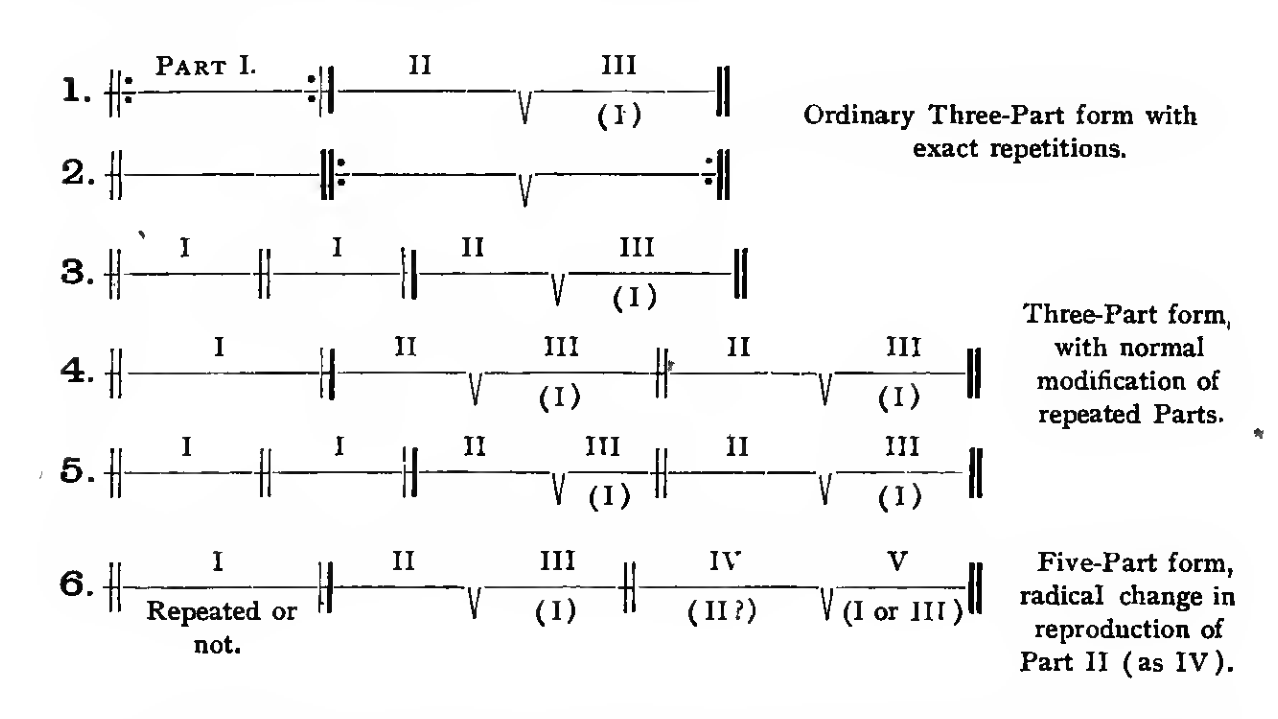
The Five-Part form is illustrated in the 14th Song Without Words;—(first, number the measures; observe that the two endings of Part I are to be counted as the same measure , and not separately; they are both measure 8):—Part I extends to the double-bar, and is repeated literally, only excepting the rhythmic modification of the final measure; Part II extends from measure 9 to 23; Part III, measures 24-35; Part IV, measures 36-47; Part V, measures 48-60; coda to the end. The comparison of Part IV with Part II discloses both agreement and diversity; they are, obviously, practically the same Part , but differ in key, in form, and in extent. The comparison of Parts I, III, and V reveals a similar condition, though the agreement here is much closer, and each confirms the leading statement.
A more characteristic example will be found in the familiar F major Nachtstück of Schumann, op. 23, No. 4, which see:—Part I extends from measure 2 to 9 (after 1 1/2 measures of recitative introduction); Part II, measures 10-13; Part III, measures 14-21; Part IV, measures 22-32; Part V, measures 33-40; codetta to end. The Fourth Part bears very little resemblance to the Second, and assumes rather the character of a wholly independent Part.
GROUP OF PARTS.—In some, comparatively rare, instances, the arrangement of perfect cadences is such that,—coupled with independence of melodic formation and character,—the composition seems to separate into four or more individual sections or Parts, with or without a recurrence of the First one; or into three different Parts, lacking the evidence of the return to the beginning. When such irregularities are encountered, or when any conditions appear which elude or baffle natural classification among the Three-Part Song-forms (simple or enlarged), the piece may be called a group of Parts. The use of this term is entirely legitimate, and is commended to the student on account of its convenience, for all examples of the Song-form which, upon thoroughly conscientious analysis , present confusing features, at variance with our adopted classification. Of one thing only he must assure himself,—that the design is a Song-form ( i.e. an association of Parts ), and not one of the larger forms to be explained in later chapters. The definition is given in Chapter IX (on page 84).
A fair illustration of the utility of the term "Group of Parts" is seen in Schumann, op. 68, No. 18. Others will be cited in the following Lesson.
LESSON 11.—Analyze the following examples of the enlarged Three-Part Song-form. As before, the form of each Part should be defined, and introductions and codas (if present) properly marked. All of the given examples belong to this chapter, but are not classified; it is purposely left to the student to determine where repetitions occur, and whether they are exact, or variated,—in a word, to decide which of the above diagrams the composition represents.
Mendelssohn, Songs Without Words, No. 3, No. 4, No. 8, No. 10, No. 11, No. 12, No. 16, No. 17, No. 19, No. 21, No. 23, No. 24, No. 27, No. 31, No. 34, No. 39, No. 43, No. 44, No. 46.
Schumann, op. 68, No. 5; No. 6; No. 10; No. 13; No. 15; No. 19; No. 22; No. 30; No. 36; No. 43.
Mendelssohn, op. 72, No. 5.
Chopin, Prélude , op. 28, No. 17.
Mozart, pianoforte sonata No. 8, Andante (entire).
Mozart, No. 18, Andantino (of the "Fantasia").
Chopin, Mazurkas , No. 1, No. 2, No. 4, No. 5, No. 8, No. 15, No. 16, No. 18, No. 37, No. 44, No. 48.
GROUPS OF PARTS:
Chopin, Mazurkas , No. 3 (apparently five Parts, not counting repetitions; Part V corroborates Part I, but the intervening sections are too independent to be regarded as one long Second Part,—as would be the case if this corroboration were Part III). Also No. 7 (same design); No. 14 (four Parts, the last like the first); No. 19 (four Parts, the fourth like the second); No. 20: No. 21; No. 27 (Part V like I, Part IV like II); No. 34; No. 39; No. 41.
Schubert, Momens musicals , op. 94, No. 3.