Playable BooksREADING EDITIONS
McKay, Creative Orchestration

George Frederick McKay · section 6 of 111

Transposition ratios

Read and hear this section in the playable edition →

In order to produce the correct pitch to correspond with the rest of the orchestra, certain instrumental parts must be written higher or lower than the pitch or key in which the rest of the orchestra is playing.

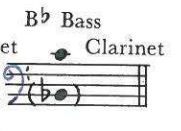
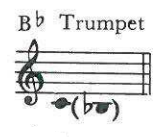
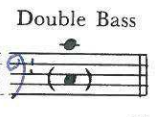
In the chart below, the natural pitch of each of these transposing instruments is compared to middle C. To determine how much higher or lower to write the part for a specified instrument, find the interval listed for it on the transposition chart below.

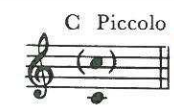
C Piccolo
Fig. 34 · Play this example in the reader ▶
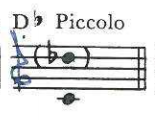
D♭ Piccolo
Fig. 35 · Play this example in the reader ▶
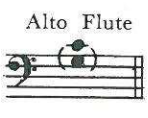
Alto Flute
Fig. 36 · Play this example in the reader ▶
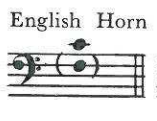
English Horn
Fig. 37 · Play this example in the reader ▶
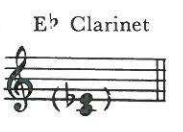
E♭ Clarinet
Fig. 38 · Play this example in the reader ▶
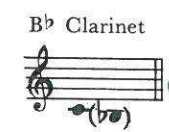
B♭ Clarinet
Fig. 39 · Play this example in the reader ▶
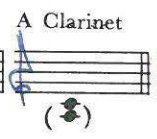
A Clarinet
Fig. 40 · Play this example in the reader ▶
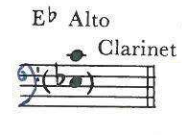
E♭ Alto Clarinet
Fig. 41 · Play this example in the reader ▶
B♭ Bass Clarinet
Fig. 42 · Play this example in the reader ▶
B♭ Trumpet
Fig. 43 · Play this example in the reader ▶
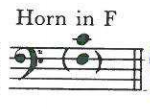
Horn in F
Fig. 44 · Play this example in the reader ▶
Double Bass
Fig. 45 · Play this example in the reader ▶
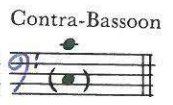
Contra-Bassoon
Fig. 46 · Play this example in the reader ▶
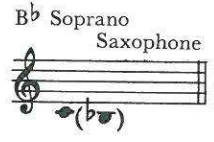
B♭ Soprano Saxophone
Fig. 47 · Play this example in the reader ▶
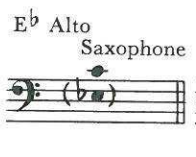
E♭ Alto Saxophone
Fig. 48 · Play this example in the reader ▶
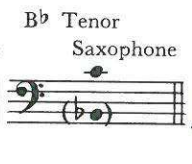
B♭ Tenor Saxophone
Fig. 49 · Play this example in the reader ▶
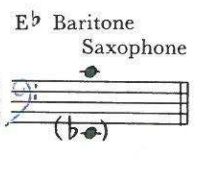
E♭ Baritone Saxophone
Fig. 50 · Play this example in the reader ▶

TRANSPOSITION CHART

If middle C is lower than the pitch tone (the tone in parentheses), the part for that instrument must be written lower than actual sound by the distance shown.

If middle C is higher than the pitch tone of the instrument, the part must be written higher than actual sound by the distance shown.

For instance, the chart shows that for the C piccolo, middle C is an octave lower than the pitch tone. The part must therefore be written an octave lower than actual sound. For the horn in F the chart shows that middle C is a fifth higher than the pitch tone. The part must therefore be written a fifth higher than actual sound.