Playable BooksREADING EDITIONS
McKay, Creative Orchestration

George Frederick McKay · section 7 of 111

Rules for bowing and phrasing

Read and hear this section in the playable edition →

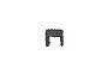
Down-bow is marked with this sign:

Down-bow sign
Fig. 51 · See it in the reader

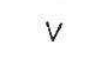
Up-bow is marked with this sign:

Up-bow sign
Fig. 52 · See it in the reader

In general, there will be two bows to a measure, with down-bow and up-bow alternating.

Example: two bows to a measure, down-bow and up-bow alternating
Fig. 53 · Play this example in the reader ▶

If down-bow and up-bow alternate continuously this is the most natural pattern and does not need to be marked.

All notes included under a single slur will be played by one bow.

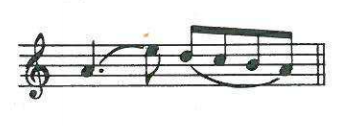
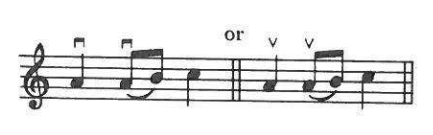
If a phrase begins with an up-beat or anacrusis it is understood without marking that it will be played up-bow. If down-bow is preferred it must be indicated.

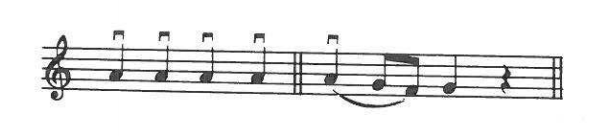
Any desired deviation from the regular alternation of down-bow and up-bow must be marked accordingly.

Example: down-bow marks, "or" up-bow marks
Fig. 54 · Play this example in the reader ▶

Successive down-bows give a powerful hammered effect.

Example: successive down-bows
Fig. 55 · Play this example in the reader ▶

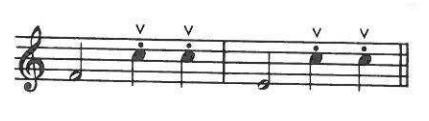
Successive up-bows are more light and graceful.

Example: successive up-bows
Fig. 56 · Play this example in the reader ▶

Separated notes with dots indicate varied types of staccato which must be defined for the player by further description in Italian: spiccato, saltato, martele; or by the English meaning: "rapidly and lightly," "jumping bow," "hammered," etc.

Separate notes with dots may be included in a slur, with the type of dot indicating intensity of articulation.

Example: dotted notes under slurs, "or" tenuto-dotted notes under one slur
Fig. 57 · Play this example in the reader ▶

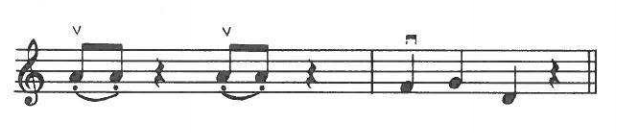
Whenever dots are used under a slur to indicate successive down-bows or successive up-bows, or whenever any deviation

from the normal alternation is brought into the phrasing, mark indications for the bowing which will return it as soon as possible to the normal alternation (down-bow, up-bow).

Example: bowing marks returning the phrase to the normal alternation
Fig. 58 · Play this example in the reader ▶

It is sometimes effective to have accented points in a phrase at the end of a bow, but this is a special effect and an exception.

Example: accents at the end of a bow
Fig. 59 · Play this example in the reader ▶