Playable Books
George Frederick McKay · section 106 of 111
Sufficient variety within general design
Read and hear this section in the playable edition →Maintenance of structural attractiveness depends upon sufficient variety in the organizational plan. A too long-continued use of any one general plan, when applied to contiguous segments of form, will cause monotony. There are four prototypical organizations which can be alternated to prevent this. Beethoven’s music is the best source for illustration of such prototypes in creative action. His scores show an alternation of four basic organizational plans. These are shown on p. 196.
Such a balanced relation in structural organization may be defined as normal alternation of organizational prototypes.
Study as many scores as you can, to become familiar with this principle. Every composer must use some degree of variety
from BACH: Brandenburg Concerto No. 5 in D Major (By permission of Universal Edition A.G., Vienna) — PLATE XLIV. VARIED THICKNESS AND THINNESS OF TEXTURE [Plate withheld from the public edition: the excerpt is still in copyright.]
within general design. Study the symphonies of Beethoven particularly. He, more than any other composer, proved the classic strength of this procedure.
Four excerpts from Beethoven’s Symphony No. 6 illustrate these four types of prototypical organization:
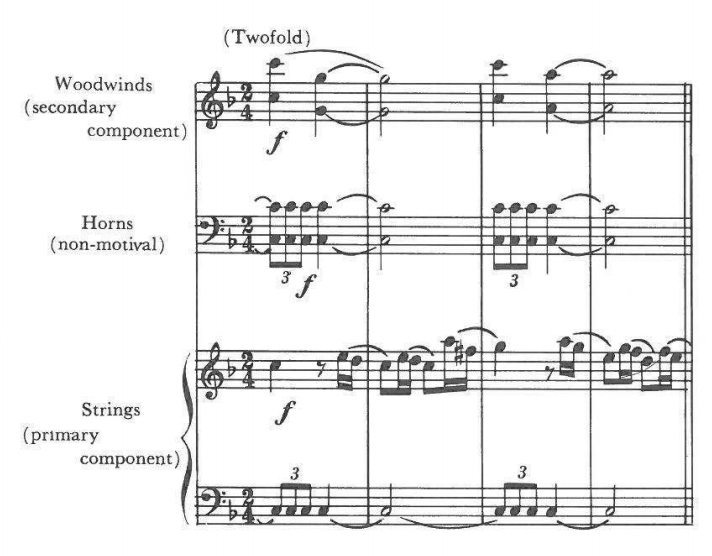
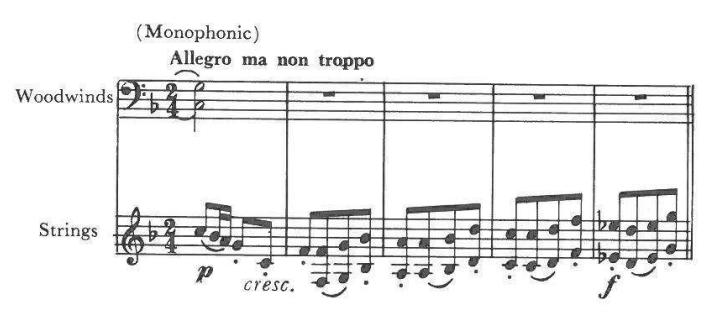
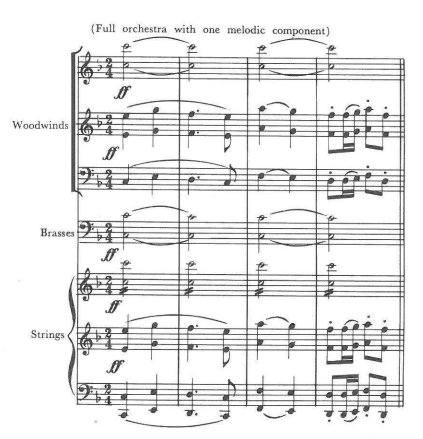
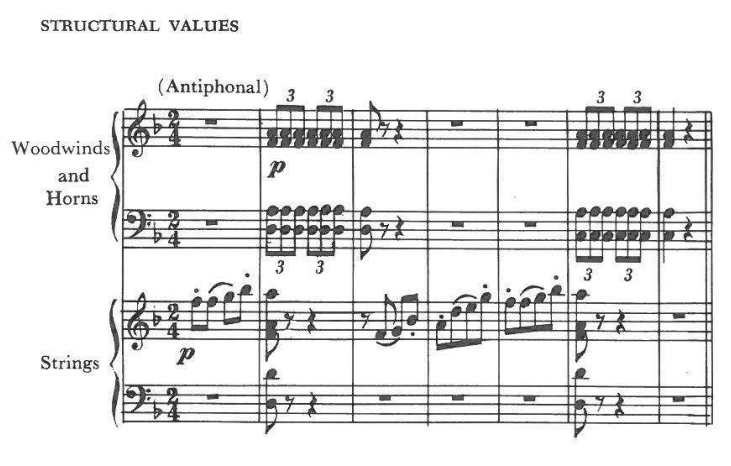
Another good illustration of the normal alternation of organizational prototypes is to be found in the Symphony No. 4 by Brahms. At the beginning of the slow movement (page 64, Kalmus Edition) the first few measures are monophonic. These are followed by a oneness of organization of harmony and design (one melodic component), in which the woodwind and horn theme is doubled by the pizzicato strings. At measure 15 a twofold organization appears (two supplementary melodic components); this is followed by a return of the “onefold” statement. At measure 36 a striking antiphonal passage enters the scene. A study of this sequence of organizational prototypes will supply a clear and inspired example of balanced use.
Study other scores, particularly recent ones, to observe the continuing vitality of this stabilizing principle (normal alternation of organizational prototypes).