 Playable Books
George Frederick McKay · section 107 of 111
V. Orchestral Types
Read and hear this section in the playable edition →The composer may be either experimental or traditional in his choice of instrumentation. In either case, it will be valuable to have in mind some knowledge of the history of the orchestra and the evolution of the standard instrumentations.
The earliest instrumental groups were probably random sets of instruments which accompanied dancing or singing. There was no standard orchestral instrumentation inherited from earlier centuries. At the time of Bach and his contemporaries (1700-1750), the concerto grosso type of instrumentation was established. This orchestral ensemble included a body of accompanimental strings, a few featured solo instruments, and the plectrum sound of the harpsichord.
Haydn’s period (1750-1800) crystallized the orchestra into its classic division of three major families of sound: woodwind, brass, and strings. In Haydn’s orchestra the woodwinds were in pairs (two flutes, two oboes, two clarinets, two bassoons) and the brass was limited to two natural horns and two natural trumpets (without valves).
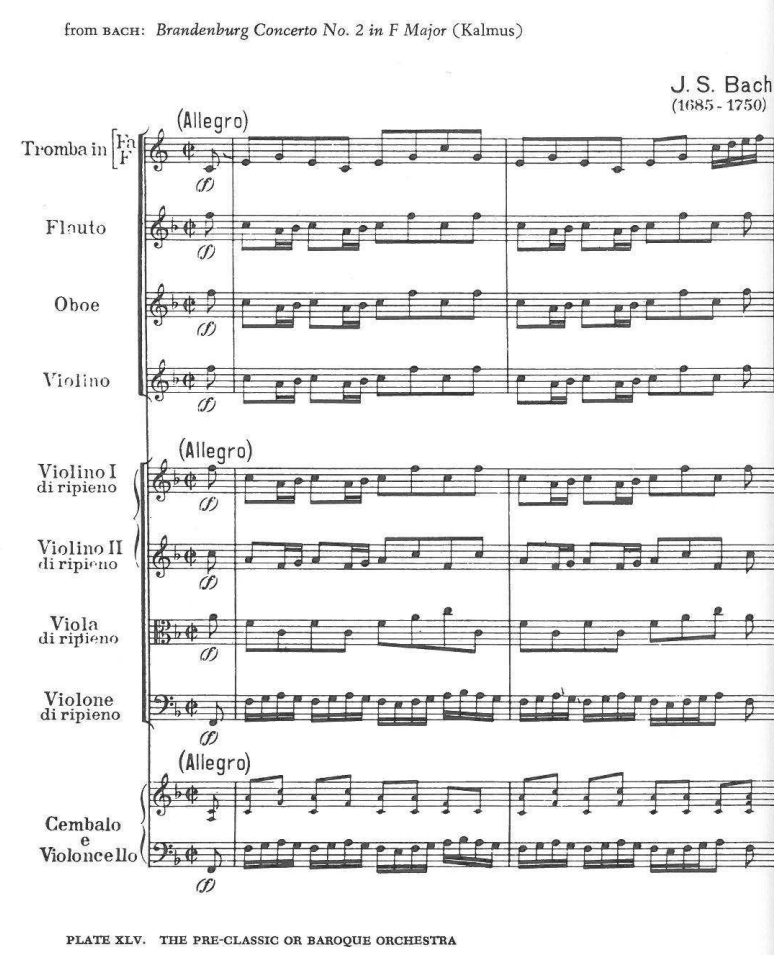
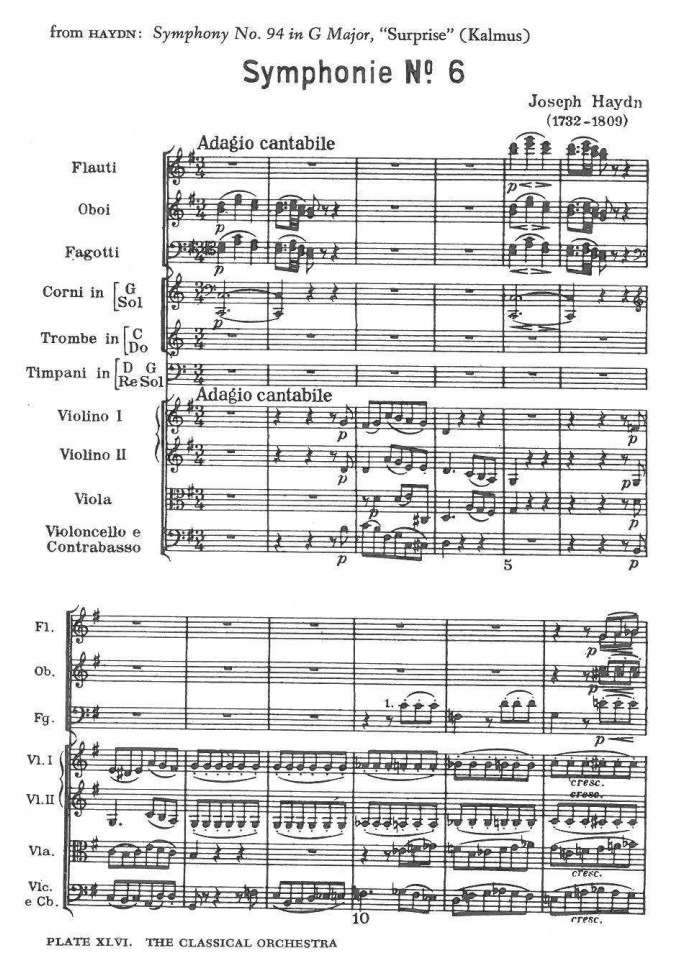
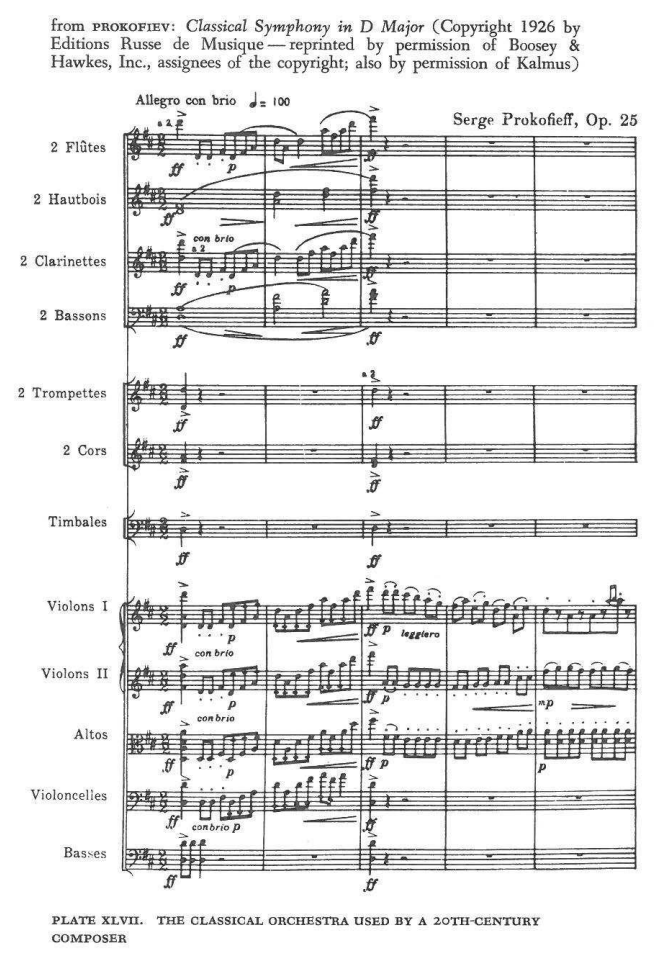
The Romantic Period (1800-1850) added the standard brass grouping (four horns, two trumpets and three trombones), and in the late Romantic Period (1850-1900) Wagner expanded the woodwinds to groups of three (three flutes, two oboes and cor anglais, two clarinets and bass clarinet, three bassoons). He also experimented with the addition of various types of tubas. In the music of Wagner the French horn came into its own with the invention of the valves, and brought in new melodic possibilities. Berlioz, in the early Romantic Period, was a great innovator who introduced many special effects, such as muted strings, valve cornets, harps, and strings pizzicato, and began a tendency toward “gigantism” which continued until Schönberg’s Gurre-Lieder with its mammoth instrumentation (ten horns, for instance).
The next major development in orchestral instrumentation came from Russia in the late Nineteenth Century, through the music of Tchaikovsky, Rimsky-Korsakov, and — eventually — Stravinsky. The orchestra was not significantly expanded by these composers, except in certain works by Stravinsky which demanded larger brass and woodwind resources. What these composers were most significant for was their pioneering of a new consciousness of the vitality of tone color and instrumental motion, and for an emphasis on instrumental action for its own sake.
Debussy and the other “Impressionists” brought a new development to orchestration by putting the strings into the background and bringing the woodwinds into the foreground. They also gave new life and motion to the brass designs, and established the harp as an indispensable part of the total timbre. The reappearance of the “plectrum” sound supplied by the harp brought back into music an ingredient that had formerly been supplied by the harpsichord.
Today, all of the orchestral types mentioned in this short historical survey continue to influence composers to some degree, but the most recent tendencies are toward smaller, more varied,
from VAUGHAN WILLIAMS: Symphony No. 4 in F minor (Copyright in U.S.A. and all countries, 1935, by the Oxford University Press, London) — PLATE XLVIII. THE MODERN ORCHESTRA [Plate withheld from the public edition: the excerpt is still in copyright.]
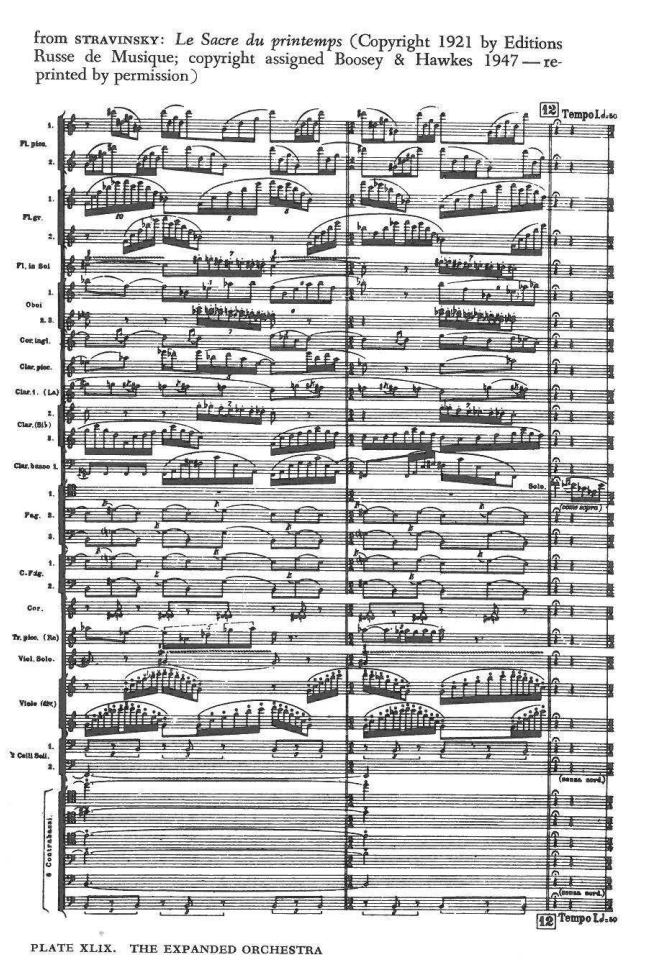
from MILHAUD: Symphony No. 1 for Small Orchestra, “Le Printemps” (Universal) — PLATE L. THE CHAMBER ORCHESTRA [Plate withheld from the public edition: the excerpt is still in copyright.]
and intensely clear groups. Villa-Lobos, in Brazil, set an example by using very unusual groups of instruments, with the instrumentation constantly varied to suit the meaning of the composition or the adventurous interest of the composer. A tendency among the imitators of Webern, and exemplified by Pierre Boulez, is the use of small groups which contain almost the total mixture of basic tonal ingredients.
The American “jazz” groups have also added to the history of instrumentation. Worthy of notice are certain extended brass and woodwind ranges, the several brass mutes, new percussion effects, novel small and experimental combinations of instruments, and a certain textural fantasy that results from gifted improvisation.