 Playable Books
George Frederick McKay · section 31 of 111
Consistency of unit organization
Read and hear this section in the playable edition →The ear naturally tends to separate the different families of sound into units of tonal action and to focus similar timbres into unified meaning.
Because of this tendency, achievement of clarity demands that instruments of similar timbre (woodwinds, brass, strings, and percussion) be grouped into units that are rhythmically and harmonically consistent.
There are no immutable laws governing this grouping, since matters of preference will always enter into the writing of any music. However, certain general suggestions can be offered.
(1) Groups usually consist of instruments of related or similar timbre: e.g., four horns, four strings, three woodwinds, etc.
(2) Each group should be rhythmically consistent and harmonically complete, and should make musical sense when played separately.
(3) Groups may be made up of any number of voices, but two-, three-, and four-voice units are the most common. A single line may be used as a representative grouping, since it is obviously consistent in design.
(4) Harmonically full groupings of more than four voices are quite often used, but it should be remembered that rich sounding chords tend to obliterate clarity of design. If one group has many harmonic voices, other groups sounding at the same time should ordinarily counter this by using few voices.
(5) The harmonic spacing of a group can be open or close, depending upon preference, but once a spacing has been established it should, as a rule, continue.
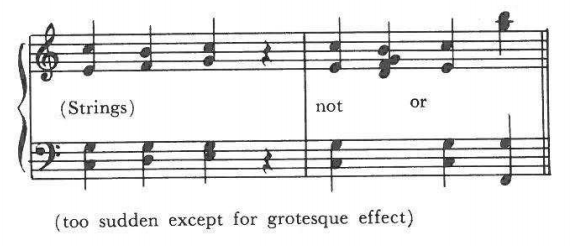
(6) All groups should ordinarily use the same general harmonic progression, but each can have its own independent disposition of parts. If each group is harmonically complete in its own right there is no further harmonic organization needed.
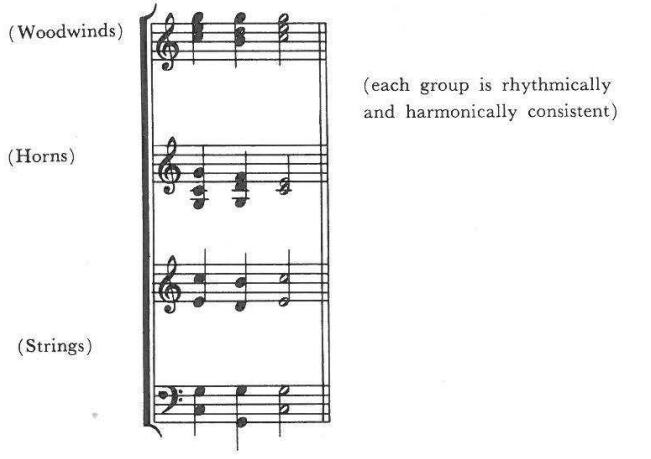
(7) Different groups sounding simultaneously may have different rhythms or similar rhythms, but the rhythmic relationship of two or more groups should be inclined toward either contrast or similarity.