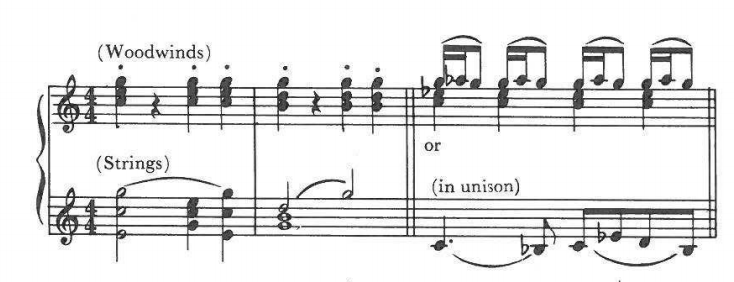
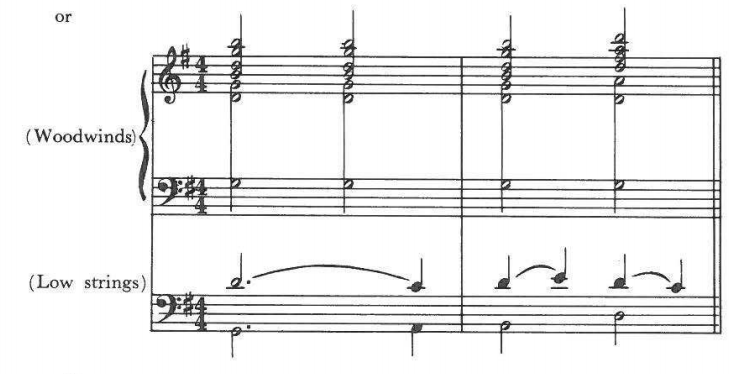
Organization of the families of sound into structurally consistent groups is the most fundamental of all orchestration techniques and deserves much practice. Use only two groups at a time. The possibilities are manifold: e.g., two flutes and three violins; or three woodwinds and four brass, etc.
Dissonant or clashing melodic and decorative tones are softened and absorbed when groups of contrasting timbre are sounded simultaneously (see the example on page 150).
Analyze the unit organization in the foregoing example, and invent similar simultaneously sounding multiple groups of your own. Analyze the group organization in some of the classic and modern scores.
In writing out the separate parts for performance it will be necessary to transpose certain parts. For instance, horn in F must be written a fifth higher, and B-flat clarinet must be written a whole step higher. For explanation, consult the transposition chart in Chapter 1 (page 6).
 Playable Books