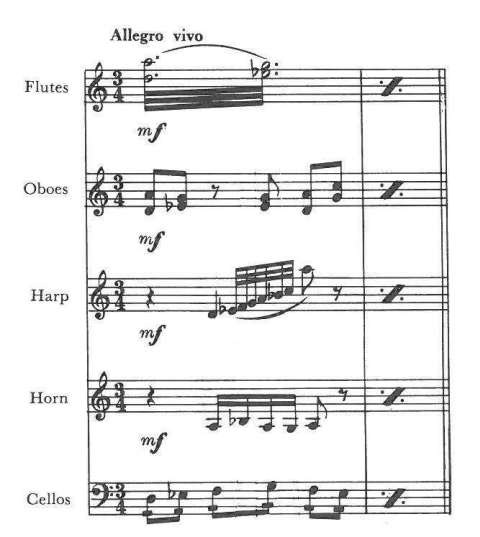
The characteristic unity of the polyrhythmic texture results from a dominating rhythmic "drive" or unified kinaesthetic impact which enables the listener to merge differing threads of instrumental motion into a single impression.
There can be quite a number of simultaneous but differentiated threads in this composite, but the action of each of these threads of motion must be non-motival, so that no one motion factor will predominate. Within an excitingly primitive rhythmic emphasis, an overriding similarity of "beat" will absorb and unify an idiomatic and rhythmic diversity.
The polyrhythmic texture, with its interplay of variety and unity and its almost hypnotic rhythmic excitement, originates from a time as far back as it is possible to trace African drums and other orgiastic percussions.
Although common to ancient and primitive music, polyrhythm became almost extinct in the music of the Classic and Romantic Periods. It has had a revival in the music of Twentieth-Century composers such as Stravinsky and Debussy. It also has had an influence on "jazz" music. The modern use of poly-
rhythmic texture grew partially from a widening of musical expression to include a certain primitive energy drawn from attractively naïve folk cultures.
Analyze the opening pages of Stravinsky's Petrouchka — with its exciting "hurly-burly" of instrumental action. Also study the opening pages of Ibéria by Debussy and certain passages in his La Mer that tend toward the polyrhythmic. The example below exemplifies the characteristics of the polyrhythmic texture.
 Playable Books