 Playable Books
George Frederick McKay · section 45 of 111
Heterophonic texture
Read and hear this section in the playable edition →The word "heterophonic" when literally translated means "with differentiated voices." When applied to orchestration, it implies a principal melodic line sounding with other concurrent lines which are recognizably similar yet different enough to create internal surprise and variety. The heterophonic texture could be said to be "a melody with simultaneous variations."
One or more such simultaneous variations may be added, depending upon the degree of complexity desired. In the following two examples, the variations are more complex than the melody to which they are added.
This and the next example from BEETHOVEN: Violin Concerto in D Major
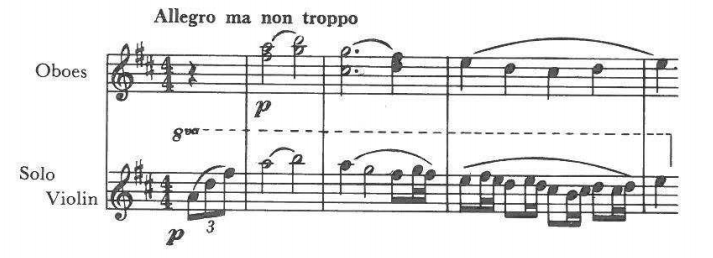
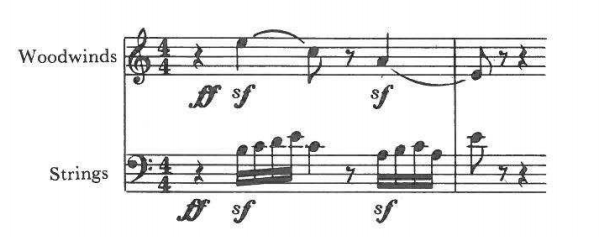
The variation added is often more simple than the melody, rather than more complex. If more than one variation is added, a certain balance between simplicity and complexity is desirable. If it has sufficient unity and enough surprise and variety of motion, the resulting heterophonic effect will be both clear and interesting.
Primitive peoples made much use of heterophonic techniques. These techniques are naturally effective in any essentially monodic music, and still furnish great vitality and excitement when applied to the modern orchestra.
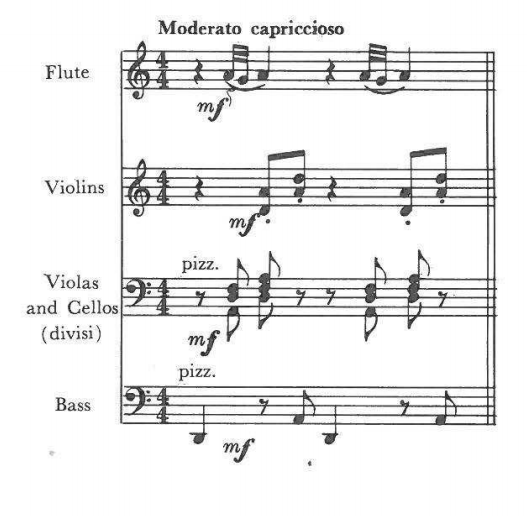
from MALIPIERO: Impressioni dal Vero (By permission of the copyright owners, J. & W. Chester, Ltd., London) — PLATE VI. POLYRHYTHMIC TEXTURE [Plate withheld from the public edition: the excerpt is still in copyright.]
The heterophonic texture is mainly a melodic phenomenon. Therefore, if harmony is added it should be kept quite thin. Accompanimental material will ordinarily not be needed, since the varied action of the other voices supplies enough complexity of motion.
However, when elaborating the accompaniment in homophonic design there is a special heterophonic technique which can be applied. The example on page 67 shows an accompanimental unit which has been heterophonically enriched by differing versions of an essentially arpeggiated motion.
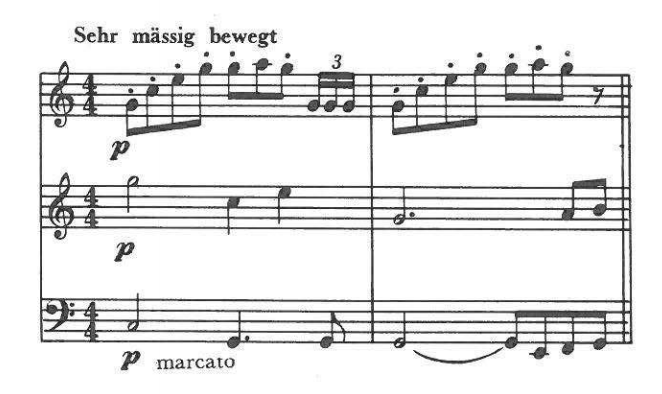
Analyze the relationship of the voices in the next example. Which variant of the melody is more complex? Which is more simple? Would you add harmony or further accompanimental design?
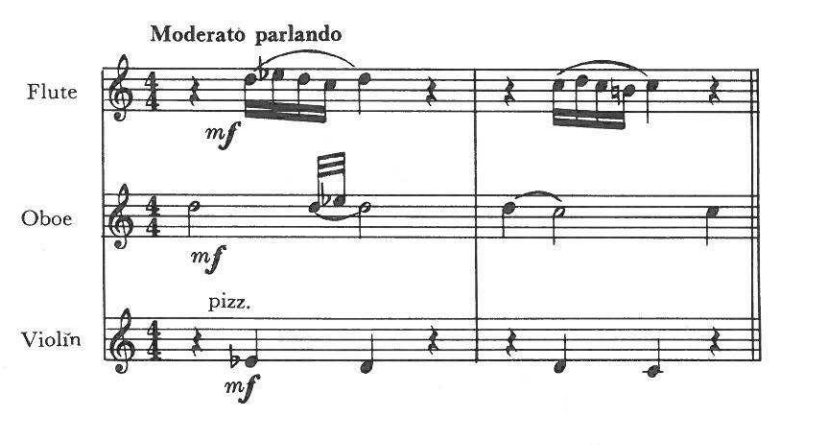
The type of heterophonic texture thus far explained can be designated as horizontal, since its unity results from a main, on-going, line. There is another manifestation of essentially heterophonic unity which can, for analytical purposes, be thought of as vertical. In this type, two or more familiar and self-sufficient tunes are played at the same time (vertically juxtaposed): e.g.,
Swanee River by Foster and Humoresque by Dvořák. The impression of unity results from the natural clarity of meaning of the readily recognized tunes. The polyphony will be rough, harsh, and perhaps incorrect, but the resulting variety will have an attractively vigorous and rough-hewn quality of unique interest.
A well-known example of this vertical application of heterophony occurs in Wagner's Die Meistersinger Overture, at the point where the composer finally brings together three main motives which have previously been heard separately — shown in the reproduction below. Each of these is memorably tuneful. They are rather similar in motion, but different enough to make sufficient variety in combination.
Still another illustration is this moment in the Shostakovitch Symphony No. 1. Here the first and second themes have been brought together. Each is authentically tuneful in its own right. Note the rough-hewn vigor of the design and the independence of the harmony (see example on page 71).