George Frederick McKay · section 46 of 111
Project 8 Read and hear this section in the playable edition →
Write some pages of reduced scoring to illustrate the two types of heterophonic texture (horizontal and vertical). In the
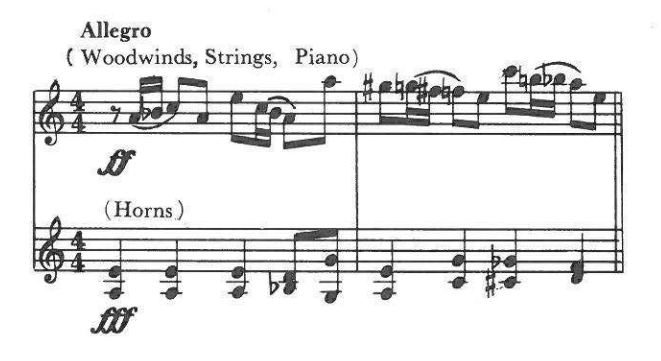
Fig. 156 · Play this example in the reader ▶ horizontal type, try for intensity of motor interest. In the vertical type, the page will probably be limited to the lines of the independent tunes. Because the differing lines will have already put such a strain on the attention, other demands can hardly be added without endangering clarity. Study scores and search out as many examples as you can of heterophonic texture types. Observe the necessarily stark and linear character of the design, also the relative sparseness of sustaining and accompanimental material.
Good heterophonic examples may be found in the Lieutenant Kijé Suite by Prokofiev and in "Farandole" from the L'Arlésienne Suite by Bizet.
← Heterophonic texture All sections Onomatopoeic texture → More Playable Books Sanganeria, Arrival Build jazz lines that land, with 30 original playable examples. Fux, Gradus ad Parnassum Learn how independent voices work together, one species at a time. Goetschius, Exercises in Elementary Counterpoint Build independent melodies through graded exercises, with 471 recorded examples. Goetschius, Counterpoint Applied Study imitation, canon, and fugue with 393 recorded examples. Prout, Analysis of J. S. Bach’s Forty-Eight Fugues Follow Prout through all 48 fugues of the Well-Tempered Clavier, every example playable. Rameau, Treatise on Harmony Explore the foundations of harmony, composition, and accompaniment. Rimsky-Korsakov, Practical Manual of Harmony The classic harmony course, newly translated from the 1910 French edition, with all 640 examples playable. Tchaikovsky, Guide to the Practical Study of Harmony Tchaikovsky’s Moscow Conservatory harmony course, with playable examples. Fenaroli, Partimenti Six books of partimenti, with playable basses, contrapuntal exercises, and bilingual rules. Reger, Supplement to the Theory of Modulation Explore Reger’s modulation method with 100 analyses and 102 playable examples. Schoenberg, Theory of Harmony Read all 22 chapters, with the original German beside a new English translation. Rimsky-Korsakov, Principles of Orchestration Discover instrumental colors through scores and orchestral recordings. Forsyth, Orchestration A witty, thorough guide to every orchestral instrument, with the original pages. Berlioz, Treatise on Instrumentation Berlioz’s treatise on the orchestra, revised by Richard Strauss, with the original pages. Bona, Complete Method for Rhythmical Articulation Practice rhythm through 120 graded studies, with playable notation and original scans. ← All Playable Books  Playable Books