 Playable Books
George Frederick McKay · section 49 of 111
Textural combination
Read and hear this section in the playable edition →Control over group organization and the ability to invent clear and positive texture types are basic to any soundly developed orchestration technique. Other principles of clarity organization will be studied subsequently, but the techniques of unit consistency and texture formation should be thoroughly understood and practiced before going on.
Throughout all future stages of orchestration study, it will be important to analyze scores constantly to observe the formative power of the textural prototypes. Such analysis will keep alive an understanding of the creative force and organizing power of these elemental unities. They must be understood as protean sources, structurally necessary to any textural manifestation.
All discussions thus far have presented textures in their most elemental forms, but as scores are analyzed it will be discovered that there are many variants of these fundamental types. Through compounding and hybridization many transformations of the basic unities are possible.
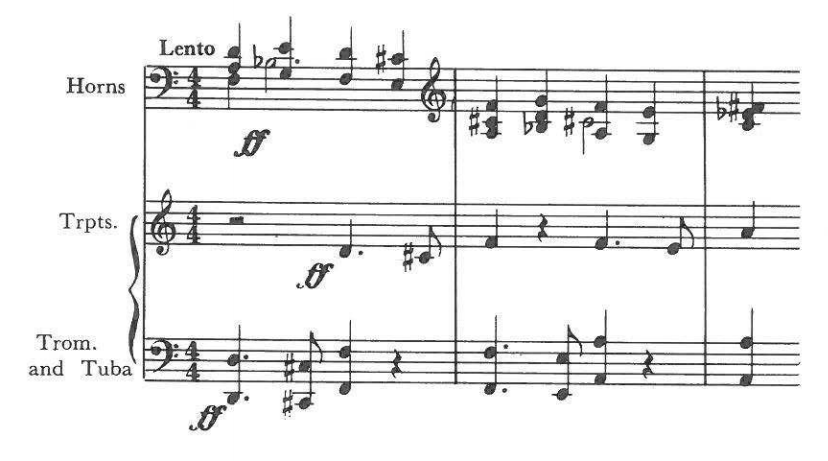
A compound texture is a texture with two or more choirs, each of which is organized by a different unity principle. In the example opposite (from Franck's Symphony in D Minor), the composer has organized the horns as a chordal texture. At the same time the trumpets and trombones together make a polyphonic texture.
A hybrid texture is a texture that blends the characteristics of two different unities. For instance, there might be two essentially chordal textures, one in woodwind and one in brass, overlapping in a polyphonic way: e.g.,
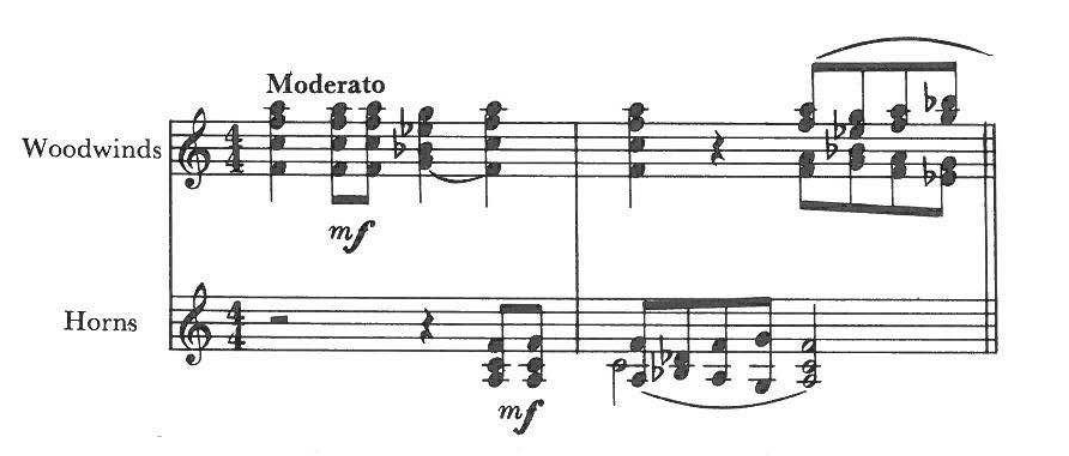
Why is this chordal? Why is it polyphonic? Why is it not a compound texture?
These possibilities of compounding and hybridization are endless, and further study in orchestration could well include experiments with these complex types. Keep in mind, however, that the closer texture comes to the pure prototype, the stronger its impact will be and the more immediately intelligible it will be to the audience. Before attempting complex textures, succeed first with the simple ones.
At this point in the development of technical understanding it is pertinent to re-emphasize that the choice of timbre or "tone color" is very much a matter of personal preference. There is no need to be overly concerned yet about choice of timbre;
clarity of structure comes first. If the groups are consistent and the textures positive, almost any timbre takes on a fascinatingly mysterious quality.
Certainly, choice of tone color makes a real difference and is, in a way, the very heart of orchestration; but achievement of clarity should come first in the earlier stages of study.