 Playable Books
George Frederick McKay · section 50 of 111
Pitch distribution
Read and hear this section in the playable edition →The placement of tones into effective pitch locales has much to do with clarity. Melodies, accompaniments and harmonies must be placed in the registers in which they can be most clearly heard in relation to one another. Extremely high pitches tend to obscure lower tones. Extremely low tones are difficult to hear clearly and produce a blurred effect when used harmonically. Middle register tones are weak and easily obscured.
On the staff there is a central area located among the tones closest to middle C — see the example below. This is the tonal area that is most inconspicuous and the most naturally suited to accompanimental design and harmonic background. It is in this register that the horns, violas, clarinets and second violins seem to be comfortably non-stringent, normally relaxed and fluent. When written higher, accompanimental material takes on brightness and shrillness; and when written lower, harmonies become progressively blurred and vague as the lowest tones are approached.
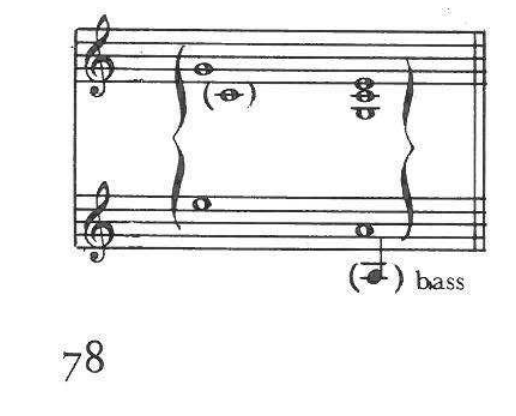
Normal accompanimental distribution
Competing factors in similar pitch locale have a tendency to neutralize one another and to obliterate design. When melody, accompaniment and harmony, or competing motives and lines are located in different non-competing pitch locales, the result is crystal-clear and vivid.
To illustrate the negative action of two motives competing in the same register, let us suppose that there are two motival designs in two different tone colors sounding together as follows:
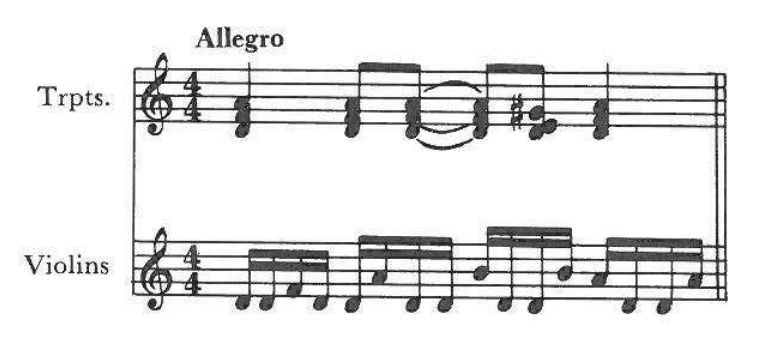
Because they are in the same register, neither motive can be heard clearly, since the two tend to "eat each other up." At one time or another, every novice composer will have suffered from this ineffective sort of distribution of registers. One way to improve the result would be to move the violins up an octave, so that the trumpets can have the middle register to themselves. Or, if the trumpet design were played by flutes, an octave higher, the violins could continue in middle register with typical D-string vigor. In either case, the design could come forth clearly. Because of this attention to the pitch locale, the two opposing designs would no longer interfere with one another.
The shrill intensity of extreme high pitch or the gruff "fogginess" of extreme low pitch becomes tiring if allowed to continue for too long. If both high and low pitches sound together for any length of time, the danger to clarity is further increased.
The foregoing analyses lead to the following general recommendations for the restriction and control of pitch distribution:
(a) Use the natural and moderate middle register much of the time, alone or in combination with either high or low pitch.
(b) Use high and low pitch together (without middle register) only for special effect.
(c) Use the high, middle and low pitches, sounding together, only for maximum intensity and only for brief periods of time.
(d) High pitch alone or low pitch alone are very expressive but incomplete and tiring.
(e) Competing motival ideas should be in different registers.
(f) There should be sufficient variegation of pitch locale to ensure growth, variety and interest.
When a certain composer said "All symphony orchestras scream," he was, no doubt, thinking of the tendency of composers of the Romantic Period to overuse the high brilliant sounds for dramatic excitement.
There is an acoustical fact back of this observation. High frequencies tend to absorb and obscure low frequencies when they are sounded together. This means that the addition of low sounds to high will enrich the high sounds, but the addition of too many high sounds to low will tend to block out the low sounds. If low sounds are to be featured they should be heard in a rather isolated structure. What registers would you choose for the accompaniment in a concerto for double bass?