 Playable Books
George Frederick McKay · section 52 of 111
Limitation of harmony
Read and hear this section in the playable edition →Orchestral instruments are so naturally rich in overtones that when they are sounded together harmonic effects are intensified. Even when played in unison there is an illusion of harmony. The harmonies in the score will seem magnified in performance, so that harmonization which is too full will endanger structural clarity.
Study of scores will lead to the conclusion that master composers often restrict the harmony in order to allow essential design to come through clearly.
The music of Beethoven is typical of this kind of restriction. It serves especially well as a general illustration of the effective limitation of harmony, and it shows the importance of such limitation to the achievement of the clearest possible result.
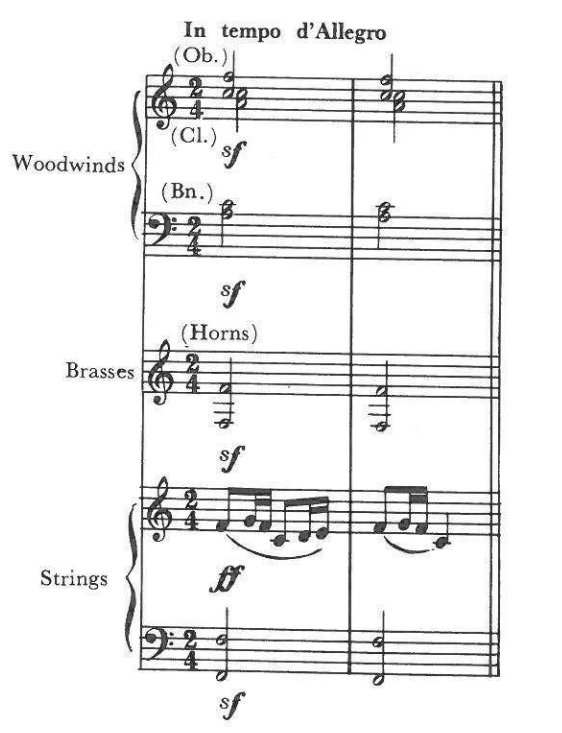
The outstanding clarity of the music of Beethoven seems to imply a formula for harmonic limitation which may be stated as follows: (a) in the string section use strong, clear, linear design with a very small amount of harmony in the middle register; (b) restrict the brass to strong, open, foundational intervals; (c) concentrate the harmonic emphasis in the woodwinds, where it will be most softened and inconspicuous.
Observe the application of this formula in this excerpt from the Symphony No. 6 of Beethoven (opposite page).
It is when played by the brass choir that harmony has the most naturally intense harmonic impact. If the harmonization is located there, hardly more will be needed, especially since additional harmony in the woodwinds and strings can be heard
only with difficulty. If all three choirs are harmonic at the same time the effect will be too full, too cloying and too undifferentiated.
Even when the harmony is limited to the brass, care must be taken not to fill up too wide a total range with brass timbre, as this will tend to obstruct the possibility for other timbres to be clearly heard.
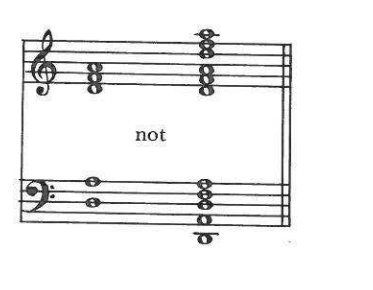
Most other composers do not concentrate the harmony in the woodwind section as Beethoven did. More often, they alternate the harmonic role among the several choirs (even percussion can simulate harmony with bell sounds). Beethoven's treatment of harmony was an outcome of his personal predilection, and it should not be imitated too exactly; but it does prove, through the outstanding clarity of his music, the general value of limitation of harmony.
If three degrees of harmonic intensity are categorized into: (1) close harmony (strongly harmonic), (2) foundational open harmony (moderately harmonic), and (3) linear design (non-harmonic), a general law may be stated as follows:
The most normal balance in the use of harmony will result from a combination of three different degrees of harmonic intensity.
The three different degrees (strong, moderate and non-harmonic) should be distributed among differing families of sound.
Six optional distributions are possible, since these three degrees of intensity can be combined in six different ways.
TABLE I
Any one of these distributions of the harmonic emphasis would produce an effective balance of harmonic intensity or, in other words, a normal harmonic limitation.