 Playable Books
George Frederick McKay · section 53 of 111
Project 11
Read and hear this section in the playable edition →Write some pages of reduced scoring in which experiments are directed toward trying out various dispositions of the harmonic factor. Balance the differing degrees of intensity as suggested by the previous discussion and table of balances.
For the best harmonic result certain other points about harmony should be kept in mind:
(a) When played on a piano, quick changes of complex harmony are easily and clearly heard, but if harmonies change rapidly in orchestral music they are more difficult to follow. Orchestral harmony, therefore, needs to be based upon a slower harmonic rhythm than does harmony for other media.
(b) Orchestral harmony normally maintains a consistency of choir action (number of voices and type of spacing), but the number of voices and type of spacing may be varied if varied within a design which is sufficiently clear and purposeful.
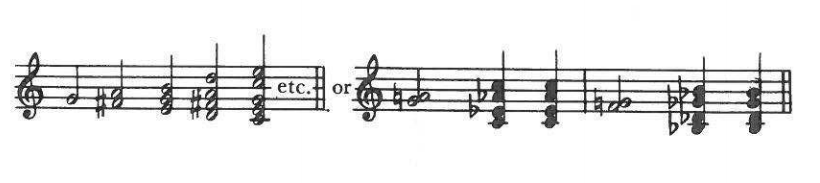
(c) The relation of parallel, oblique and contrary motion should be balanced. At any point in harmonic progression where there are two or more choirs there will be a need for supplementary difference. If all choirs move upward or downward at the same time there will be an imbalance which, if continued over a long period, could make both players and audience "seasick" with parallel motion.
Since the orchestra is such a massive entity, orchestral music needs some kind of "keel" action at the center of things, so that parallel and contrary motion in other groups can be steadied or stabilized by their relation to it.
Play the following parallel structure:
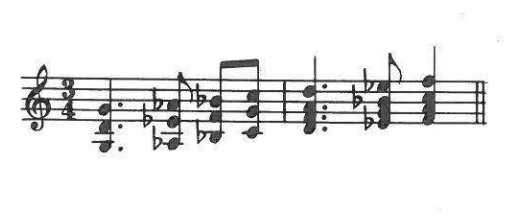
Play it again, this time with a stabilizing or "keel" action added by the horns. Note the increased strength and interest in the effect.
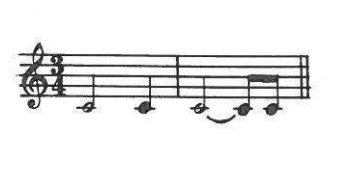
In further scoring, a unit of contrary motion might be added. This would give still more stability and balance.
Since the very essence of value in orchestration is design and movement, harmony is perhaps only a lesser or minor element, which often becomes stronger in effect than was intended. Young composers sometimes dote upon the harmony which they conjure up from the piano and use improvisation as a resource from which to evoke intensity of feeling. In writing for orchestra this tendency must be somewhat guarded against for the sake of strong design. Harmony can be magnificently poignant and expressive, as Delius, Wagner and Franck prove by their music. Nevertheless, it is suggested that for healthy growth in the study of orchestration the highest aim should be flourishing design in combination with somewhat meager harmony — not the opposite (flourishing harmony with meager design) which is often the "easiest way."
from COPLAND: Appalachian Spring (Copyright 1945 by Hawkes & Son [London] Ltd. — reprinted by permission) — PLATE XI. LIMITATION OF HARMONY [Plate withheld from the public edition: the excerpt is still in copyright.]