 Playable Books
George Frederick McKay · section 54 of 111
Vividness of timbre
Read and hear this section in the playable edition →A melody or pattern is strengthened and made clearer when it is presented to the ear by means of a vivid timbre. When timbre is non-vivid, structural elements have a tendency to be absorbed into the general background.
Vividness can be partially achieved by loudness or softness, but the most intense vividness results only from distinctive tonal character. Unusual timbre is sometimes inherent, as in the case of the English horn, which always makes a striking effect with its dark, brooding tone. However, unusual timbre is most often obtained by the use of extreme registers (high or low).
Nearly every instrument is rather mild and neutral in its middle register. The clarinet is a typical example of this. In its middle register it is easily obscured and relatively simple in sound, but in its upper register it takes on a brightness and positiveness of character which is shrilly and sweetly intense. The low or chalumeau register is rich, warm and dramatic, and it has a distinctive character that cannot be duplicated by any other instrument or register. The viola and cello also become characteristically vivid in high or low register, while becoming more neutral in the middle register.
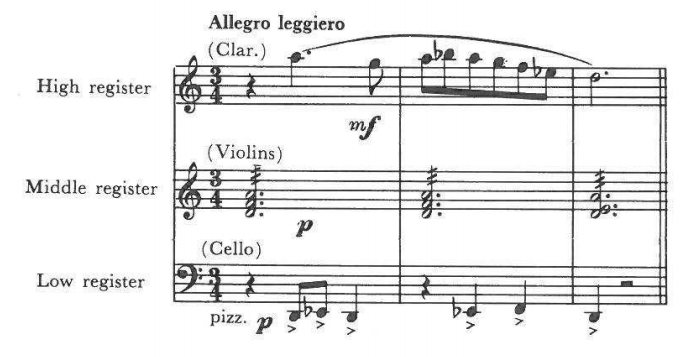
These differences naturally suggest the use of middle register for background material when the aim is to effect a sort of quiet obscurity. If the aim is to vivify soloistic or motival material, high or low registers should be used.
In performing groups in which all voices have relatively similar timbre (e.g., the male chorus and the string orchestra), it is difficult to clarify design by means of vividness of timbre. This means that in these media special attention should be given to structural methods of ensuring clarity. The symphonic band, the mixed-voice choral groups and the pipe organ have a less oppressive similarity of timbre than the male chorus and string orchestra, but they, too, must depend principally upon structural means for clarity or upon conscious use of strikingly opposed registers. In the band, the sound is too often neutrally bland because of the constant sounding together of brass and woodwind. When the brass and woodwind are antiphonally separated, the sound immediately becomes more vivid and therefore clearer.
Opportunities for clarification through the use of vivid timbres are naturally offered by the orchestra because of its variety of tone color resources unequalled by any other medium. This vast palette of tone is a natural challenge to experimentation.
Timbre becomes more vivid when highlighted by essential contrast. In Table II a few types of tone quality are listed in contrasting pairs.
TABLE II
Other contrasts which might be categorized for possible use are smooth-sharp, brittle-plastic, ethereal-vulgar, shrill-mellow, etc.
Categorization of tonal contrast is technically difficult and is a relatively unexplored psychological realm, as is evidenced by the groping terminology that must be used to describe tone qualities. Surprisingly little is said about timbre contrast in the literature of musical analysis. The unexplored world of percussion timbre has been especially neglected. There has not been a positive enough attempt to classify timbre according to the "attributes of tone" (the scientific term used by psychologists). Since timbre contrast is of such importance to the art of orchestration, perhaps the future will bring psychological clarification and a more positive terminology.
Although this categorization is a psychologist's scientific problem, it is nevertheless a musical artist's practical problem which must be met, in spite of the present lack of scientifically established terminology. Practical experiments with timbre contrast will lead to the following general principle:
Opposing timbres in differing design tend to become particularly clear.
For example, a trumpet or xylophone sounding against a background of middle-range strings would effect a contrast of strident against subdued tone. Or, a pizzicato line in the strings against a choir of flute sound would effect a contrast of dryness against liquidity.