Playable Books
George Frederick McKay · section 56 of 111
Limitation of melodic components
Read and hear this section in the playable edition →In music, some elements of design require very little attention for comprehension. Because they are simple in structure, briefly stated and repeated, they are intelligible almost immediately. Other elements of design are more lengthy and without repetition. They acquire their meanings from a set of consecutive relationships which may be compared to those of syntax in a sentence.
It is this relation of words or musical symbols that demands attention and mental effort. In language, this consecutive meaning results in the sentence. In music it becomes the melodic line, theme, motive or phrase.
If a succession of words without syntax is presented to the attention, as in the statement "rain, rain, rain," little effort is needed for comprehension and the mind can pass on to something else. However, if an elaborate syntax is presented, as in the statement "because of certain low pressure systems converging from the south, it will probably begin raining today at 2 P.M.; there will be some snow and hail, and you had better carry chains in the car," closer attention is required.
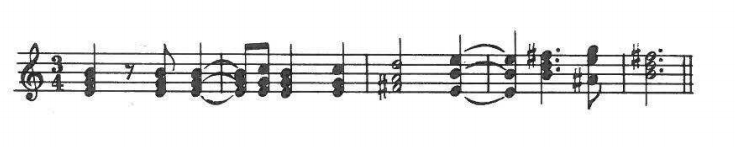
Music is similar to language since it demands varying degrees of concentration. Analyze the following rhythmic pattern. The musical meaning is easily comprehended because the state-
ment of the design is contained in a single measure and this measure is repeated. It is intentionally relaxed and non-consecutive in its meaning.

If this same material is developed so that it takes on a set of consecutive relationships, it must be heard throughout its length because of an organic totality which requires concentrated attention. If it is to be comprehended, more mental effort must be expended.
In orchestration, those elements which contain this more demanding consecutive meaning can be spoken of as melodic components. To achieve clarity in orchestration, there must be limitation in the number of melodic components sounding at any one time.
The memory and the attention power of the average listener are limited. It seems that the average mind can follow only one train of thought thoroughly at a time. To illustrate this, a comparison can be made to an attention-distracting situation from real life. If a person is asked to give attention to several things at once (a telephone conversation which is in progress, a political speech blaring over the radio, a scolding landlady, the town crier passing by), he will either grasp only fragments of each or will have to block out the others and give attention to the one that he really wants to comprehend.
In music, the psychological facts are comparable to those just described. The average listener can follow only one line of consecutive musical thought (one melodic component) at a time. Psychological experiment leads to this conclusion.* The ability to grasp two (rarely three) melodic components sounding simultaneously can be developed only by those with intense musical training. Given a specific degree of natural or developed attention power, the progressive addition of simultaneously sounding melodic components rapidly increases the difficulty of comprehension to the point of impossibility.
Beethoven, with his gift for clarity, seems to apply this knowledge about the listener's powers. His orchestration shows an almost instinctive limitation of melodic components, and it rarely demands attention to more than one melodic component at any one time.
Study the scores of Beethoven to analyze this limitation of melodic demand. Choose any one of the Beethoven symphonies and go through the score, underlining melodic components at different points. This will supply a vivid visual exemplification of the principle of limitation of melodic components.
For maximum clarity an orchestral texture should contain only one melodic component. There can sometimes be two components, but the second should be less demanding in its consecutive content than the principal melodic component. If a third melodic component is added, it will necessarily be even more restricted to a minimal consecutive content.
The excerpt on p. 95, from the Piano Concerto No. 2 by Brahms, will illustrate three levels of melodic definiteness and is an example of Brahms' limitation of melodic components.
After stating the foregoing formulation, questions will immediately arise. Polyphonic texture has three, four, five or
*Harrison E. McKay, "Multiple Tone-Pattern Discrimination" (Master's Thesis, Purdue University, 1958).
more equally important voices — are these not melodic components? Polyrhythmic texture often has four, five or six threads of differentiated rhythmic action — are these not melodic components?
Let us answer these questions. In the polyrhythmic texture the purpose is a kind of "oneness" of over-all motion. The repetitive threads of design which merge into this "oneness" are not melodic components because they are intentionally non-consecutive and have the basic simplicity of accompanimental material. It seems that if the ear is not expected to hear any of the separate threads of musical action as consecutive thought, the whole composite of motion comes to the mind as one compound meaning. The result is a single merged impression.
The polyphonic texture usually has such similarity of motion in the voices, that these also merge into a "oneness." A particularly characteristic quality of good polyphony is an "antiphonality" which permits the ear and attention to shift from one line to the other as principal motives come into the foreground, while lesser designs are comfortably absorbed into a generality of background motion. Any Bach fugue or invention will illustrate this alternating entrance of motive in polyphonic music, and will support the contention that a polyphonic texture is heard as one complex, developed, melodic component (a supreme example, of course, is his Art of Fugue).
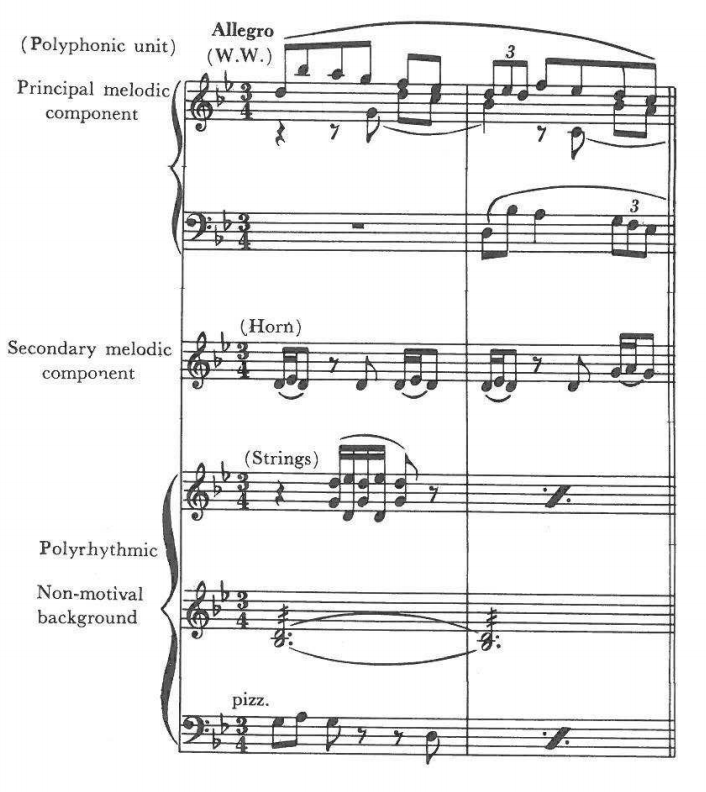
The example on p. 97 is offered to illustrate the use of both polyphony and polyrhythm as components. The woodwinds are polyphonic (principal melodic component), the horns are polythematic (secondary melodic component), and the strings are polyrhythmic and non-melodic. There will still be an essential clarity when this compound texture is heard, because of the "oneness" of impression given by the unities of the polyphony and the polyrhythm.
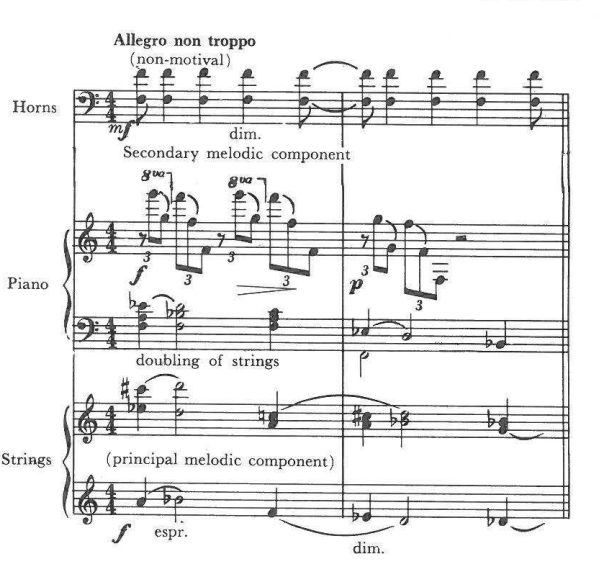
As a final example, to illustrate the need for limitation of melodic components, the illustration on p. 98 is offered from my own experience. In my Evocation Symphony (1951), there is a passage in the finale which was difficult to clarify in rehearsal.
Examination of the score will show that the rehearsal difficulty was caused by insufficient limitation of melodic components (even the tuba part has some small bit of consecutive meaning). The strings and horns are too similarly definite in melodic content, and the extremely active brass design also demands melodic attention. Since only two such attention-demanding elements can be successfully heard at one time, one of the three competing components will have to be modified. Either the brass has to be softened to pianissimo, so that it will become mere background, or the horn part has to be made less melodically definite, so that the listener can hear the string line and trumpet-trombone unit in combination as foreground.