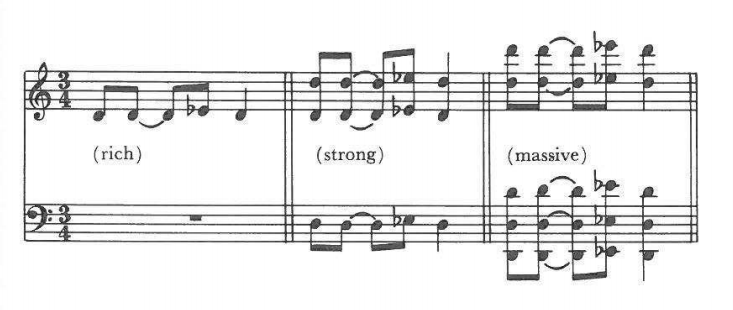
When two instruments are played in unison this is known as doubling. Indiscriminate doubling results in rather poor and characterless sound. A cardinal rule should be this:
Unless the purpose of the doubling is theoretically clear to the composer, he should avoid it.
There are only two good reasons for doubling: (1) for tonal power, and (2) for tonal subtlety. Even when consciously chosen, a doubling which continues for too long will become tiring to the ear. Use no doubling or unison blending except for definite dramatic, structural or coloristic purposes. Before scoring any doubling, justify its use by explaining to yourself why it is needed. If you cannot justify the doubling, use only the clear, unmixed tone color.
Acquaintance with scores will lead to the conclusion that some composers, such as Tchaikovsky, Mozart, Mendelssohn and Debussy, prefer the pure, unmixed tone colors. Others prefer the richness of blended tone. Beethoven uses a great deal of octave doubling; note that it is most often related to moments of power need. Rimsky-Korsakov does much melodic tone-mixing, and there are striking examples of blend for subtlety in Ravel's Rapsodie espagnole. The degree and type of doubling depend upon personal preference and artistic purpose.
The most common type of doubling is doubling for power. An intense and powerful sound results from multiple unison of timbres. This unison may be written either in a single line or in octaves. The more the doubling can be concentrated into one line (toward the middle register), the richer and more varied
the effect will be. The more the octave doubling is utilized, the more powerful the effect will be.
 Playable Books