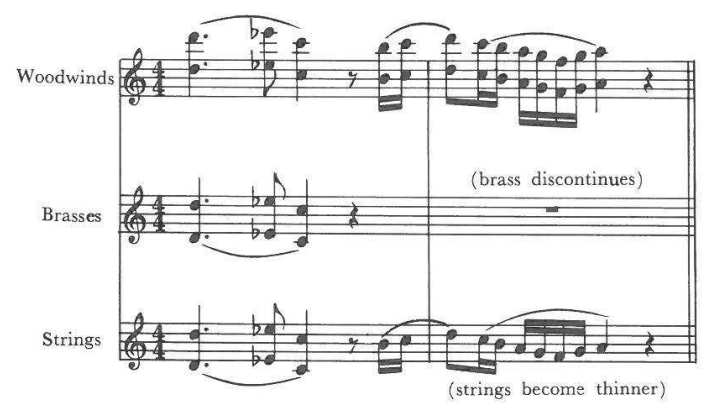
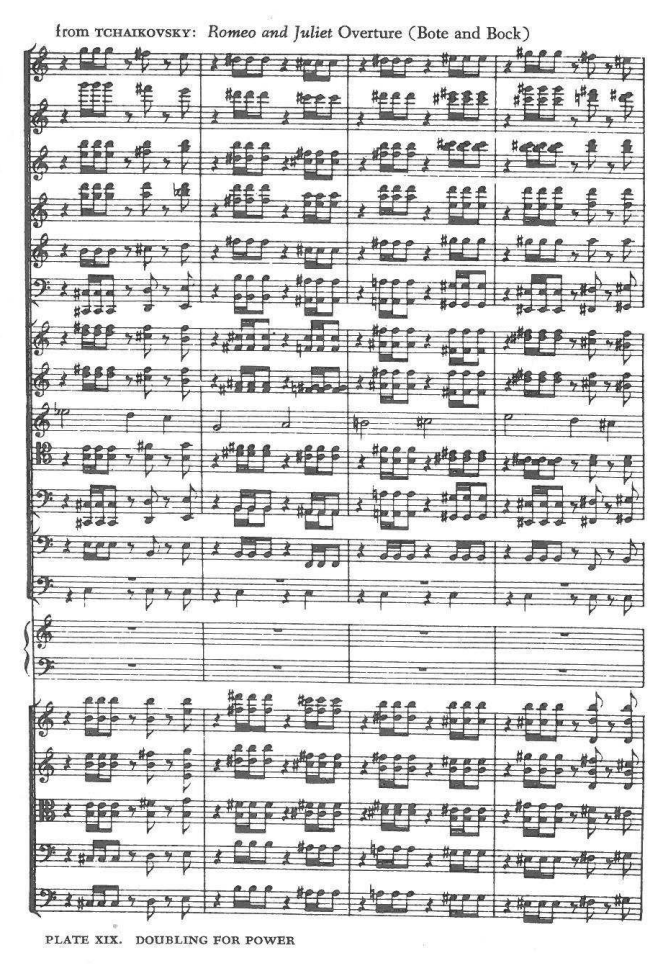
Write examples which illustrate the three types of distribution shown just above: (a) actual unison, (b) unison with moderate octave doubling, and (c) unison with maximum octave doubling. As an exercise in transposition, score these illustrations of doubling with all parts correctly transposed.
Since the brass instruments tend to dominate, to become tiring, and do not have the natural agility of the woodwinds and strings, it is usually more effective in these unison passages for the brasses to sound only part of the time. This will make the impact of their power, when they do enter, much more fresh and telling (see p. 120).
This same limitation should be applied to the use of bell-toned percussion instruments (piano, xylophone, glockenspiel, etc.). In the orchestra their sounds are so attention-getting that the ear soon tires of them. This is also true of the piccolo. Such vivid timbres as these should be reserved for moments of surprise and brilliance and should be added to the unison only for a short spell.
A purely monophonic unison line is very effective, but it may be somewhat structurally dull. In many a score it will be
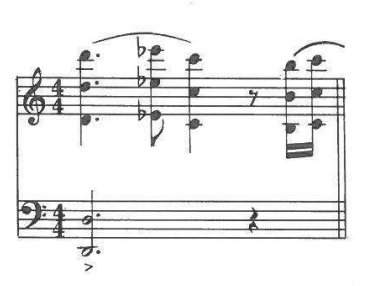
found that the structure has been livened by some small heterophonic enrichment or by a simple background. For example, to the above unison effect there might be added a simple reinforcement of the tonic center, to give a foundation or “floor” to the tonal structure — as in this example:
This music is still, in essence, doubling for power, even though a bit of additional structure has been supplied to keep it from being too spare. In fact, any effect is magnified by some slight supporting structure (like the setting around the diamond or the frame around the painting).
 Playable Books