 Playable Books
George Frederick McKay · section 67 of 111
Blend for subtlety
Read and hear this section in the playable edition →The most subtle sounds result from the mixing of dissimilar timbres. A striking instance of the mixture of opposites is found in Ibéria by Debussy. At the beginning of the second movement, “Les Parfums de la nuit,” Debussy blends the soft gentleness of the low register of the flute with the commonplace, solid “clink-clank” of the xylophone. The result is an unusual new sound, rich and alluring like a distant bell. Another striking instance of subtle blend is found in Tchaikovsky’s Romeo and Juliet Overture, where viola and cor anglais are doubled in the famous melody. The blend of the mellowness of the viola tone with the “bite” and brooding “graininess” of the cor anglais tone, creates a sound of moving and memorable richness.
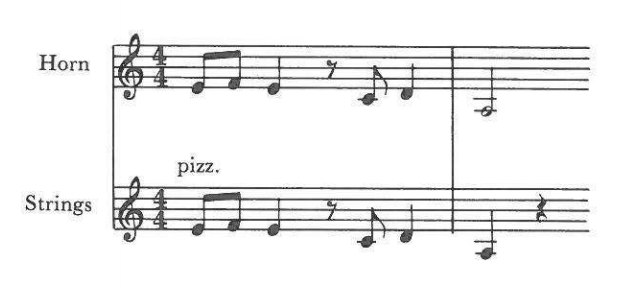
It seems that the most striking blends are derived from the combination of only two opposing timbres or, at most, the timbres of two contrasting melodic instruments combined with one dryer, percussive sound such as snare drum or pizzicato strings. When three or more sustained timbres are heard in unison, vividness of tonal character seems to merge into a general sound usually identified with reinforcement rather than subtlety.
The most usual type of blend for subtlety is doubling which uses contrasting timbres sounding as a single line.
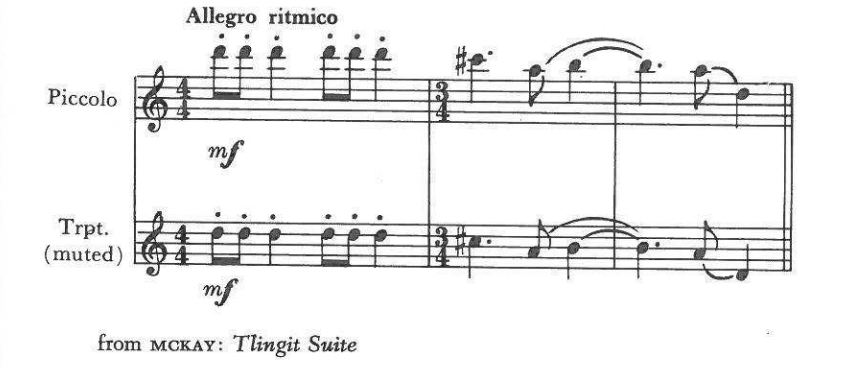
When a line is doubled with contrasting timbres an octave apart, there is less blend, but a striking freshness results.
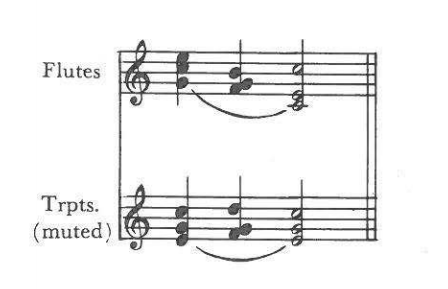
When exact doubling is applied to choirs of contrasting timbre, the harmonic resonance has a less blended effect than that which results from a slight differentiation of action in the
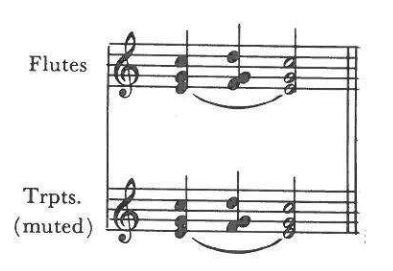
choirs (see the two examples above). Richard Wagner applied such a differentiation in his scoring. His main lines (main melody, bass line and counter melody) are doubled fully, but each supporting harmonic unit has its own independent design and spacing. This differentiation produces a delicately blended, yet not routinely exact mixing of resonances, which gives the impression that a superior type of tone-blending is being heard.
Earlier composers were not unaware of the possibilities of tone-blending. Bach used the plectrum sound of the harpsichord in his concerti grossi, and Renaissance composers often doubled vocal parts with orchestral instruments. In Nineteenth-Century music there was a tendency to use choirs of instruments of similar timbre, which caused some of the vitality of timbre to give way to harmonic values.
With the invention of new instruments in the Twentieth Century and the revival of some of the older ones, a new interest has developed in the many possibilities for timbre. Various mixed chamber-music combinations, and the chamber orchestra with one soloist on each instrument, are examples of instrumental groups which show a consciousness of new subtleties afforded by this increase in resources for diversified timbre.