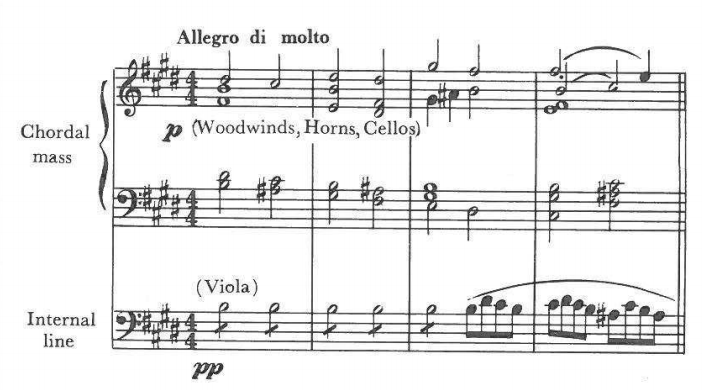
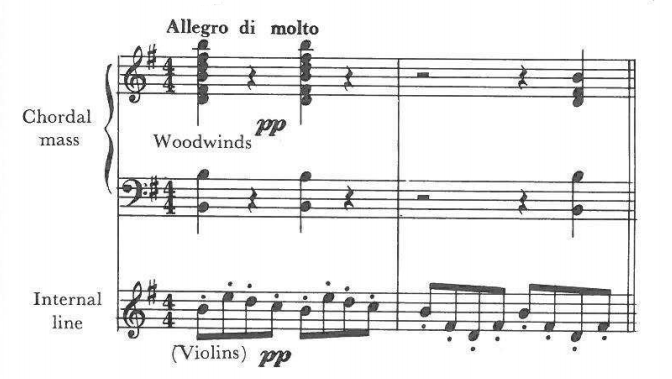
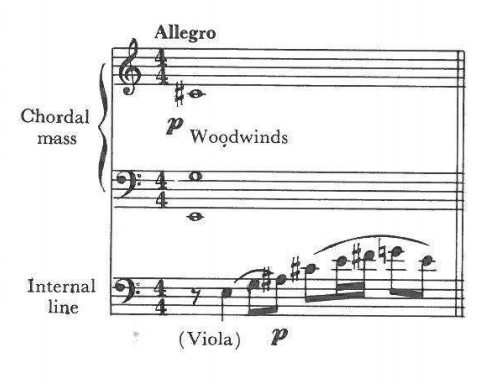
When a melodic line cuts through a mass of sound, the contrast which is effected has inherent tonal interest. The usual homophonic manifestation of melody and accompaniment is a contrast of chord and line, but its choicest sound comes from the subtle tone-mixing that results when the line cuts through a chordal structure which is in a similar pitch locale. This brings about a blend of tone and action that can be derived in no other way.
The Midsummer Night’s Dream Overture of Mendelssohn (shown in the first two examples on p. 149) shows considerable use of this principle, as does the Tannhäuser excerpt of Wagner (shown in the third example). The result in each case is a strangely appealing warmth and richness. Analyze the examples on p. 149.
from MARTIN: Petite Symphonie Concertante (Universal) — PLATE XXVII. UNUSUAL INSTRUMENTATION [Plate withheld from the public edition: the excerpt is still in copyright.]
 Playable Books
![from WEBERN: Fünf geistliche Lieder (Universal) — V. [Doppelcanon in motu contrario] — Fließend (♩ = ca 60) — Gesang (pp; text “Fahr hin, o Seel’, zu deinem Got](/mckay-creative-orchestration/assets/original/7717d47184a67b2d3e8226793ea39726d471b20668c3e4862db2254f3e561c93.png)