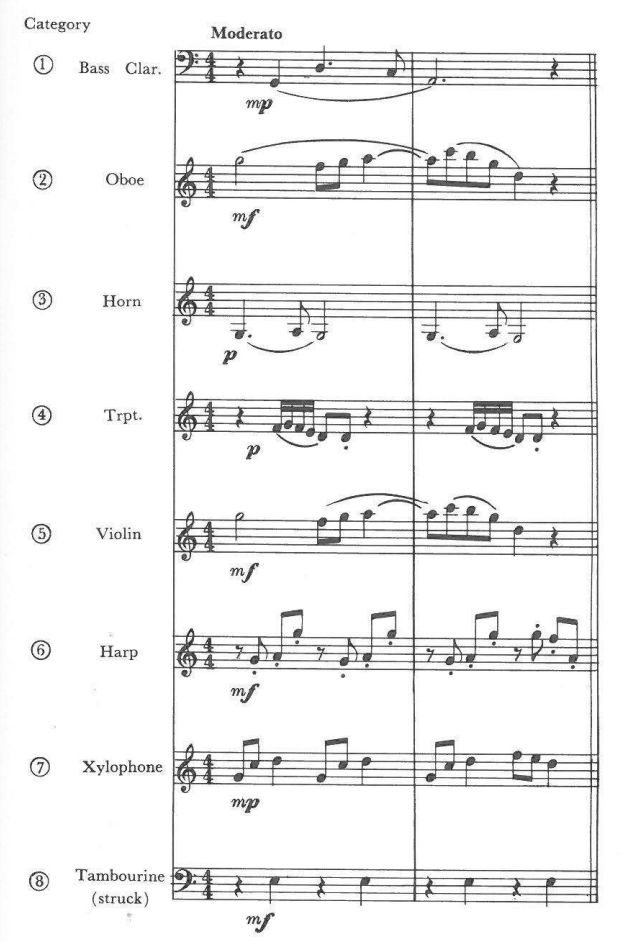
To experiment with the effect of total mixture, choose one instrument from each of the eight categories listed above. Write a piece (a few measures) in which, at some point, all eight basic types of timbre are sounding simultaneously, as in the example on page 145. Listen to Le Marteau sans maître by Boulez, and to the complete works of Webern (recorded by Robert Craft). Also compare the instrumentation of various modern dance bands and other small combinations, in order to make objective theoretical judgments as to their relative degrees of “total mixture.”
Britten’s Serenade for Tenor, Horn and Strings, Varèse’s Octandre and the symphonies of Milhaud are valuable for such analytical comparison.
It is interesting to observe how certain ingredients of “total mixture” have come into and gone out of fashion. Plectrum in-
struments such as lutes and mandolins, now seldom used, were an important part of early Italian orchestras. The harpsichord was very prominent in the time of Bach, but practically disappeared until revived in the Twentieth Century. The Petite Symphonie Concertante by Frank Martin, which features harp, harpsichord and piano in combination with strings, is typical of the revived Twentieth-Century interest in plectrum sound.
Handel’s Water Music was played on a barge floating down the Thames. The orchestra was made up of oboes, bassoons and strings, a jolly but incomplete instrumentation. In the Classical Period, there was almost an over-emphasis on the strings. In America, in the early Twentieth Century, the strings almost withered away and disappeared from dance bands. The symphonic band has shown a one-sided over-emphasis on the clarinet and brass sounds.
 Playable Books