 Playable Books
George Frederick McKay · section 84 of 111
Strings as background
Read and hear this section in the playable edition →Throughout the Classic and Romantic Periods, the strings were used as the mainstay of orchestral sound. The woodwinds were secondary in importance and often doubled or reinforced the strings, while the brass and percussion were used as supporting strength on forte passages. Mozart and von Weber began to break through its limited use, but it was only in the Debussy “impressionistic” style and after invention of certain mechanical improvements (Boehm system fingerings for the woodwinds and valve systems for the brasses), that a more developed use of brass and woodwinds began.
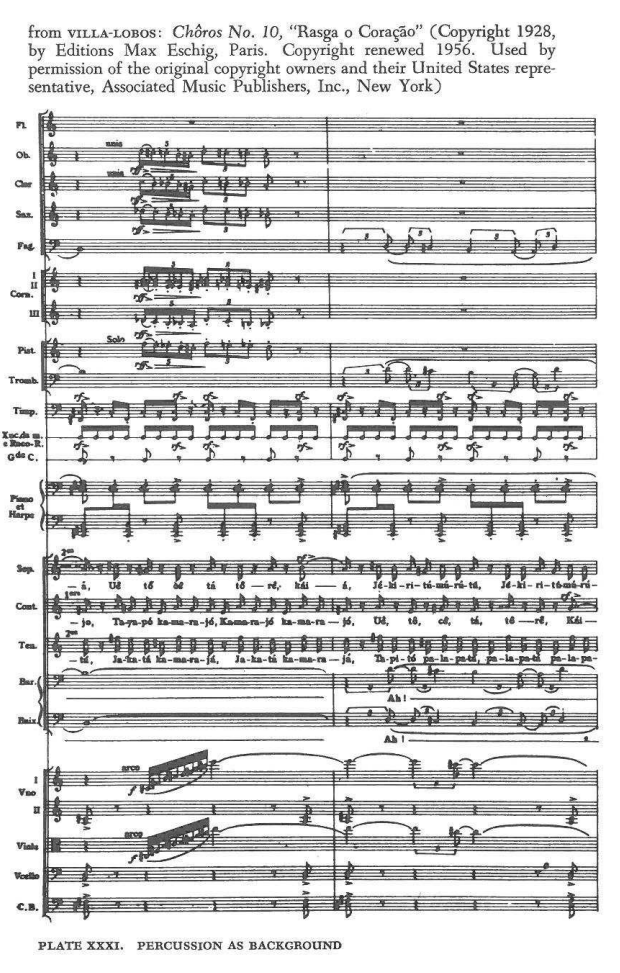
As the woodwinds and brasses became more soloistic and individually capable, the roles of the instruments were reversed. The strings became background (they can, indeed, make a wonderful background) and the brasses and woodwinds (particularly the woodwinds) became foreground. As will be explained later, this use of the woodwinds as foreground, with strings as background, is a more nearly natural balance of the idiomatic characteristics of the choirs.
Debussy nearly always included the harp in his orchestrating; and Manuel de Falla included the piano to make a more complete balance of character in the sound, and to approach the “total mixture” (non-doubled) already discussed.
String sound can be so delicate and varied that the invention of string patterns for background has endless and fascinating possibilities. As this naturally fluent, vague and active background material combines with a foreground of definite woodwind and brass timbres, there is a new liveness and attractiveness of sound in the whole orchestra.
Listen, with score in hand, first to a classic work and then to a Debussy work, in which strings recede to the background and woodwinds take over the foreground. The live and luminous quality of the Debussy score will be immediately apparent.
Study many contemporary scores to analyze the techniques that produce this special type of tonal interest, to see how subsequent composers have utilized the ideas explored and revealed by Debussy. Scores especially recommended for this are La Mer and Ibéria by Debussy, Escales by Ibert, the Daphnis and Chloé Suites by Ravel, and Trois Poèmes Juifs by Bloch.