Playable Books
George Frederick McKay · section 87 of 111
Balance of idiomatic characteristics
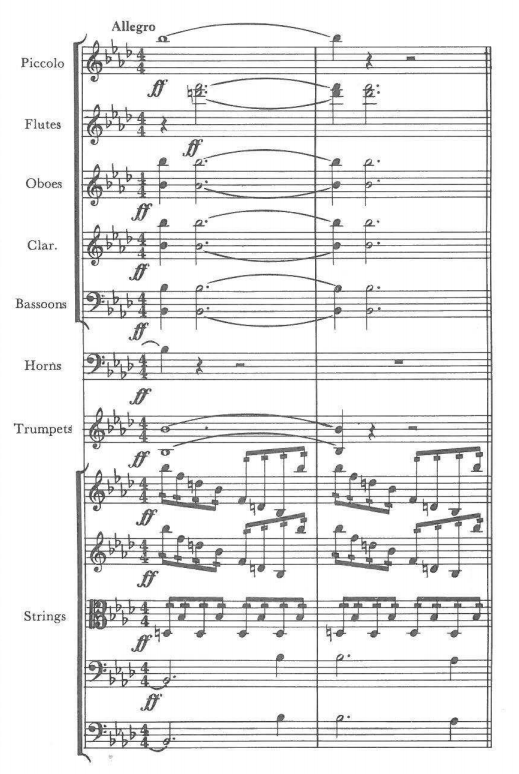
Read and hear this section in the playable edition →Each family of instruments has a particular kinaesthetic personality. The brasses are slower in articulation and are naturally harmonic. The woodwinds are more moderate in speed and tend naturally toward melody. The strings are accurate and rapid in articulation and are well suited to florid design.
If this comparison is followed through, it will lead to the conclusion that there is a normal “good sound” which results when these three main families of instruments are used together, fulfilling their naturally supplementary and somewhat contrasting kinaesthetic roles (woodwind melodic — brass sustaining — strings in active design). This “good sound” can be said to result from simultaneous fulfillment of natural “roles” or, in other words, from a balance of idiomatic characteristics.
For special effects this normal interplay of kinaesthetic qualities may be reversed. The brass might become melodic, the strings harmonic and slow-moving, and the woodwinds agile and decorative. The effect would be striking, as are all intentional distortions and grotesques.
Composers differ considerably in their uses of this principle of balance. Sibelius, for instance, uses a normal balance of articulative speed and makes much of it. Hindemith, on the other hand, prefers to have the instruments on an equal footing much of the time, with all instruments busy, in a sort of musical democracy. In one sense, this is musically progressive and tends to liberate and develop the slower-moving instruments into more challenging activity; but it also loses the simple strength of normal balance. The following excerpt from Beethoven’s Symphony No. 6 shows an old-fashioned, but healthy, balance of articulation and motion. Note that the strings are active, the woodwinds moderate in speed, and the brass slow and sustaining.