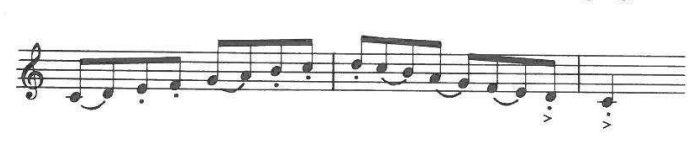
All effective phrasing, bowing or shaping of ideas will make some use of contrast of staccato and legato in consecutive action. To illustrate this, an ordinary scale passage will do.
Sawed out by the violins in this expressionless détaché bowing, the result is quite dull:
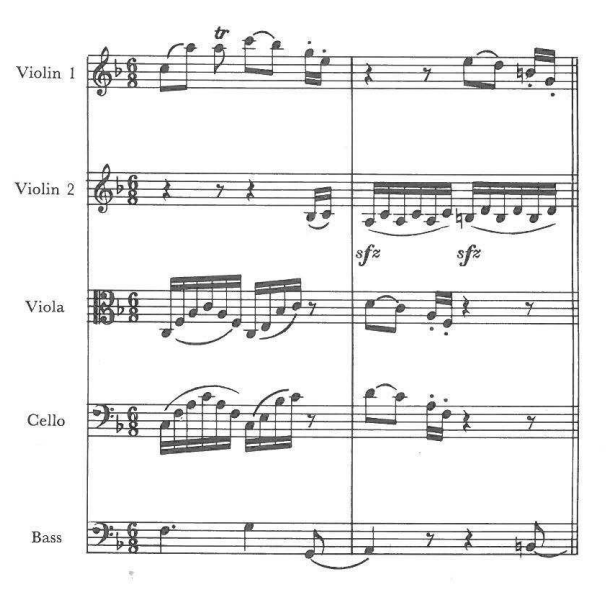
This inner contrast within a line is one way to create enjoyable sound; all successful composers make use of it. Haydn, in particular, was especially creative with this process, and all the composers of the Classic Period made much of this “architectural” contrast. Contrast of staccato and legato is particularly necessary in the writing of string parts. With the many alternatives of bowing available, there are wonderfully rich possibilities for invention in the shaping of string design. Study the classic string quartets to get a feeling for subtleties of bowing. Observe the staccato and legato design in this excerpt from Beethoven’s Symphony No. 6:
 Playable Books