 Playable Books
George Frederick McKay · section 91 of 111
Expanded tonal groups
Read and hear this section in the playable edition →The rich full-sounding harmonies of Wagner and other late-Romantic composers brought about an expansion in orchestral instrumentation. To the wind choirs, new and deeper timbres were added; the strings were often divided and the number of voices multiplied in both high and low registers.
To the woodwind section Wagner added a third flute, the cor anglais, bass clarinet, and a third bassoon. Each woodwind timbre could then have its own independent three-part harmony, as shown below. This created a new depth and richness in the
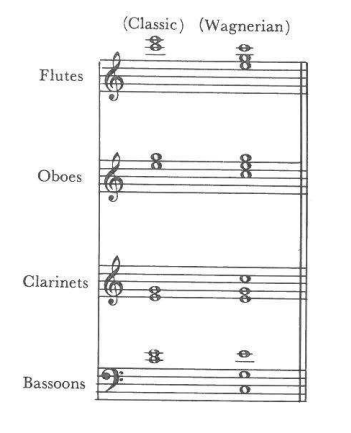
woodwind choir. Villa-Lobos and others have occasionally added saxophones for even further deepening.
It was in scoring for the string section that the most significant expansion took place; here, again, Wagner was an important innovator. The string unit in the classic orchestra was essentially like a string quartet, but with a little extra strength in the center and with the cello doubled by bass (sounding an octave lower). Wagner at times wrote for an ensemble in which each string timbre sounded as an independent choir — as shown here:
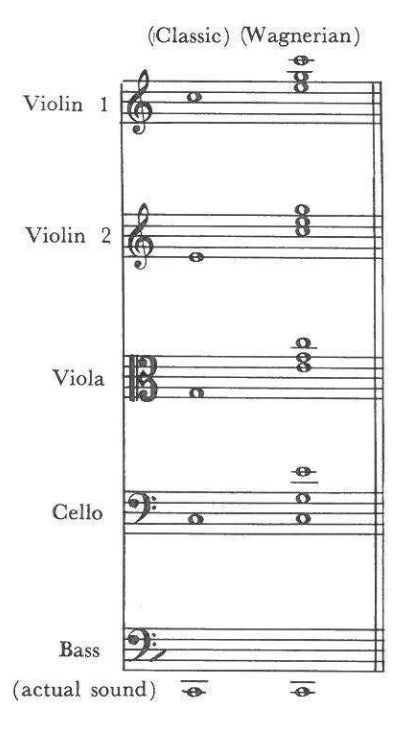
There are a great many possibilities for spacing such divisi strings. It is largely a matter of personal choice and dramatic
fitness, but each harmonic grouping must have structural and harmonic consistency. Wagner’s Lohengrin Prelude shows a highly effective use of divided strings; so does The Swan of Tuonela by Sibelius. Another major work for strings is Fantasia on a Theme by Thomas Tallis by Vaughan Williams, which employs two string orchestras and a string quartet to create unusual variety in string writing. Still another outstanding work of this type is the Concerto for Two String Orchestras by Martinu.
Divided strings produce an enjoyably full and creatively expressive tone quality. A significant enrichment takes place from the strengthened lower registers. On the other hand, when the higher strings are divided without the foundation of the lower string tone they become particularly “etherealized,” as in the opening of the famous Lohengrin Prelude.
While there were important additions to the woodwind choir and expansions in the string choir during the Wagnerian period, the groupings in the brass section showed less change.
The band profits from the use of flügelhorns because of the more truly deep trumpet sound; but, as a general rule, the piling up of brass timbres too often results in a heavy, qualitatively inferior sound. The power of the brass is so striking that two trumpets and one trombone can create the illusion of a multitude and “blow down the walls of Jericho” without further aid. For this reason the brass choir has not often been expanded.
The baritone horn, or tenor tuba, is an unusual brass instrument which is sometimes added. For an illustration of expanded brass section, study the final movement of The Pines of Rome by Respighi. For an example of the use of both cornets and trumpets in the brass section, study the Franck Symphony in D minor. For illustration of the use of baritone horn, examine The Planets (“Mars”) by Holst and the arrangement of When Johnny Comes Marching Home by Roy Harris.
The tuba must be used sparingly. It is most valuable for doubling of the lower trombone part when deep power is needed,
but it is inevitably slow in articulation, and its too constant use will tend to retard action and blur sonority.