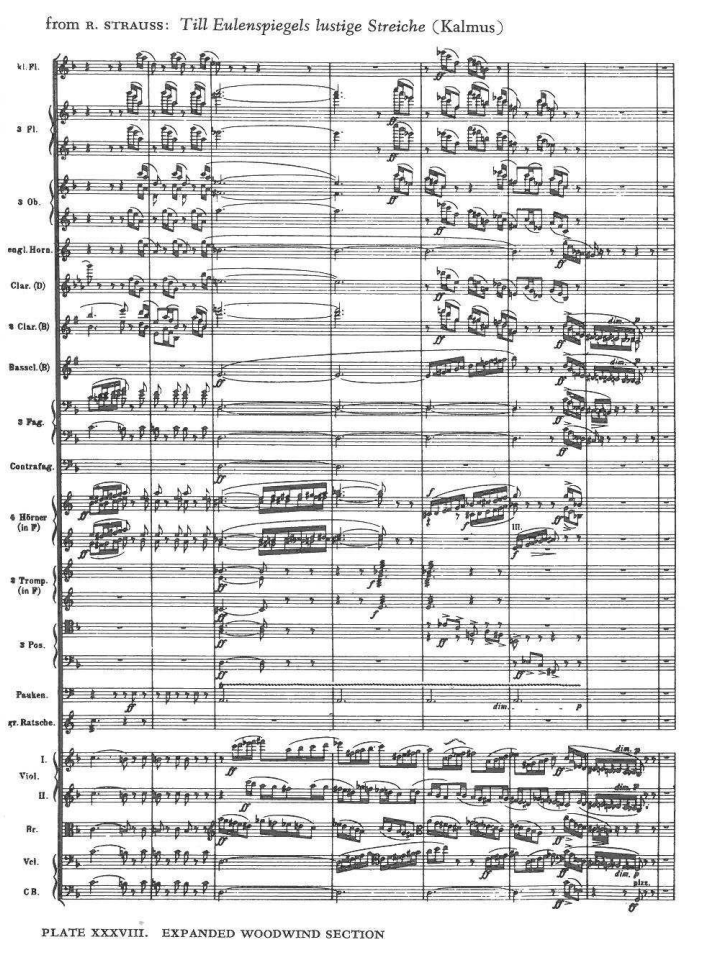
The most effective exercise in the use of an expanded choir will come from writing small compositions for: (1) the full woodwind choir, (2) the full brass choir, and (3) the string orchestra. For the woodwind group use the full-fledged Wagnerian or “modern orchestra” woodwinds, with the inclusion of third flute, cor anglais, bass clarinet and third bassoon. Add any saxophones that you need for experiment. Use the chordal texture for these expanded unit exercises, as this will supply additional concentrated practice in organizing for unit consistency.
In the brass example use the standard “modern orchestra” grouping — four horns, three trumpets, three trombones and tuba. Add baritone horns if you wish. Here again, use a texture which is “chordal” in type. This will give additional experience in spacing and unit organization.
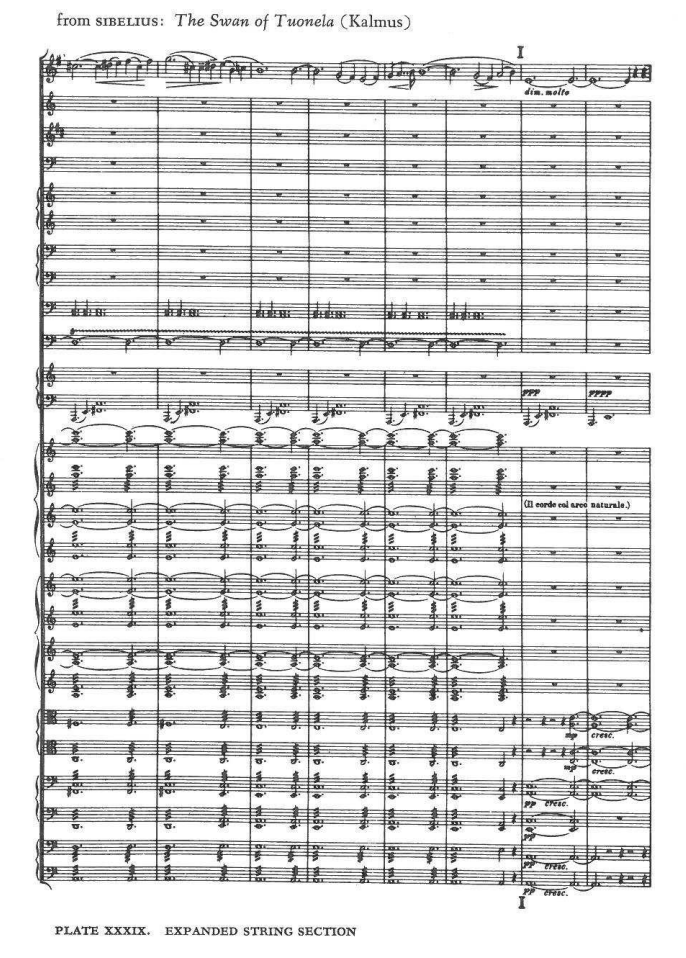
For the string ensemble use the string section of the standard symphony orchestra — first violins, second violins, viole, celli and bassi. Experiment with some divisi multiplication of parts. Because the strings have so many possibilities of distribution, more textural variety and imagination will be in order.
Any of the separate timbres of the string group may be expanded into independent choirs (first violins, second violins, viole or celli). Or some may be harmonic groups while others are not. This gives the orchestrator much more freedom of choice.
The basses are usually used for doubling of the bass line, but in rare instances have also been used for harmonic choirs.
Such bass harmonies have usually been scored to sound separately, so that their rather delicate timbre will not be obscured.
 Playable Books