Playable Books
Ebenezer Prout · section 37 of 50
Fugue 35 · Book II, No. 11 · BWV 880
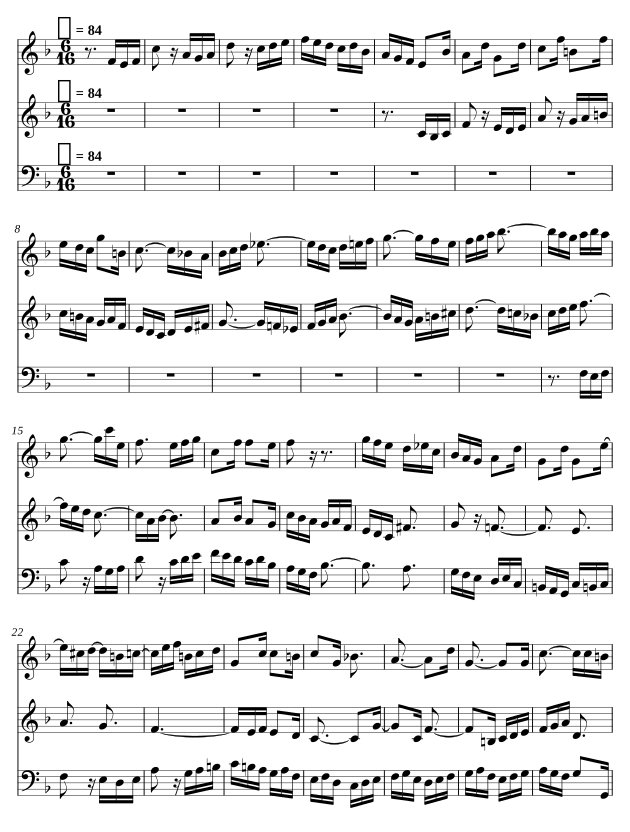
Read and hear this section in the playable edition →F Major (Three Voices).
A fugue of unusual construction, in the few entries of the subject, and the very large proportion of episode. An important feature of the fugue is its two pedal points (bars 61 to 65, and 76 to 82): the latter is the longest yet met with in the collection.
Exposition
The subject leaps from tonic to dominant—

and therefore takes a tonal answer. The treble leads, answered by the alto. A long codetta (bars 9 to 14) separates this from the entry of the bass with the subject. After another codetta (bars 18 to 21) the same voice gives a redundant entry of the answer; this is unusual, though occasional analogies are to be met with (e.g., Fugue 19). There is no regular countersubject.
Middle Section
The first and longest episode (bars 25 to 52) commences with a sequential treatment of bar 25, followed, at bars 29 to 33, with imitations founded on bars 4 and 5 of the subject. Bars 33 to 34 are developed from the codetta (bars 9 to 14). From bar 45 to 52 is a sequence in the bass, made from the subject. In bar 52 the subject reappears in the alto, partly in the original key, but so harmonized as to close in D minor. If we accept Riemann's view that this entry denotes the commencement of the final section, we shall have a middle section consisting solely of episodical matter. But the next entry is in the subdominant (bar 66, bass), so that it is best to regard the final section as not commencing until bar 85.
The second episode (bars 56 to 66) is founded on bar 10 of the codetta. In the third (bars 70 to 85) we have mostly the rhythms of the codetta, with new thematic material—e.g., the canon at the seventh for treble and alto, bars 72 to 76.
Final Section
The final entries are irregular, the first (bars 85 to 89) in substituting a minor submediant for a major, the other (bars 89 to 95) in leaping a fourth (like the answer) and containing sequential extensions which prolong it by two bars. The coda (bars 95 to 99) is founded on the beginning of the first episode.
Complete fugue: Bach, Well-Tempered Clavier, Book 2, No. 11, BWV 880. The reference score and piano recording below contain the entire fugue; the smaller engravings above reproduce Prout’s selected examples.