Playable Books
Ebenezer Prout · section 39 of 50
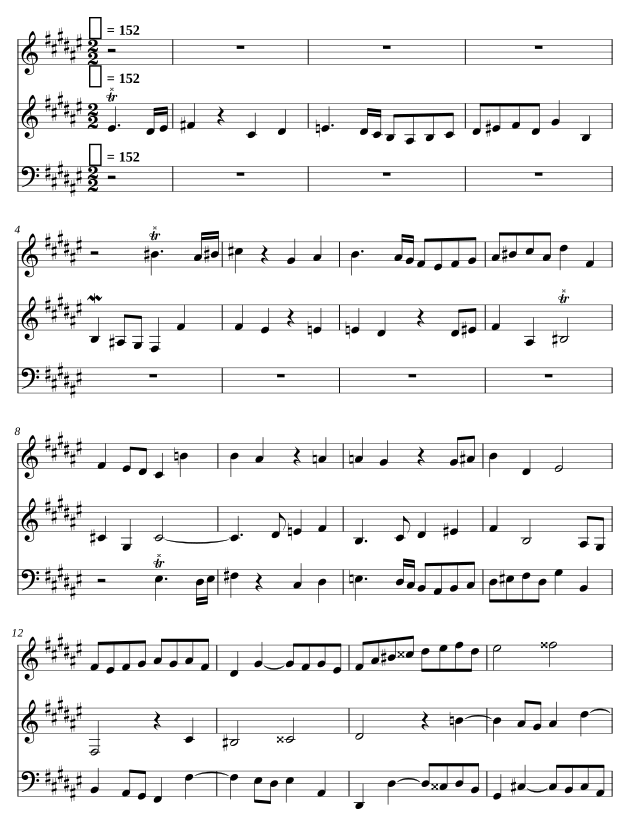
Fugue 37 · Book II, No. 13 · BWV 882
Read and hear this section in the playable edition →F Sharp Major (Three Voices).
Exposition
The subject is announced in the alto:—

The answer, given to the treble in bars 4 to 8, is real, the dominant being treated as supertonic of B. into which key a passing modulation is made, and therefore answered by G sharp, the supertonic of F sharp. There is a countersubject, commencing one
crotchet later than the subject, and terminating with the last accented note of the subject, not having a feminine ending. There is no codetta, and the bass entry at bar 8 is regular.
Counter-Exposition
After an eight-bar episode, founded on a variation of the quaver figure of bars 2, 3, with new counterpoint, a counter-exposition commences in bar 20, with subject in treble and countersubject in bass. A second episode (bars 24 to 32) separates this entry from the rest of the counter-exposition, and consists of free canonic imitation, between treble and alto, of a sequence made from the first notes of the countersubject, accompanied by quavers in the bass. In bar 32 the answer appears in the bass, with countersubject in the alto, transferred to the treble in bar 34, last beat, and varied; in bar 36 the subject is in the alto, and the countersubject in treble.
Middle Section
This starts abruptly in bar 40, with an entry in the relative minor (subject in treble, countersubject in alto), without any connecting episode. Episode 3 (bars 43 to 52) is a transposition of Episode 1, with the two upper parts inverted. The only other middle entry (from bar 52) is in the key of B, with the subject in the alto and countersubject in the treble. The fourth episode (bars 56 to 64) is a transposition and inversion of the second, on the same plan as the third is of the first. All the episodes in this fugue are of exactly the same length—eight bars.
Final Section
The entries are quite regular (bass, alto, treble, bars 64, 70 and 76 respectively), but the countersubject is more or less incomplete or varied, and is wanting in bars 70 to 74. There is a short coda from bar 80, founded on the second episode.
Complete fugue: Bach, Well-Tempered Clavier, Book 2, No. 13, BWV 882. The reference score and piano recording below contain the entire fugue; the smaller engravings above reproduce Prout’s selected examples.