Playable Books
Ebenezer Prout · section 40 of 50
Fugue 38 · Book II, No. 14 · BWV 883
Read and hear this section in the playable edition →
F Sharp Minor (Three Voices).
A very fine fugue, of unusual construction. It is sometimes described as a " triple fugue," but this is not strictly accurate. Two counterpoints introduced later (bars 20 and 36) are subsequently combined with the subject, somewhat as in No. 4; but with this difference, that they do not first appear together with the subject. Thus they do not fulfil the conditions of true countersubjects; and although they have treatment somewhat analagous to separate expositions, the intervals of entry are too irregular to justify their being called new subjects. We therefore treat them, on their first appearance, as episodes, designed to be employed subsequently as countersubjects.
Exposition
The subject is in the alto:—

The answer in the treble is tonal, the dominant being answered by the tonic. A codetta (bars 7 to 8) is introduced before the entry of the bass with the subject. There is no countersubject in the exposition.
Counter-Exposition
After the first episode (bars 11 to 14), which is formed from the first note of the subject and answer, treated by imitation, direct and inverted, there is a partial counterexposition, in which only two voices participate. The bass leads with the answer, which is here real instead of tonal, is somewhat varied in bar 15, and breaks off at the second beat of bar 16, where the treble enters with the subject in stretto. A codetta, or link, leads to a perfect cadence in the key of the relative major in bar 20.
Middle Section
The second episode (bars 20 to 28) announces the first new theme. This is given out by the bass—
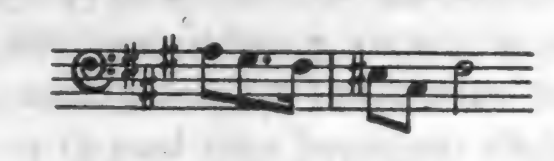
imitated successively by the alto and treble at distances of half a bar, and then further developed with fragments of the subject (e.g., bar 24, alto, bar 28, treble and bass). It commences in F sharp minor and modulates through A major to B minor. In this key appears an isolated entry of the subject in the alto (bars 28 to 31), combined with the counterpoint (from Episode 2) in the treble in bar 29 and bass in bar 30. The next entry is in the bass, in C sharp minor, at bar 34, with the new counterpoint in the upper voices. The third episode (bars 37 to 51) introduces the second new theme, slightly overlapping the preceding appearance of the subject.

This is imitated successively by the treble and bass, and developed at some length. A re-entry of the subject in B minor in the alto (bars 51 to 54), accompanied in the bass by material derived from the new (third) episode, could possibly be regarded as the commencement of the final section in an irregular key; but it is more logical, not only on account of the key, but also because the triple counterpoint does not commence until the next entry, to refer this one to the middle group.
Final Section
The three themes which have been quoted are now combined in triple counterpoint. In bars 54 to 57 the subject is in the treble, in the tonic key, slightly modified at its commencement, the triple counterpoint being found in bar 56. Bars 57 to 60 and 63 to 66 contain the fourth and fifth episodes, with new treatment of the semiquaver figure. In bars 60 to 63 the answer in the bass, and in bars 66 to 69 the subject again in the treble. Three of the six possible positions of triple counterpoint are employed, each theme appearing once in the bass; bar 56 should be carefully compared with bars 61 to 62 and bar 68.
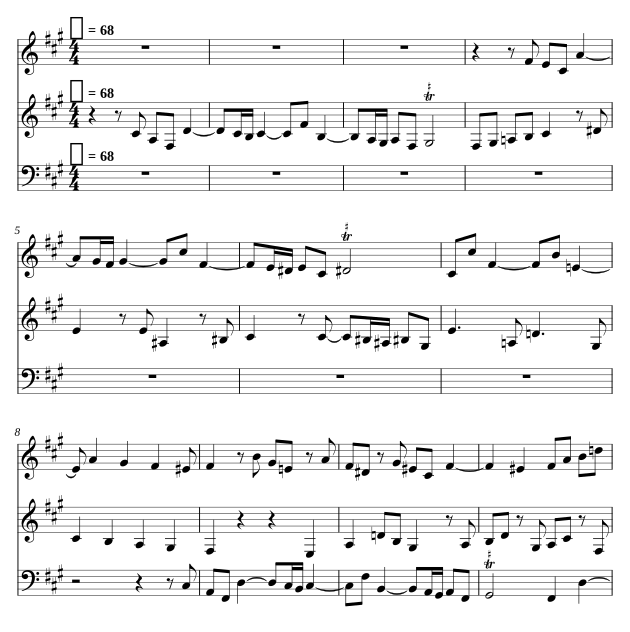
Complete fugue: Bach, Well-Tempered Clavier, Book 2, No. 14, BWV 883. The reference score and piano recording below contain the entire fugue; the smaller engravings above reproduce Prout’s selected examples.