Playable Books
Ebenezer Prout · section 50 of 50
Fugue 48 · Book II, No. 24 · BWV 893
Read and hear this section in the playable edition →B Minor (Three Voices).
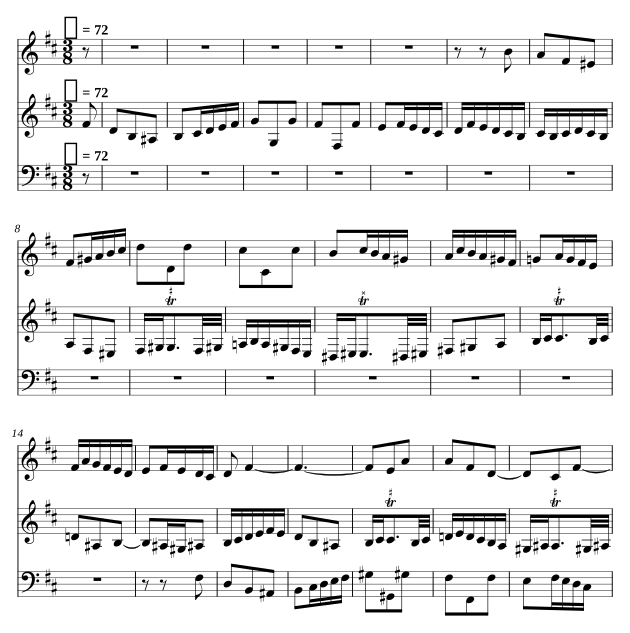
This fugue is so regular in construction and so clear in outline as to require but few notes. There is a regular countersubject, but it does not appear until after the exposition proper (compare No. 4).
Exposition
The subject, in the alto, commences on the dominant:—

The answer (treble, bars 6 to 12) is therefore tonal. The codetta (bars 12 to 15) is developed from the end of the subject and the counterpoint which accompanies it. The subject is given to the bass, and after an episode formed from the codetta, a redundant entry in the alto (bars 26 to 32) substitutes a real answer for a tonal. This entry is noteworthy for the first appearance of the countersubject—the semiquaver theme in the bass from bar 29.
Middle Section
The second episode, which is built on a bass suggested by the countersubject, modulates, leading to a half cadence in D major. In this key the subject enters in the treble (bar 35); the countersubject (bar 38) is given to the alto. This entry is answered in bars 44 to 50 by one in the bass in the key of A, with countersubject in the treble. In bars 54 to 60 there is an isolated entry in the alto in F sharp minor, with countersubject again in the treble.
Final Section,—In bars 69 to 76 there is a partial stretto for the two lower voices; the treble once more supplies the countersubject. As this entry commences definitely in the tonic key, preceded by a formal cadence, it marks the commencement of the final section, notwithstanding the incidental modulation into the subdominant key. There is only one further complete entry, namely, that in bars 81 to 87; but the coda (bars 87 to 100) contains, in its last five bars, an incomplete stretto for all the three voices, the bass inserting a passing note between the F sharp and the D, and the treble considerably ornamented.
The episodes, in addition to the two already noticed, are in bars 41 to 44, 50 to 54, 60 to 69 and 76 to 84. They are, as usual, made from material previously employed; and the greater part of the coda is a transposition of Episodes 2 and 4.
Complete fugue: Bach, Well-Tempered Clavier, Book 2, No. 24, BWV 893. The reference score and piano recording below contain the entire fugue; the smaller engravings above reproduce Prout’s selected examples.