Playable Books
Ebenezer Prout · section 49 of 50
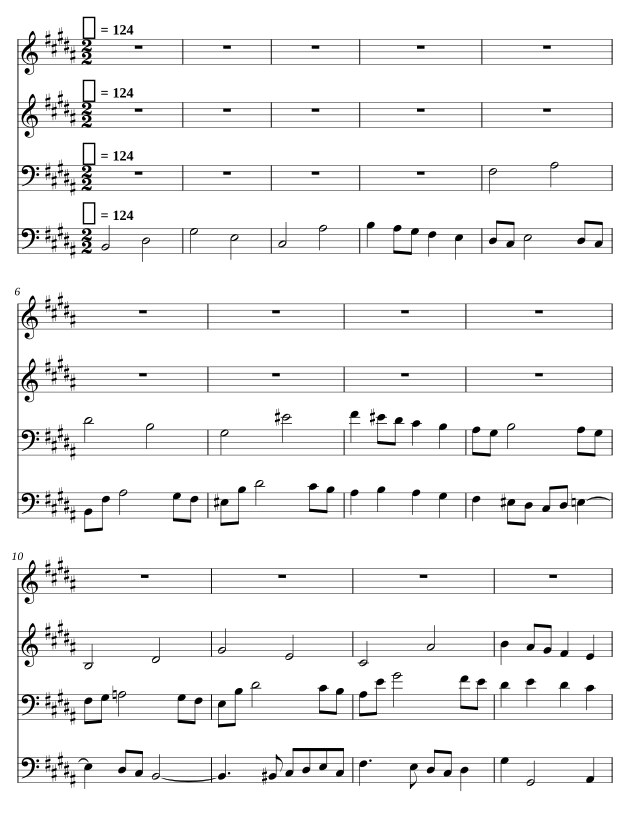
Fugue 47 · Book II, No. 23 · BWV 892
Read and hear this section in the playable edition →B Major (Four Voices).
The finest example of double counterpoint in the twelfth which is to be met with in the whole collection. There are two countersubjects, one which is used in the exposition and not subsequently, the other — invertible in the twelfth — in the counterexposition and onwards. We mark them CS 1 and CS 2, as in other cases where there is more than one.
Exposition
— The subject is in the bass:—
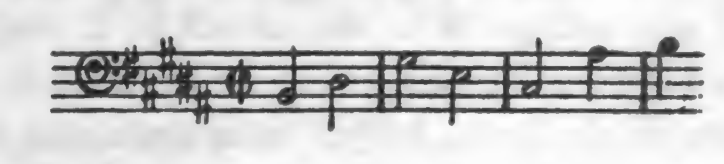
A few notes of codetta separate this from the answer (in the tenor) and CS 1 (in the bass). The answer is real. A longer codetta, formed from the first and from the beginning of CS 1, is found in bars 8, 9, and another, identical but with a new counterpoint added below, in bars 17, 18. The alto takes the subject in bars 10 to 13, and the treble the answer in bars 14 to 17; in bars 19 to 22 the bass has a redundant entry of the subject, allowing CS 1 to appear in the treble, i. e., in double counterpoint.
Counter-Exposition
— After an episode of five bars, containing reminiscences of codetta and of CS 1, but largely new, a counter-exposition commences at bar 27 the answer leading in the tenor. Here CS 2 first makes its appearance: —
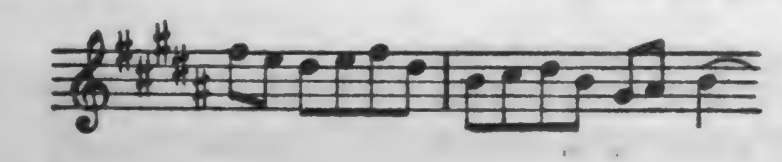
A rather long codetta (bars 30-34), formed from this new countersubject, precedes the entry of the subject in the alto. Against this entry, CS 2, now in the bass, is employed in double counterpoint at the twelfth. In bar 42 the answer is in the treble; CS 2 (again inverted at the twelfth) accompanies it in the alto. There is no entry of the bass in the counter-exposition.
Middle Section
Bars 43 to 45 having been harmonised so as to modulate into the minor keys, the middle section is introduced without the interposition of a true episode, though there are a few bars of link. In bar 48 the bass enters with the subject in G sharp minor, the treble taking CS 2, at its original interval. In bars 53 to 56 the subject is in the tenor, in E major, CS 2 in the alto, in sixths with the subject, hence in the inversion at the twelfth; in bars 60 to 63 the subject is again in the tenor, but in G sharp minor, CS 2 in the treble, at its original interval. A long episode (bars 63 to 74) terminates the middle section of the fugue, leading back to the key of B.
Final Section
The subject and answer alternate, separated by episodes; see bars 75 (bass), 85 (tenor) and 93 (treble). Against the first of these entries, CS 2 is not used, though a fragment of it appears against the first bar of the subject.
The coda (bars 96 to 104) and most of the episodes are not formed directly from the material of either the subject or the countersubjects, but are either chiefly or entirely of new material. The principal episodes are in bars 22 to 27, 38 to 41, 56 to 59, 63 to 74, 78 to 84, 88 to 92.
The fugue contains no stretto.
Complete fugue: Bach, Well-Tempered Clavier, Book 2, No. 23, BWV 892. The reference score and piano recording below contain the entire fugue; the smaller engravings above reproduce Prout’s selected examples.