 Playable Books
Jean-Philippe Rameau · section 10 of 109
Chapter seven
Read and hear this section in the playable edition →On Harmonic Division, or the Origin of Chords
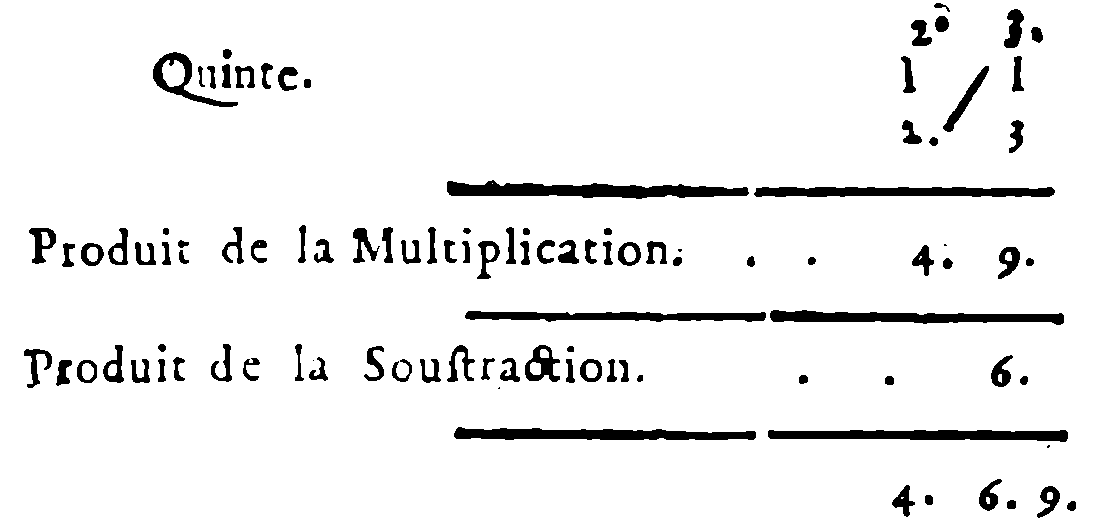
Harmonic division, which in our system is nothing other than arithmetic division, gives us no harmonic means except the fifth and the two thirds. If the fourth and other intervals occur in it, they do so only through the octave; every difference we perceive arises solely from the different disposition of the sounds composing this fifth and these thirds. Harmony invites us to this free mixture of sounds so that their diversity may make us feel more strongly the perfection of the whole; but this must not make us lose sight of a principle that always remains present. Now the fifth and thirds not only divide all the principal chords, but also compose them, whether by their squares or by their addition. If, therefore, we apply the rules of multiplication and subtraction to these intervals, we shall derive all harmonious chords from them. For example, multiplying the two thirds gives the fifth, and subtracting them gives the two harmonic means of this fifth.
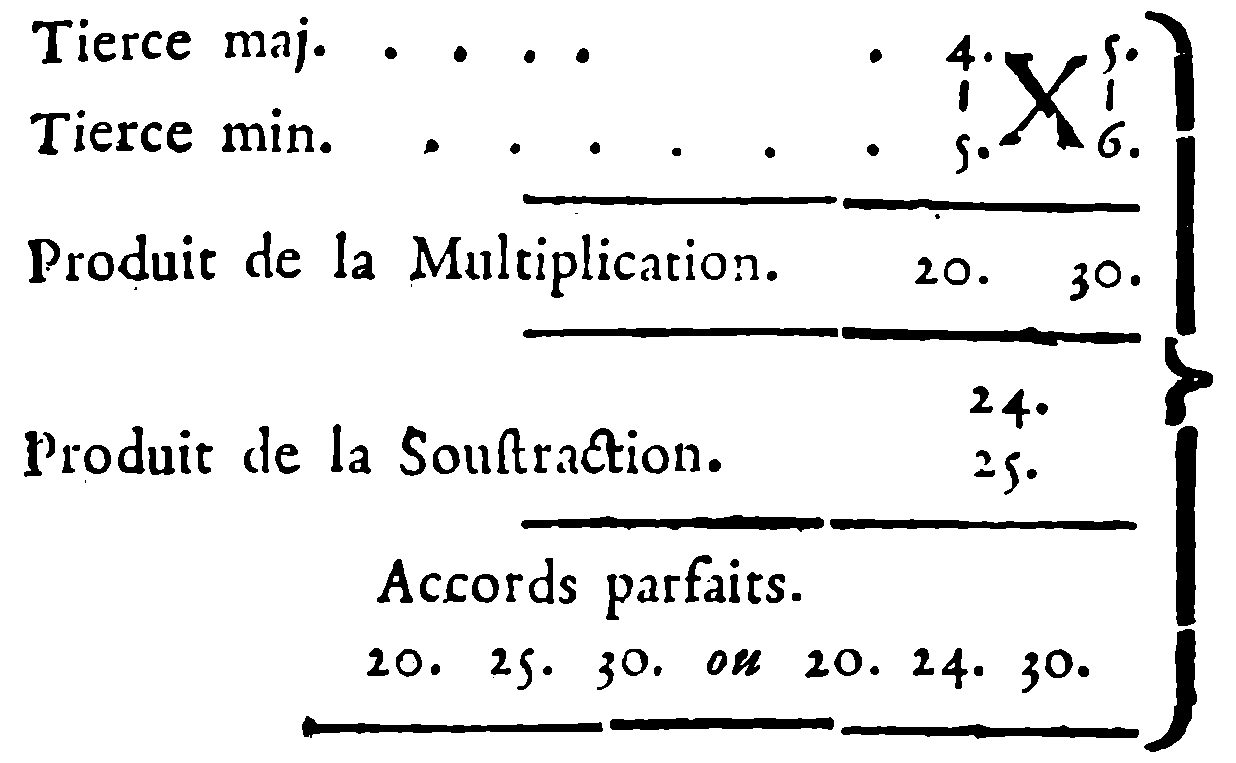
The interval between 20 and 30, divided at 25, gives the perfect chord called major, because the fifth is divided with the major third below; the same numbers, divided at 24, give the perfect chord called minor, because the fifth is divided with the minor third below. Moreover, the numbers 24, 25 give the ratio of the minor semitone, which is the difference between the major and minor thirds.
Squaring the major third gives the augmented fifth, and squaring the minor third gives the diminished fifth; subtraction in each square divides the resulting interval harmonically.
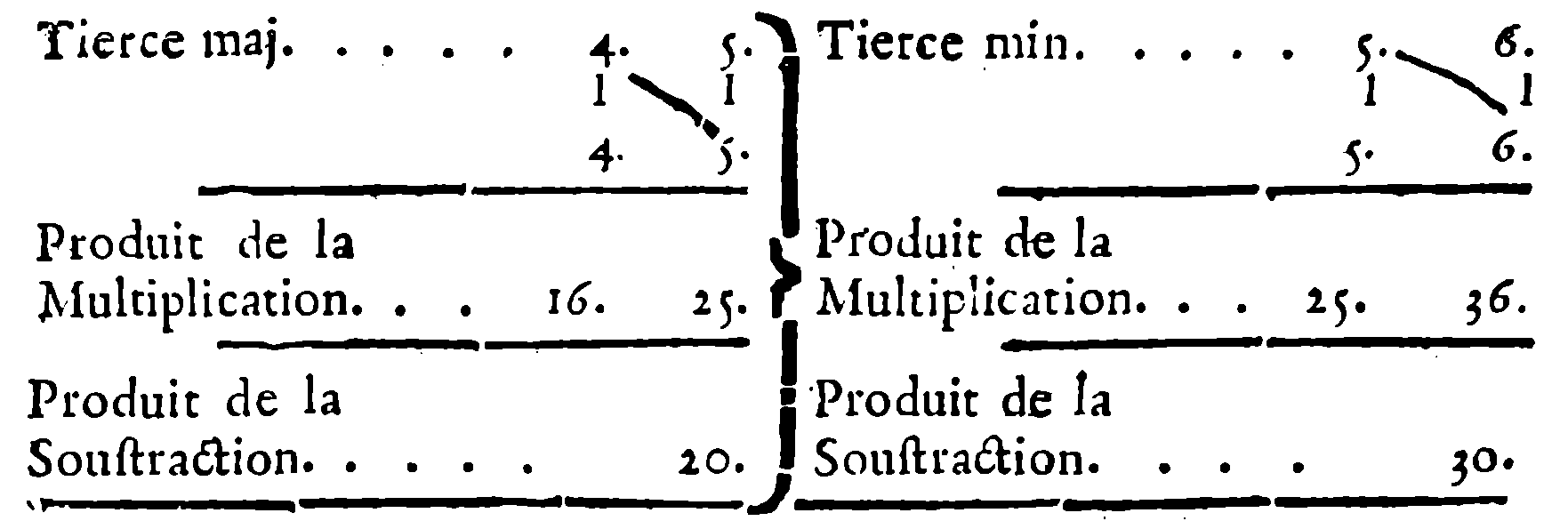
We must now observe that no chord is complete without the fifth, and consequently without the union of the two thirds composing it, because every chord must originate in the perfect chord formed by their union. Thus, if the fifth does not sound in a chord, its foundation is then inverted, supplied by supposition, or borrowed; otherwise the chord will be incomplete, or else worthless. Accordingly, we have not given the name chord to these diminished and augmented fifths divided harmonically, because the chord arising from them is incomplete. This is why Zarlino established the diminished-fifth chord without a foundation, as we shall see elsewhere.
If there are harmonious chords other than the preceding perfect chords, they must be capable of being formed from a perfect chord and one of its parts, namely one of the thirds. For example, adding a third to a fifth gives the interval of a seventh, and their subtraction gives its complete chord.
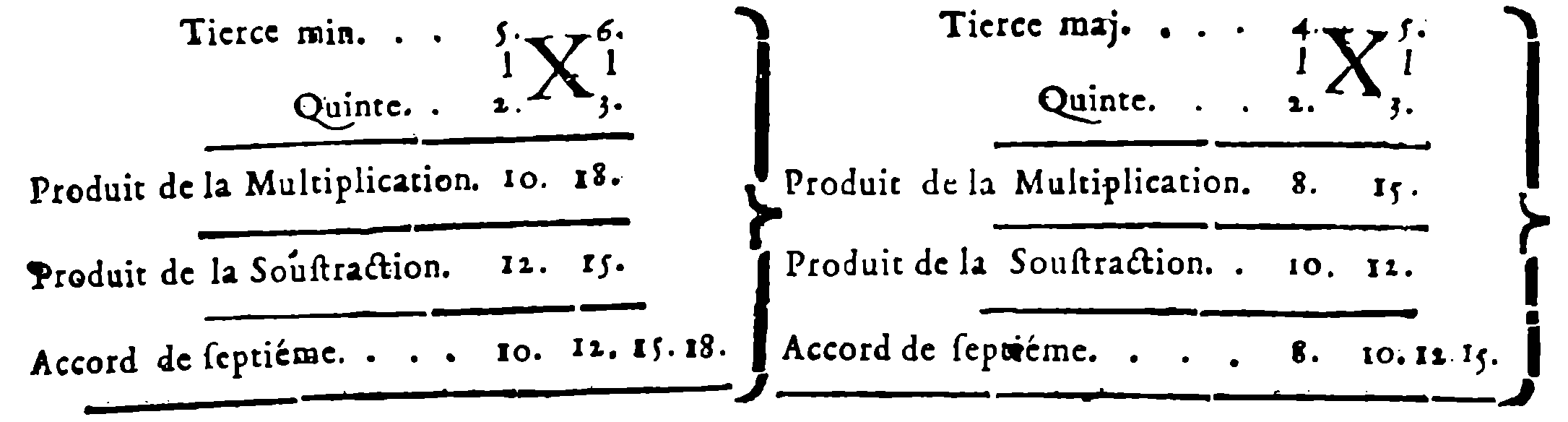
We obtain two other seventh chords simply by multiplying the ratios of each perfect chord by that of the minor third.
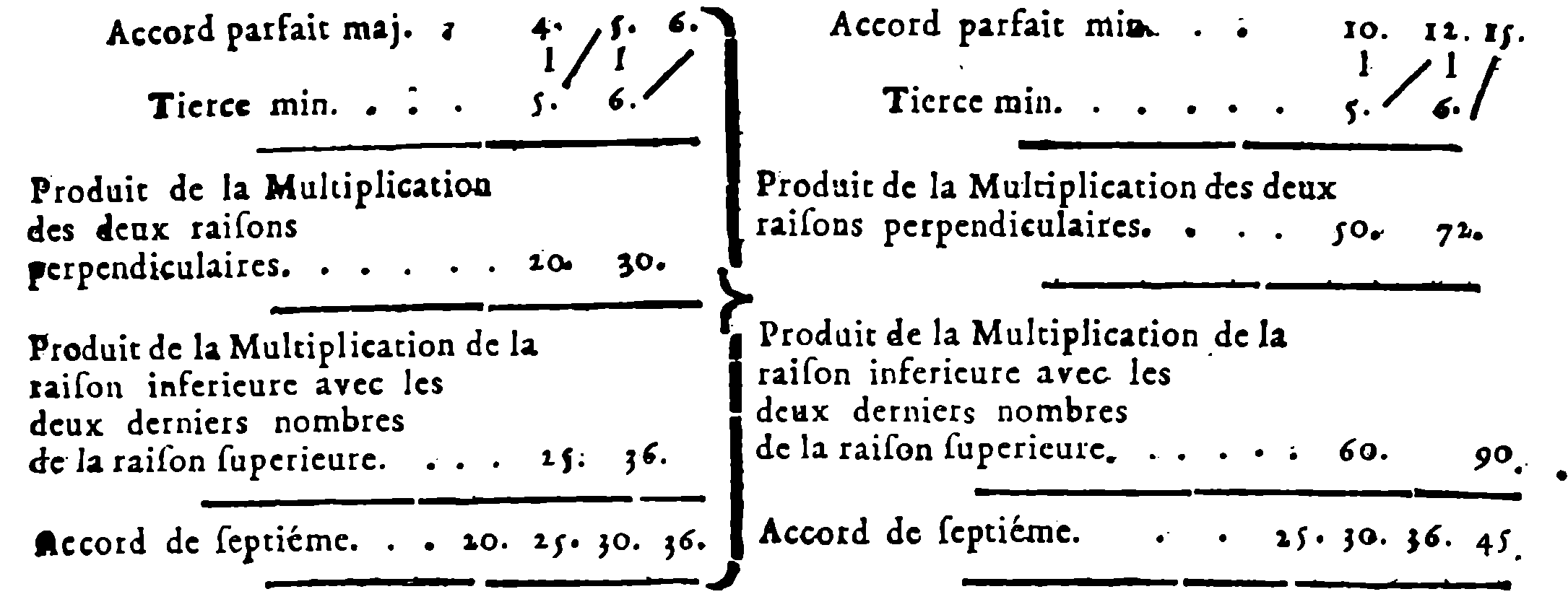
Although the fourth can give us a seventh by being squared, it cannot divide that seventh harmonically.
We see that the fifth prevails in every seventh chord. In the first two, it occurs between 8 and 12, 10 and 15, and 12 and 18; in the third, it occupies the lower position between 20 and 30; and in the fourth, the upper position between 30 and 45. We also see that all these chords lie within the octave of the lowest sound, which is their principle. We are convinced, moreover, that it cannot be otherwise: if the octave is merely the replication of a sound, then all intervals exceeding that octave must likewise be replications of those contained within it, as we have already observed. The fifth, however, has the privilege of giving us, through its square, a chord that harmony accepts even though it exceeds the bounds of the octave. This chord is called the ninth, because the interval generated by squaring the fifth spans that distance, although the interval considered by itself could be regarded merely as a replication of the second.
The harmony of this chord, divided on either side by the fifth, is easy to understand: to form it, we need only divide each fifth in turn by the major or minor third, as nature requires. The eleventh could also be obtained by adding a minor third above this ninth, without then dividing the lower fifth. Perfect harmony, which naturally admits only four different sounds in the construction of its chords, can tolerate one more on account of the fifth, its sole object, but no more than that.
To be convinced at once of the compass and composition of chords, we need only recall, first, that the octave was principally generated to serve as their boundary, since chords consist only of intervals contained within that octave; and, next, that the fundamental sound chose the fifth to form every chord, and joined itself indifferently to either third to determine their construction. Without abandoning the principal objects of harmony, we therefore need only attend to some further properties natural to them, and to the inversion already discussed, in order to support by reason every new discovery experience may afford us. If, for example, experience proves that some chords exceed the compass of the octave, reason—which tells us that the foundation can exist only within that octave—leads us to judge that, to avoid destroying it, the foundation must then have a new sound placed beneath it by supposition,a at the distance of a fifth or third. This sound must in that case be regarded as supernumerary,b even though the interval it forms with the fundamental sound is always one of those that the latter chose for constructing chords. If experience further proves that the diminished fifth often takes the fifth's place in chords, reason persuades us that this arises from the power of the thirds, whose union can form only chords more or less pleasing. The diminished fifth is accepted rather than the augmented fifth because of the natural order first prescribed for these thirds: the major third lies below, while the upper position belongs principally to the minor. The minor third can always prevail above, even when the fundamental sound adopts it at the same time. It seems to have been placed there to indicate the preference we should give it when adding dissonance to the perfect chord. Finally, if experience proves that chords are not always divided by thirds, reason simultaneously proves that this arises solely from inversion of the intervals composing those chords.c
To make matters more familiar, we may now regard the thirds as the sole object of all chords. Indeed, forming the perfect chord requires adding one third to the other, and forming every dissonant chord requires adding three or four thirds to one another. The differences between these dissonant chords arise solely from the different positions of their thirds. We must therefore attribute all the power of harmony to the thirds when reducing harmony to its first elements. This can be demonstrated by adding a fourth proportional to each perfect chord, producing two seventh chords, and a fifth proportional to one of those seventh chords, producing a ninth chord that contains within its construction the four preceding chords. Admittedly, the last two seventh chords in the preceding demonstration, in which the diminished fifth occurs, cannot be obtained in this way, because the proportion between the first and third terms and between the second and fourth is then interrupted. But could not a certain reversal of the disposition of the thirds, which should have been noticed in the first operations, lead us to seek by new means what we cannot find in this manner? Did we confine ourselves to arithmetic division alone in forming a perfect chord? As soon as the fifth was divided with the major third below, did not the octave also make us perceive that this fifth could equally be divided with the minor third below? Thus what we lose on one side we shall find on the other. For example, if we did not find the diminished-seventh chord in the first operations, we must seek it in these latter ones. We shall find it precisely in the numbers 125, 150, 180, 216, by adding a fourth proportional to the ratios of the harmonically divided diminished fifth. See Chapter VIII, Article VII.
a See “Supposer” (“To supply by supposition”) in the Alphabetical Table.
b See the squares in the following chapter, Article III, in which supernumerary sounds cannot occur.
c See the triangles and squares in the following chapter, Articles I and III.
Observe that dissonant chords formed by adding a minor third to either perfect chord are far more tolerable than those formed by adding a major third. The resonance of the major third in some way stifles the sweetness of the fifth, which should dominate every chord. Diminished chords are therefore less harsh than augmented ones. This is why adding three major thirds cannot produce a harmonious chord, and why even the augmented fifth, composed of only two major thirds, is tolerable only in a mixture of five different sounds, whose chord then exceeds the bounds of the octave, as we shall learn later.