 Playable Books
Jean-Philippe Rameau · section 11 of 109
Chapter eight
Read and hear this section in the playable edition →On the Inversion of Chords
If there are only three concordant numbers, as Descartes says, we have also been able to observe that there were only three principal consonances: the fifth and the two thirds, from which the fourth and the two sixths arise. It remains only to see how all these consonances have been distinguished in chords.
Article one
The Major Perfect Chord and Its Derivatives
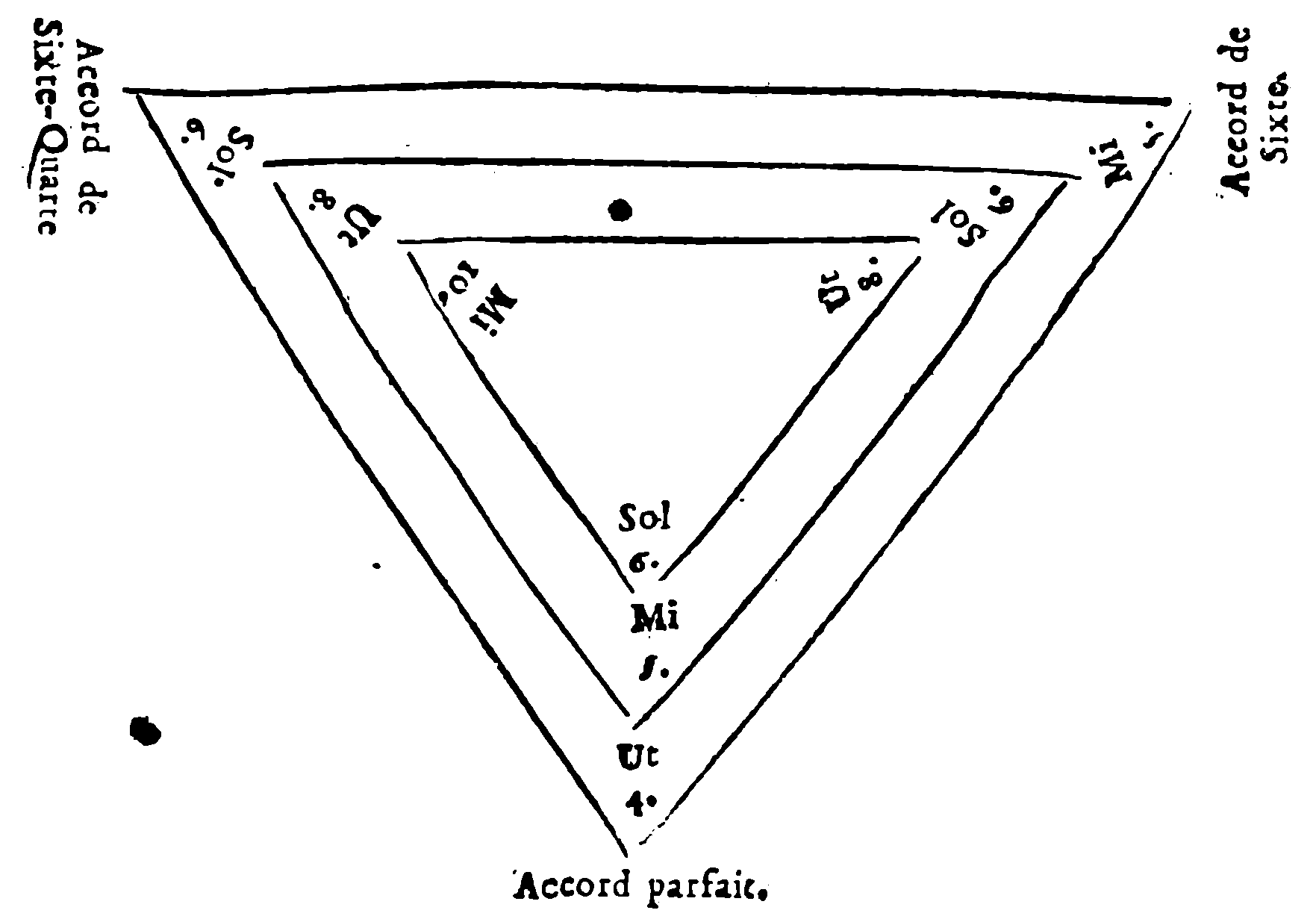
From the three prime numbers 2, 3, and 5, let us take the composite numbers 4 and 6, so that the fifth is divided into two thirds, as it should be. The major perfect chord thus consists of 4, 5, 6. If we raise 4 to its octave, we obtain 5, 6, 8, forming what is called a sixth chord, because a sixth sounds between its two outer sounds. If we then raise 5 to its octave, we obtain 6, 8, 10, forming another chord called the sixth–fourth chord, because the sixth and fourth sound between its two upper sounds and the lowest, to which every interval in a chord must be referred. If we were also to raise 6 to its octave, we should obtain 8, 10, 12, in the same proportion as 4, 5, 6. We therefore cannot carry this transposition of the lowest sound to its octave any further: the perfect chord consists of only three different sounds, and can consequently produce in this way only three different chords, of which it is the first and fundamental.
Although the two chords derived from the perfect chord are consonant, they are called imperfect, not only to distinguish them from the chord that is their principle, but also because their properties differ from its own.
We may note in passing the great power of the number 3: the fifth, which is the origin of all chords, takes shape at 3, and this single number also gives the number of concordant numbers, primary consonances, and consonant chords.
To make this perfect chord and its derivatives intelligible, we shall place their ratios in three triangles, together with the note names used to designate the chords. The largest triangle will contain the perfect chord, as the principle and root of the other chords, which will occupy the two smaller triangles. Examining the numbers and notes at each corner of the large triangle, we shall see that whichever corner we take as the base, we always find a consonant chord. Each chord contains C, E, G; their difference consists only in the different placement of these three notes or sounds. This agrees with the inversion of the numbers, since 8, the double of 4, still gives C, just as 5 and 10 both give E.
Demonstration
The Major Perfect Chord and Its Derivatives
Article two
The Minor Perfect Chord and Its Derivatives
The minor perfect chord could be demonstrated like the major, since it is composed in the same way and its inversion gives the same chords as the major did. The only difference lies in the disposition of the thirds composing the fifth: the third that was major on one side is minor on the other, and likewise with the sixths arising from them. The substance of harmony does not suffer; on the contrary, this gives it all its beauty, since major and minor thirds are equally pleasing in it. We shall therefore arrange this latter chord and its derivatives in a simpler manner, which may always be referred back to the triangles if desired.
Demonstration

Article three
The Seventh Chord Formed by Adding a Minor Third to the Major Perfect Chord, and Its Derivatives
We shall not follow the order used in the preceding chapter, because it is useful to present first the most perfect of all dissonant chords, although the diminished fifth prevails in its upper part. It seems designed to heighten still further the perfection of consonant chords, because it always precedes them—or rather, because the perfect chord or its derivatives must always follow it. This property belongs equally to its derivatives.
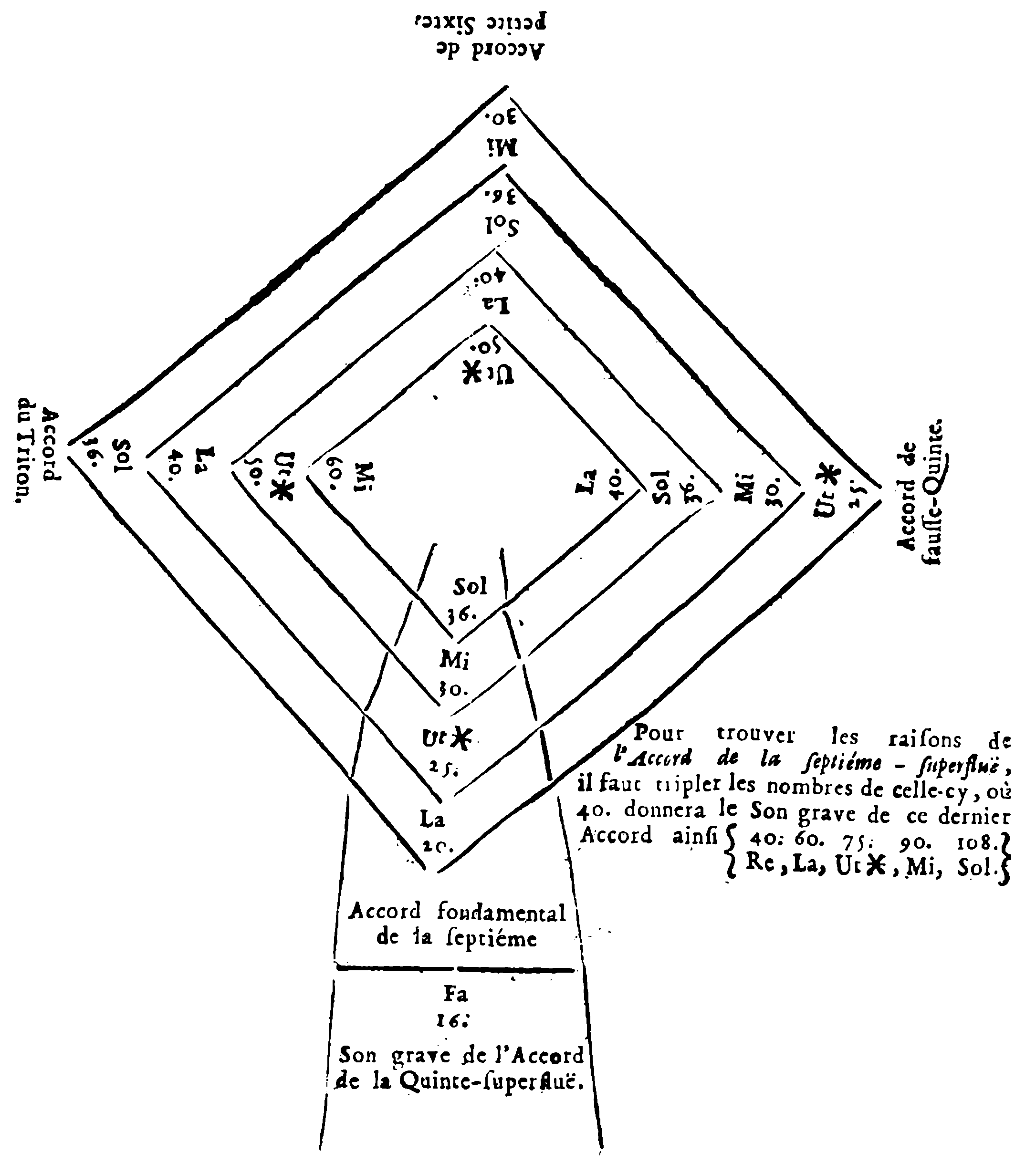
We shall demonstrate this chord and its derivatives in four squares, since it contains four different sounds. It produces not only chords by inversion, such as those contained in the three smaller squares, but also others formed by supposition beneath it, which consequently cannot be inverted, as explained in Book II, Chapter X. Hence the lowest sound of these latter chords is not contained in the squares.
Demonstration
Article four
The Seventh Chord Formed by Adding a Minor Third to the Minor Perfect Chord, and Its Derivatives
Observe that the preceding chord could have used the notes C, E, G, B♭ just as well as A, C♯, E, G: both place an added minor third above a major perfect chord. Now, if we shift this third's position by adding it below the same perfect chord, or if we add it above a minor perfect chord, we obtain a new seventh chord. As can be seen, it differs from the preceding one only in the different arrangement of its thirds.
Demonstration
Which May Be Related to the Squares
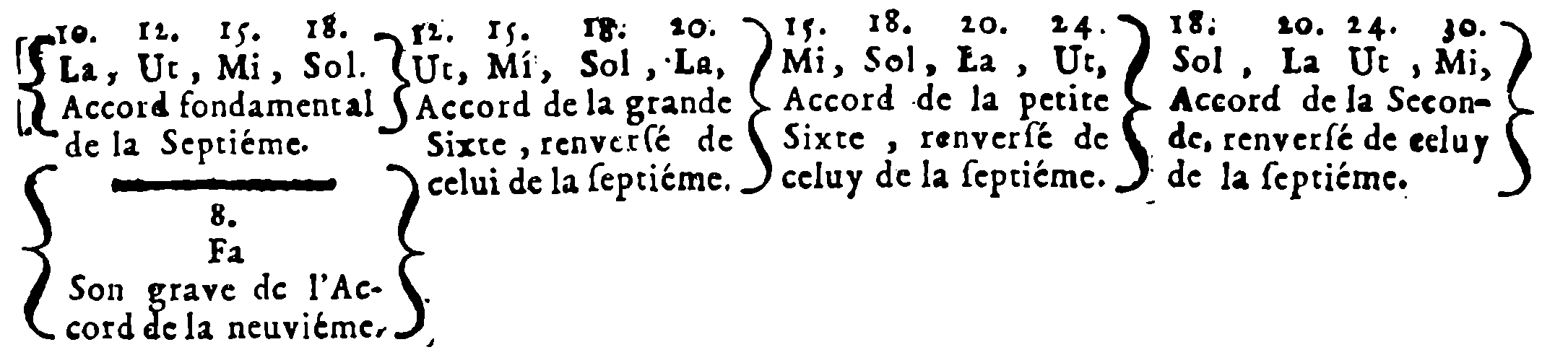
To obtain the ratios of the eleventh chord, we must triple these numbers; 20 will give the lowest sound of that chord, thus:

Observe here that in the second chord the ratio of the second lies between 18 and 20, whereas in the ninth chord the ratio of that latter interval lies between 8 and 18, not that of the second between 8 and 9. Likewise, in the second and small-sixth chords the fourth's ratio lies between 15 and 20, whereas in the eleventh chord the ratio of that latter interval lies between 20 and 54, not that of the fourth between 20 and 27. The same observations can be made concerning the small-sixth, tritone, augmented-fifth, and augmented-seventh chords of Article III. Remember that the ratios 8 to 9 and 9 to 10 both give a second, just as 3 to 4 and 20 to 27 both give a fourth. Thus the ninth's ratio must lie between 4 and 9 or 8 and 18, and the eleventh's between 3 and 8 or 10 and 27; for 8, 18 and 20, 54 are in the same ratios as 4, 9 and 10, 27.
Article five
The Seventh Chord Formed by Adding a Major Third to the Major Perfect Chord, and Its Derivatives
This chord is incidental and originates in modulation. We even observe that the ninth is almost always implied in it: the ninth added above is far less harsh than when, to form it, a low sound is added beneath the fundamental sound of this seventh chord, as should naturally be done according to our explanation in Book II. This follows from our observation in the preceding chapter that a major third added above a perfect chord does not produce as good an effect as an added minor third. Nevertheless, this seventh chord must be admitted among the fundamental chords on account of modulation; the chords arising from its inversion bear the same names as those in the preceding article.
Demonstration
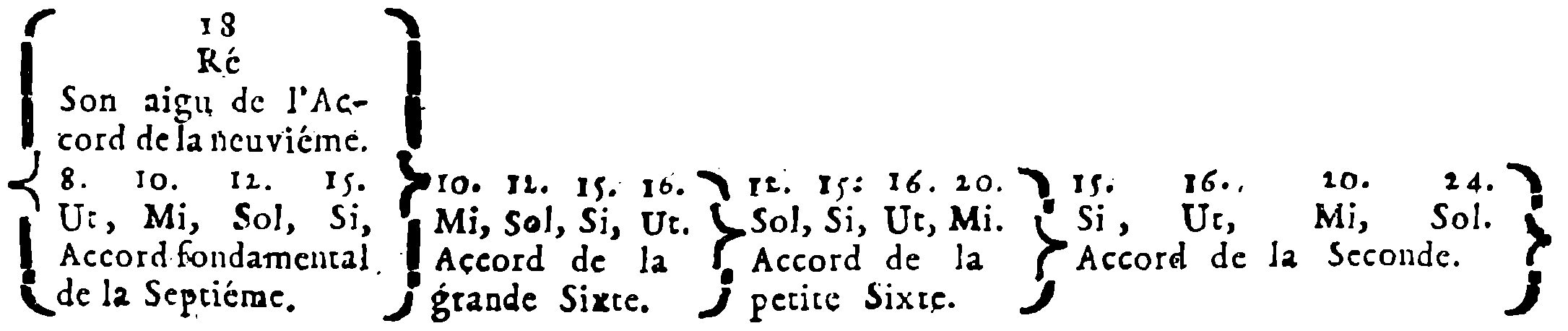
The lowest sound of the ninth can also be found at 20 by tripling these ratios, thus:

But we can readily hear that this chord is far less tolerable in this form than when the minor third is added above. This latter, unnatural addition must convince us of the imperfection of the seventh chord: arranged with the upper sound of the ninth added, its lowest sound becomes supernumerary. This is apparent from the squares in Article III, whose sounds may be inverted among themselves, while the lowest sound of the ninth or augmented fifth cannot participate in that inversion. Thus we can see that these notes

represent the ninth chord of the preceding article, since

constitute one and the same chord. Moreover, the eleventh can be found here only by multiplying the ratios of this latter seventh chord by eight—a second proof of its imperfection—with 45 supplying the lowest sound, thus:

Article six
The Seventh Chord Formed by Adding a Minor Third below the Minor Perfect Chord, and Its Derivatives
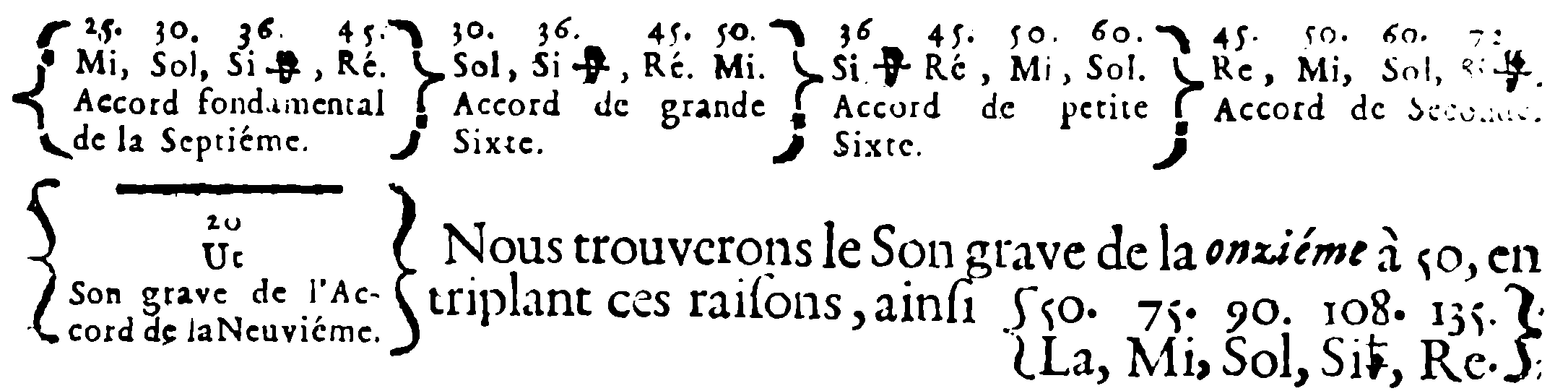
This chord differs from that of Article III only by the transfer of a major third from the lower to the upper position. The minor thirds prevailing in it make it more tolerable than the preceding chord. We do not, however, distinguish its derivatives by different names, because it too arises from modulation.
Demonstration
Article seven
The Diminished-Seventh Chord Formed by Adding a Minor Third to the Harmonically Divided Diminished Fifth, and Its Derivatives
Although this chord is formed by adding a fourth proportional to the harmonically divided diminished fifth, as we observed in the preceding chapter, we cannot derive a chord from another that is neither perfect nor complete; we must seek its principle elsewhere.
The fifth obtained from the first divisions of the string is the origin of every chord. The first chord formed from it retains its perfection equally whether the fifth is divided with the major third below or with the minor third below. The seventh chords arising from it are equally fundamental, although the diminished fifth prevails above in one and below in the other. Their division into thirds suffices to predispose us in their favor; indeed, those formed by adding a minor third are more pleasing than those formed by adding a major third. Hence the diminished fifth does not destroy the foundation, whereas the augmented fifth can be used only through supposition: harmony admits its lowest sound only as a supernumerary sound, tolerated by the ear for the sake of the principle remaining in the rest of the chord. These observations should encourage us to carry the addition of minor thirds further. After finding the perfect chord, we added a fourth and even a fifth proportional, until we felt that further additions would offend the ear. If the ear still tolerates the union of three minor thirds, although the fifth, the principle of every chord, no longer remains, we must seek the reason why this chord is tolerable despite its imperfection.
1. This chord is always divided into thirds, however its sounds are arranged, except for a new interval introduced by inversion: the augmented second. This differs from the minor third by only a minor diesis or a lesser semitone, and exceeds the diminished third by the ratio 15552 to 15625. This proves that the ear need not be offended by it, since it comes very close to a third.
2. This chord lies within the compass of the octave and can consequently be inverted.
3. If we take the seventh chord of Article III and transpose its lowest, fundamental sound a semitone higher, we form the chord in question. Observe that this transposition changes only a major third into a minor one. For example, from C, E, G, B♭, which compose our seventh chord, we form the diminished-seventh chord by raising C to C♯: C♯, E, G, B♭. Its inversion gives the augmented-second chord: B♭, C♯, E, G. Or, using the notes contained in the squares of our first seventh chord, we form the same chords by moving A to B♭. This difference between major and minor thirds does not alter the perfection of the perfect chord, where admittedly it appears only in the middle sound. It might likewise lead us to accept this diminished-seventh chord, were its foundation not destroyed by transposition of the lowest sound. To preserve the principle, therefore, the lowest, fundamental sound must necessarily be capable of being understood as implied in the sound substituted for it here. The proof is evident in the rules we establish on this subject, as will be seen later.
To distinguish this last chord and its derivatives from the chord in which they originate, we shall call them borrowed, because they borrow their perfection from a sound that does not appear in them.
The following demonstration contains the same chords as the demonstration in Article III. They bear the same names in both places, except that here we add the name of the new interval introduced by transposition of the fundamental sound. Since this interval occupies the outer positions of the diminished-seventh and augmented-second chords, these two are distinguished by those names alone.
The diminished-fifth, small-sixth, tritone, augmented-fifth, and augmented-seventh chords have the same lowest sound in each demonstration. The only difference throughout is the transposition of A to B♭. None of these latter chords can be regarded as fundamental, since they borrow their foundation from elsewhere.
Demonstration
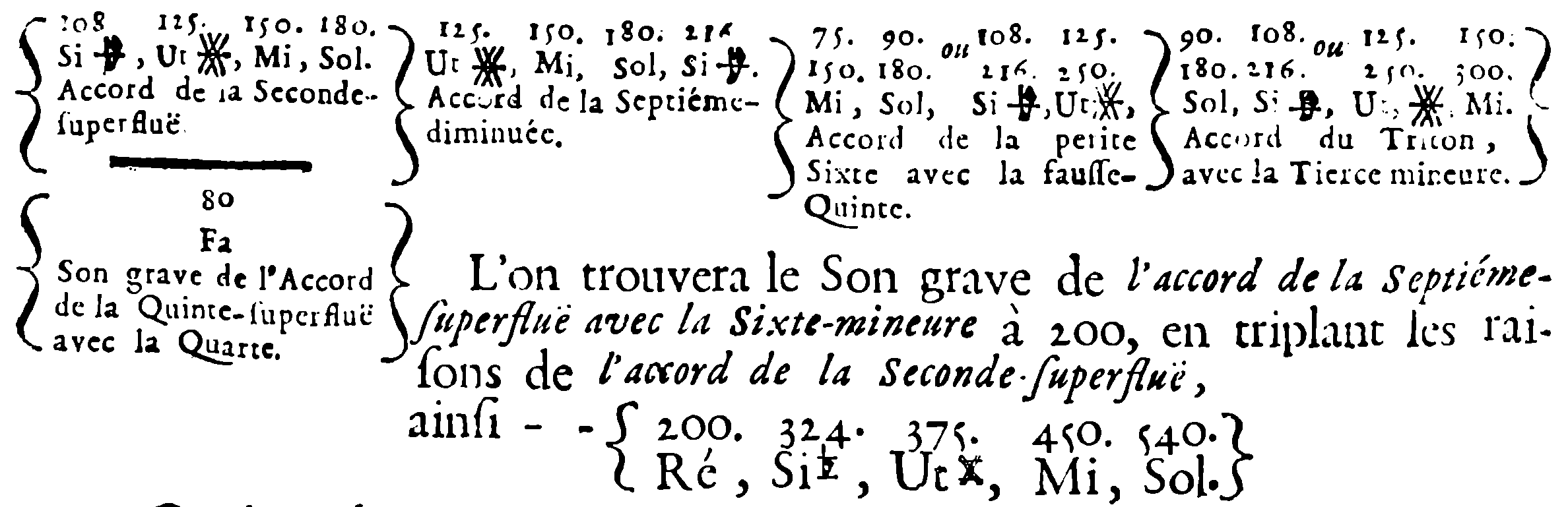
Although the diminished-seventh chord seems to be generated first, because of the added fourth proportional, we must nevertheless relate our chords by supposition to the augmented-second chord, just as elsewhere we related them to the seventh chord. This ensures that the ratio of each interval follows the order prescribed by the natural division of chords into thirds. We thus begin to perceive that it is truly the fundamental sound of the seventh chord that lends itself to the sound occupying the lowest position in this augmented-second chord and the highest in the diminished-seventh chord. As should now be understood, this principle can persist among the upper sounds only through inversion.