 Playable Books
Jean-Philippe Rameau · section 104 of 109
CHAPTER XVII. Recapitulation of the different chord successions
Read and hear this section in the playable edition →Master the modulation of every key, trying to recognize the current key from each chord you play.
With consonant chords alone, the key is often uncertain. If the first dissonant chord does not reveal it, this can only be because the major dissonance is absent. What is lost on one side is recovered on the other: the bass’s different movements tell us which chord should follow the one being played, aided by the minor dissonance, which always seeks to descend. Such uncertainty scarcely occurs except in a progression like, or derived from, the seventh-chord progression in Chapter VIII. The major dissonance that almost always concludes it immediately supplies the answer. To avoid mistakes, one must thoroughly know and practice the different chord successions; a recapitulation is therefore appropriate.
Study the following recapitulation carefully.
Fundamental progression of an ascending third, where dissonance A cannot be prepared. | Descending-fourth progression, as in Chapter VIII. | Fundamental progression of a descending third, where the dissonance is resolved by the octave and prepared by the third. | Descending-fifth progression. | Ascending-second progression, where the dissonance is resolved by the fifth and prepared by the octave. | Descending-fifth progression with chromatic motion. | Sixth added to perfect chord C, preparing an irregular cadence and resolving upward to the third. | Final cadence.
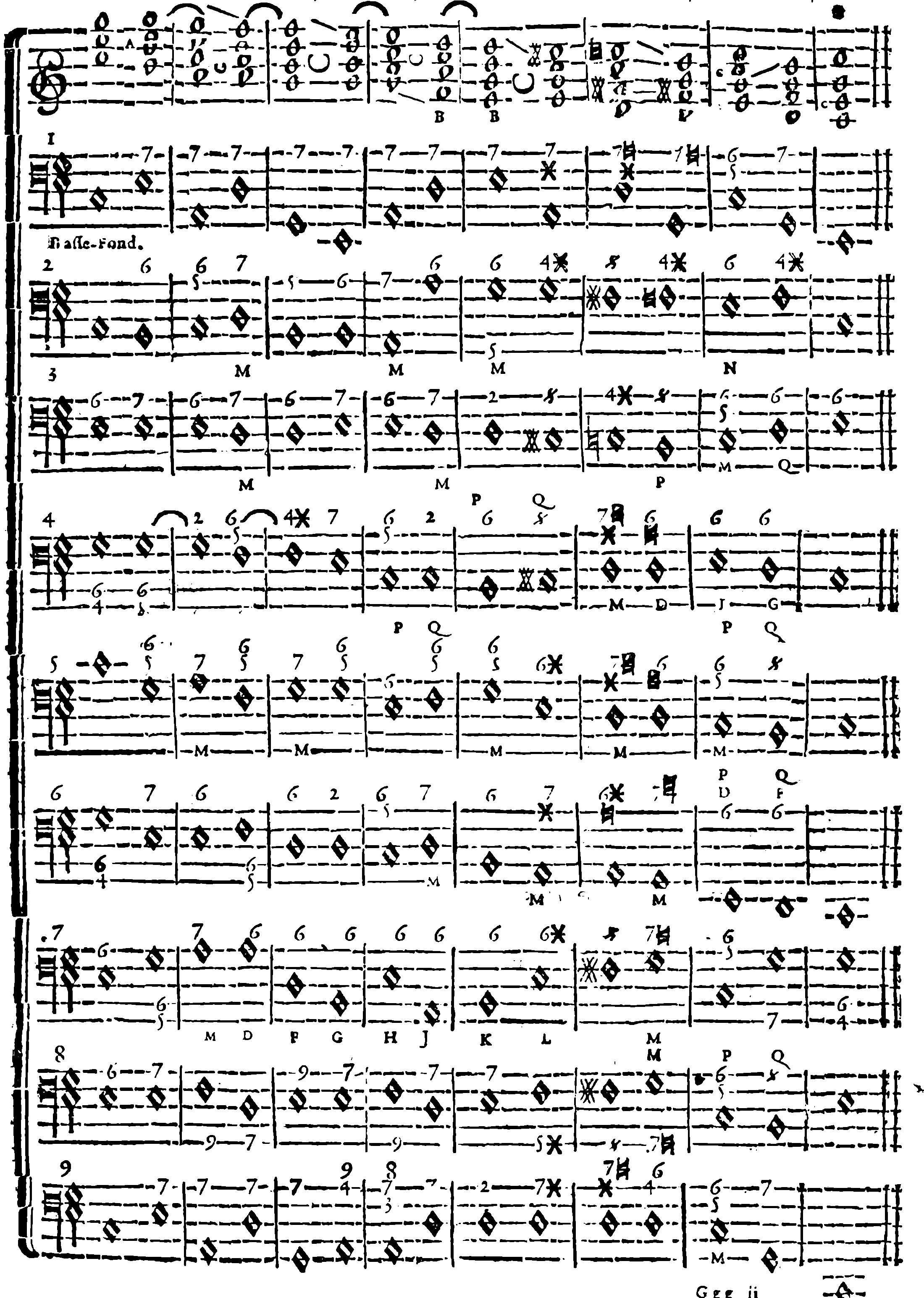
The semicircles ⌒ mark dissonances prepared by the preceding consonance. Horizontal lines — mark the same thing in chromatic motion, where the preparing consonance nevertheless forms the major dissonance. Sloping lines ╲ or ╱ mark the consonance resolving the dissonance.
The same chords serve each bass. Since the fundamental bass’s progression determines the different chord successions in the other basses, however, be warned that most of those other bass progressions are extravagant in relation to the chords. Such progressions are rare in well-composed music, especially those marked D, F, G, H, J, K, L, M and N. Should any occur, proceed as follows.
1°. If you chose not to concern yourself with consecutive octaves or fifths, you could simply add the octave to the first dissonant chord and let the fingers follow their natural course, as in the example.
2°. These faults may be avoided by accompanying each chord in the usual way, with three right-hand fingers, omitting the octave of these alternative basses from dissonant chords. If a chord then falls awkwardly under the fingers, omit one of its dissonant sounds instead of the octave, thereby reducing a dissonant chord to a consonant one. After a given dissonant chord, if a seventh, small-sixth or great-sixth chord follows, the seventh may be reduced to a perfect chord and the other two to a simple sixth chord. The small-sixth chord may also be reduced to a sixth–fourth chord, and the great-sixth to a perfect chord. Decide not only by the fingers’ natural motion, almost always flowing by step between keys, but also by the rules specifying which chord must follow another according to the bass movement. Thus, since a perfect chord should follow the major small-sixth chord when the bass descends diatonically, a seventh or great-sixth chord occurring after that small-sixth chord in this progression may be reduced to a perfect chord, as at M. Likewise, since a perfect chord should follow a diminished-fifth or great-sixth chord in ascending diatonic motion, great-sixth and seventh chords following in that progression may be reduced in the same way, again as at M.
A sixth–fourth chord may follow a small-sixth chord when the bass descends diatonically, or a great-sixth chord when it ascends. Therefore a small-sixth chord following either of those chords in the specified progression may be reduced to a sixth–fourth chord, provided the first small-sixth chord contains no leading note. If it does, the following small-sixth chord must instead be reduced to a sixth chord.
A sixth chord naturally follows a tritone chord in descending diatonic motion, or a major small-sixth chord in ascending motion. A small-sixth or great-sixth chord following either of those in the corresponding progression may therefore be reduced to a sixth chord, as at N, F, G, H and R. Although F, G and H in the seventh bass do not follow the specified progression, the fingers will find these chords by habit alone. The same holds for the small-sixth chord following a seventh chord in descending diatonic motion, as at D in the sixth bass.
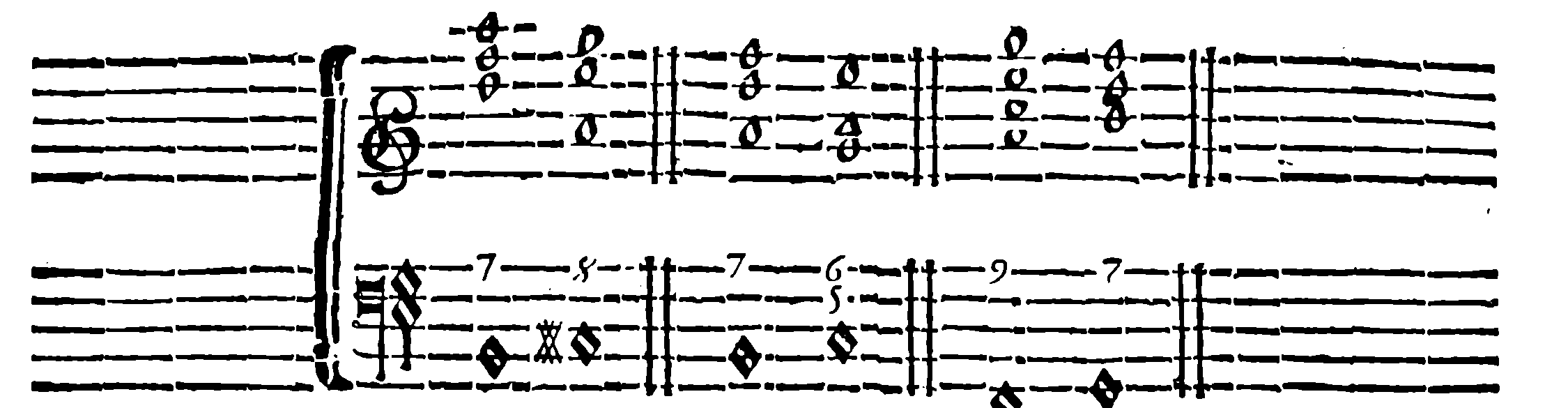
3°. When two successive chords over a diatonic bass progression are of the same kind, or at least do not follow the natural rule, and you do not wish to make the reductions above, use contrary motion between bass and chords: lower the chords when the bass rises, and raise them when it falls. Do this at P, Q, or P, M, Q, unless the chord at M in the third bass is reduced to a perfect chord. Reducing one chord removes the need to reduce the next, especially over a diatonic bass progression. Remember that this contrary motion should not make the lowest or highest finger change its key when that key can serve the following chord. Exceptions occur with an ascending diatonic bass when a diminished-fifth or great-sixth chord follows a seventh chord, or when a seventh chord follows a ninth chord, as shown below.
Example
Dissonance is merely a sound added to a consonant chord, in which alone the foundation of harmony resides. Since it cannot always be used equally easily in accompaniment, omit it when it does not fall naturally under the fingers. Sound only the consonant chord that you know should follow and toward which the fingers move of themselves, provided that chord contains only the sounds that should accompany the dissonance, and provided you have fully mastered all our examples. This overcomes many difficulties, often caused only by those who figure a bass according to the intervals used in their music without attending to anything else.
The reduction just described is wholly unsuitable for chords of the second, chords by supposition or chords by borrowing, and scarcely suitable even for seventh chords.
4°. Consecutive fifths occur between parts of chords B–B. They are rather difficult to avoid in such cases, just as when the bass rises to a sixth chord after a perfect chord, because of the arrangement of the fingers.
5°. The eighth and ninth basses contain chords by supposition. Fill them with as many of their constituent sounds as possible. You will not fail if you add the bass’s octave to the immediately preceding chord and follow the other rules already given.
6°. Above all, when several dissonant chords follow one another—whether all sevenths or of different kinds—with no consonant chord between them, the right-hand fingers always descend until a leading note appears in one of the chords. They must then ascend, at least the finger playing that leading note.
Example
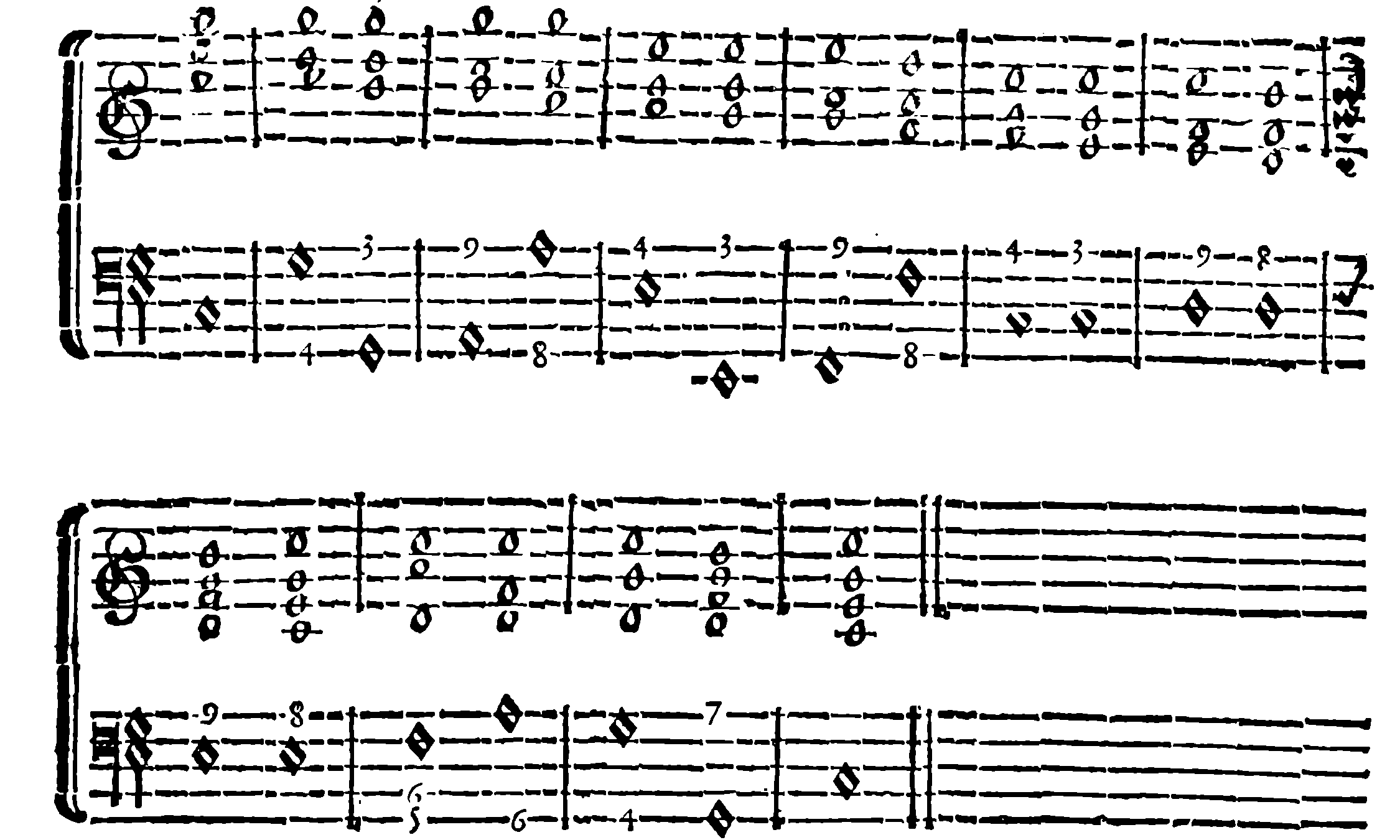
Since the figured ninth chords in this bass contain a seventh, a sixth must follow it even though unfigured and even though the octave figure after the ninth seems to indicate a perfect chord. The sixth must resolve the seventh here, just as the octave resolves the ninth. This happens without thought if the fingers are allowed to slip downward from one key to the next, following their natural progression after all minor dissonances.
The same applies when only 5 is written on a note that could bear a seventh or ninth chord in ascending diatonic bass motion, as in the first example of Chapter IX. A note figured 5 and then 6, followed by an ascending step, could confuse the accompanist unless warned that seventh and ninth dissonances falling under the fingers will sound very well with the perfect chord indicated by 5. Determine the chord indicated by 6 from the chord currently held, and still more surely from the bass note’s degree in the key, as in that Chapter IX example. A ninth may be added there to chords figured only 7 whenever that ninth lies under a finger that played the preceding chord.
7°. The same dissonance often helps form another before being resolved, as seen in Book III, Chapters XII, XV and XXVII. One note also often bears several different chords in succession, as most of our examples show, and as will again appear in what we call a pedal point.
Example
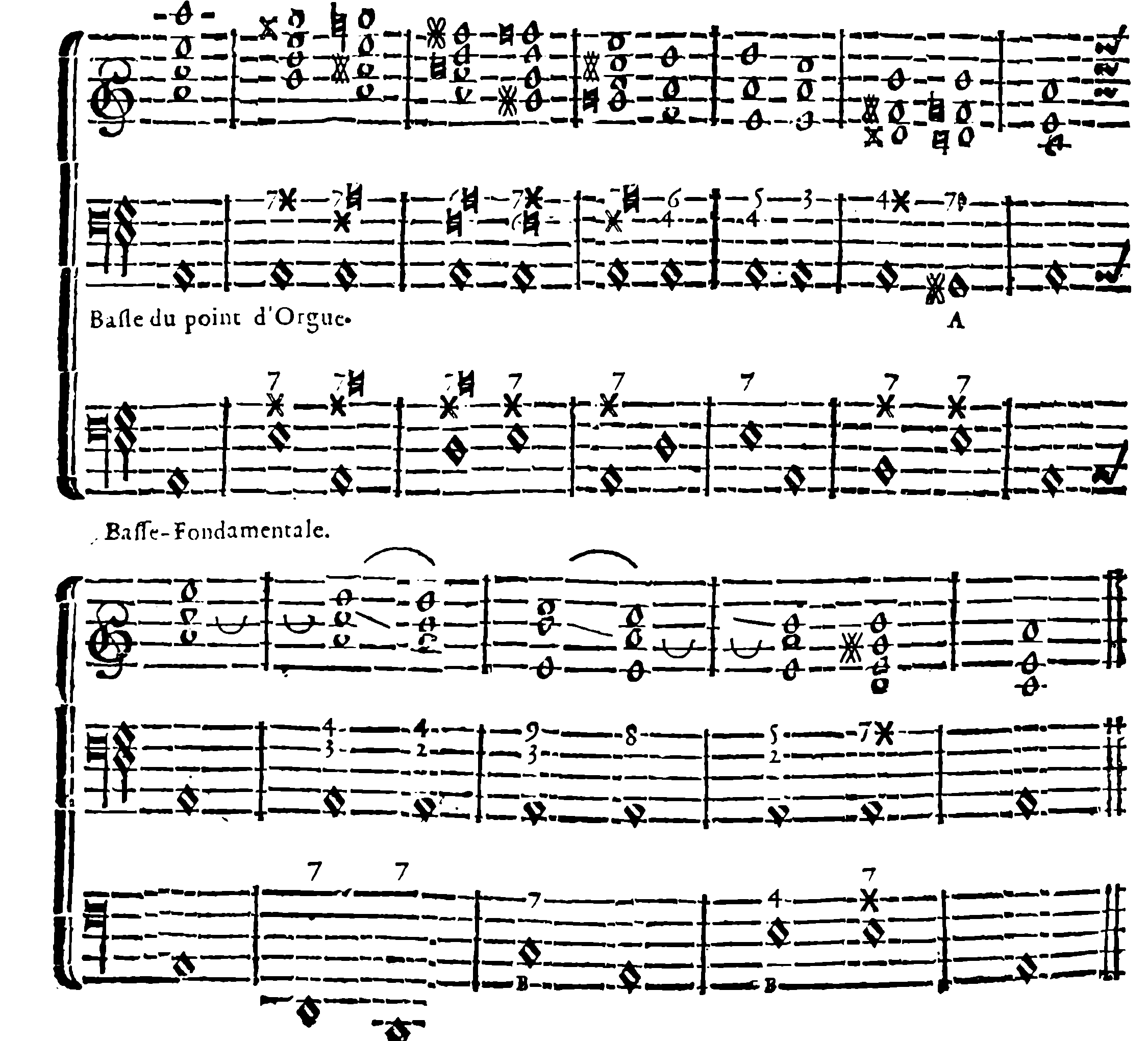
The pedal point lasts only while the bass note remains unchanged. It therefore ends at A and begins again immediately afterward.
This pedal point’s harmony follows the rules, as the fundamental bass proves. Remember that the sixth degree replaces the dominant in chords by borrowing, and that the fundamental bass must stand above the other bass in chords by supposition.
There is a double supposition at the notes marked B: an augmented fifth should naturally occur on the first, while we cannot avoid giving the irregular eleventh chord to the second. Notice, however, that the sustained bass sound slips, so to speak, out of our attention, which turns solely toward the chord sounds. Since the chords progress regularly, the sustained bass need count only as a point, or as zero among figures. This also explains the freedom, in such cases, to sound the sixth together with the seventh.
Example
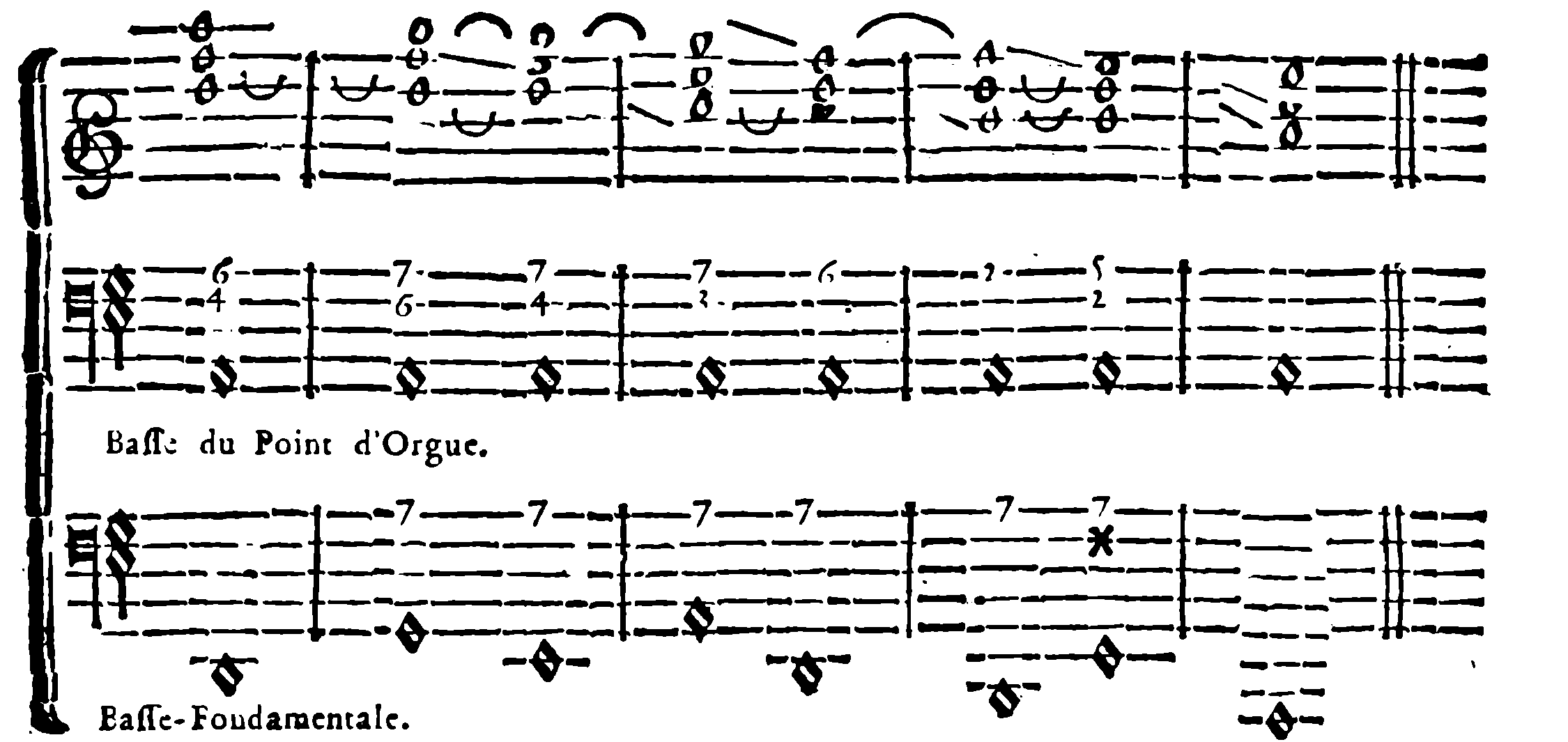
Consider the chords with the fundamental bass, removing the pedal bass: the harmony is regular. This is the only way to judge it.
Book II, Chapter XIX explains another way of using the sixth together with the seventh.
Hurdy-gurdy and musette airs derive their origin, in a sense, from this pedal point. Through it one therefore understands the different bass types of this kind.
One cannot know and practice too thoroughly this inversion of chords—or rather, this inversion of bass progression—shown in all our examples. As our fundamental basses prove, differences between the chords arise only from differences in bass movement. The endless relationships among chord progressions, to which the fingers adapt with a little practice, often anticipate us when memory fails. The fingers follow their natural path: those playing minor dissonances slip down to the neighboring key, and those playing major dissonances do the same upward. Thus, without thinking of the kind of interval, the seventh, ninth, eleventh, diminished fifth, the third in a small-sixth chord and often the fifth in a great-sixth chord must descend, and the finger playing one of them finds its destination of itself. The same occurs with the tritone and augmented second, which must ascend. Remember that of two fingers lying together, the lower must always descend, except in the irregular cadence.