 Playable Books
Jean-Philippe Rameau · section 103 of 109
CHAPTER XVI. Chromaticism
Read and hear this section in the playable edition →Chromaticism occurs only in minor keys and consists solely in making the sixth and seventh notes of the key proceed by semitones, both upward and downward, whether in the bass or in the chords.
We have already given some idea of this progression in Chapter XI, Article II. To complete your understanding, notice that here the major dissonance, which should naturally rise a semitone, instead descends a semitone—but always to the flattened form, or to the natural key, of the note that produced it. Thus one need only add a note to each of the consonant chords that ordinarily follow this major dissonance. This added note is the flattened note just mentioned and always lies immediately below the note that should have been taken as tonic after the leading note forming the major dissonance. This accords with our observation in the preceding chapter concerning the seventh that could be added to the perfect chord upon which the major dissonance resolves.
Moreover, chords by borrowing and by supposition occur frequently in this kind of harmony. It is therefore difficult to avoid mistakes when the bass is unfigured.
Example
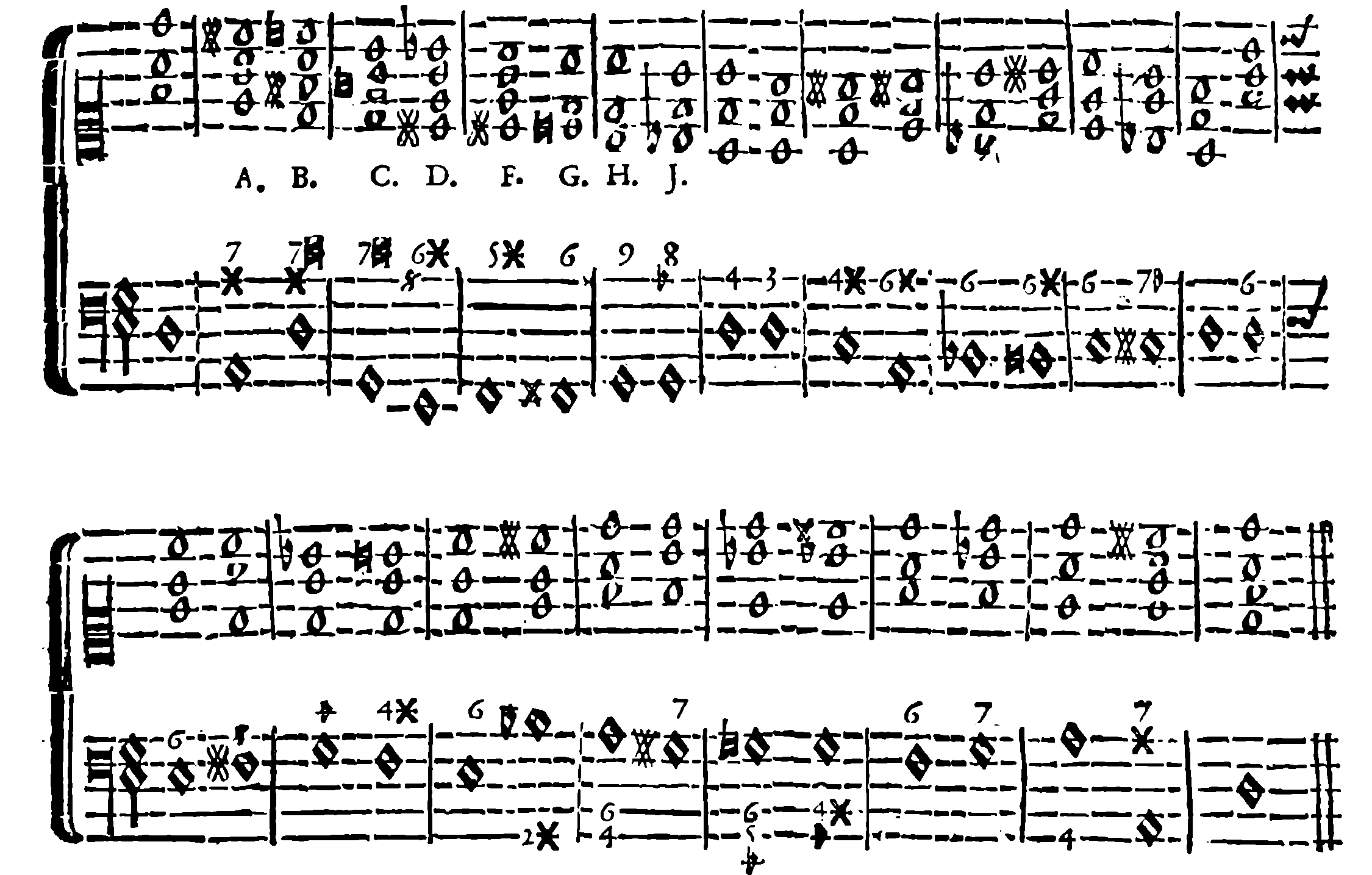
The whole succession of these chords conforms to our rules.
While the leading note descends in one part, elsewhere we find a progression conforming to that of sevenths between chords A, B and C, and by inversion between F and G. Between C and D, we find a progression derived from the interrupted cadence.
From H to J, the ninth delays the octave that follows immediately.
In the remainder, the progression is approximately that of the octaves in Chapter VI, except that here we pass from the minor third to the major or from the major to the minor. Throughout the chords by supposition or borrowing, notice the notes that occupy the places of those that should naturally be present. Once the fingers are accustomed to these different chord successions, however, they often anticipate the reflection that would otherwise be required. One need only take particular care with the intervals that continually change from major to minor in descending and from minor to major in ascending.
You cannot mistake the different keys passed through in this example if you identify their different leading notes by means of the sharps.
The natural signs we attach to figures or notes restore each note to its natural condition, cancelling a previous ♯ or ♭. Some people use a ♯ or ♭ for this purpose instead, but this is less regular, because 7 with a ♭ ordinarily indicates a diminished seventh, whereas with a ♯ it indicates an augmented seventh.