Playable Books
Jean-Philippe Rameau · section 106 of 109
CHAPTER XIX. Figuring a continuo bass and recognizing the chord indicated by each figure
Read and hear this section in the playable edition →A perfect chord may be figured by any of the three intervals composing it, although it is ordinarily left unfigured, except to distinguish its third with a ♯ when major or a ♭ when minor.
A ♯ alone always indicates the major third, and a ♭ alone the minor third. When joined to figures, they alter the indicated interval by a semitone relative to its natural form.
Every chord should be figured with the number from which it takes its name. For example:
Do not attach ♯ or ♭ to figures indicating intervals that are naturally major or minor in the key being used. If a sign must be supplied in such a case, it is better to use ♮. Only the figure indicating the tritone customarily receives a ♯.
Add the figure that changes a chord's natural construction to the figure identifying that chord.
Example
Every chord in which a major dissonance can occur should be identified by the figure that also indicates the interval of that dissonance.
Many continuo basses do not observe this consistency and may therefore mislead those guided solely by the figures. Those who follow our rules will see how necessary they are in such cases.
Some writers also put several figures where one would suffice, causing much confusion.
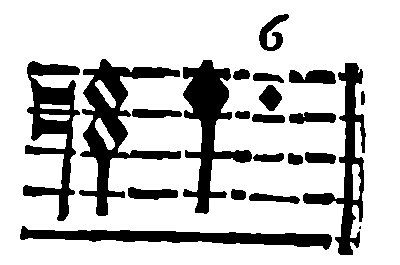
A figure placed beside a note always indicates the chord. But if it appears a little after the note, and the note can bear a perfect chord, this means that the perfect chord is to be played on its first beat and the indicated chord on the second, third or fourth beat, according to the figure's distance from the note.
A note lasting several beats can carry a different chord on each beat, or sometimes the same chord for two beats. When the positioning of the figures does not make this clear, the ear must decide.
The dot represents the note preceding it, as shown. A figure above or below the dot therefore means that the chord must be played during the duration belonging to that dot.